


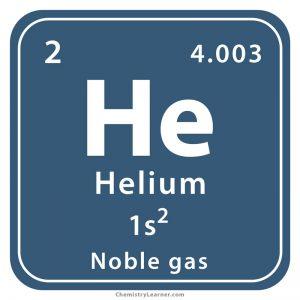
Helium
Atomic Number | 2 | ||||||||
|---|---|---|---|---|---|---|---|---|---|
Group | 18 | ||||||||
Period(s) | 1 | ||||||||
Block | s | ||||||||
Electron Configuration | 1s² | ||||||||
Phase | Gas | ||||||||
Melting Point | -272 05 °C | ||||||||
Boiling Point | -268 93 °C | ||||||||
Density | 0.1785 g/l | ||||||||
Helium, with the chemical symbol He and an atomic number of 2, is a noble gas in Group 18 of the periodic table. The lightest of the noble gases, helium is the second most abundant element in the universe and plays a significant role in various fields, such as energy production, medicine, space technology, and industrial applications. Although helium was first discovered in the Sun, it was later found on Earth, leading to significant scientific and industrial advancements.
Helium was first observed in 1868 by French astronomer Pierre Janssen during a solar eclipse in India. Using a spectroscope to study the Sun's chromosphere, Janssen noticed a new yellow spectral line in a solar prominence (a gas eruption in the Sun's atmosphere). He predicted that this line signified the presence of an element that had never been discovered on Earth. This spectral line was independently observed by English astronomer Joseph Norman Lockyer, and it was understood that it did not originate from any known element on Earth. Lockyer and English chemist Edward Frankland named this new element helium, derived from the Greek word helios, meaning "sun."
Helium, discovered in the Sun, was first isolated on Earth in 1895 by Scottish chemist Sir William Ramsay from a mineral called cleveite, which contained uranium. This discovery earned Ramsay the Nobel Prize in Chemistry in 1904. Furthermore, his work helped establish the noble gases group in the periodic table.
Helium is a colorless, odorless, and tasteless gas, lacking properties like color, smell, or taste. It exists as a gas at room temperature and has low density and a very low boiling point (−268.93°C). Helium belongs to the group of rare gases (noble gases) and is chemically inert (non-reactive). This means it is generally found in its free state in nature.
The nucleus of a helium atom contains only two protons, which is why its atomic number is 2. It also has two electrons, with an electron configuration of 1s². Due to these properties, helium does not form chemical bonds and typically does not react with other elements. A key characteristic of noble gases is that their outer electron shells are filled, which results in extremely low chemical reactivity.
In addition to its chemical stability, helium is widely used in many industrial and scientific applications due to its physical properties. Some of its primary uses include:
Helium's journey began with its discovery in the Sun, followed by its isolation on Earth and eventual industrial use. With its chemical inertness, low density, and non-flammable properties, helium has become an indispensable element in many fields, particularly in space technology, medical applications, and industrial cooling. Its contribution to scientific and technological advancements continues to be significant, and helium will play a crucial role in future developments.
"Helium." Purdue University, Department of Chemistry. Accessed March 11, 2025. https://www.chem.purdue.edu/history/helium.html.
"Helium." University of Toledo, College of Natural Sciences and Mathematics. Accessed March 11, 2025. https://www.utoledo.edu/nsm/ic/elements/helium.html.
"Helium." Los Alamos National Laboratory, Periodic Table. Accessed March 11, 2025. https://periodic.lanl.gov/2.shtml.
"Helium." Jefferson Lab, Its Elemental. Accessed March 11, 2025. https://education.jlab.org/itselemental/ele002.html.
"Helium." PubChem, National Library of Medicine. Accessed March 11, 2025. https://pubchem.ncbi.nlm.nih.gov/element/Helium#section=Historical-Atomic-Weights.
"Helium." American Chemical Society. Accessed March 11, 2025. https://www.acs.org/green-chemistry-sustainability/research-innovation/endangered-elements/helium.html.
"Helium." American Elements. Accessed March 11, 2025. https://www.americanelements.com/he.html.
Rose, Garry. "Helium." University of Kentucky. Accessed March 11, 2025. https://www.uky.edu/~garose/helium.
"Helium." Chemistry Learner. Accessed March 11, 2025. https://www.chemistrylearner.com/helium.html.
PubChem. "Helium." National Center for Biotechnology Information. Accessed March 11, 2025. https://pubchem.ncbi.nlm.nih.gov/compound/Helium.

Helium
Atomic Number | 2 | ||||||||
|---|---|---|---|---|---|---|---|---|---|
Group | 18 | ||||||||
Period(s) | 1 | ||||||||
Block | s | ||||||||
Electron Configuration | 1s² | ||||||||
Phase | Gas | ||||||||
Melting Point | -272 05 °C | ||||||||
Boiling Point | -268 93 °C | ||||||||
Density | 0.1785 g/l | ||||||||
Discovery and Historical Development of Helium
Chemical Properties of Helium
Uses of Helium
This article was created with the support of artificial intelligence.