

+1 More


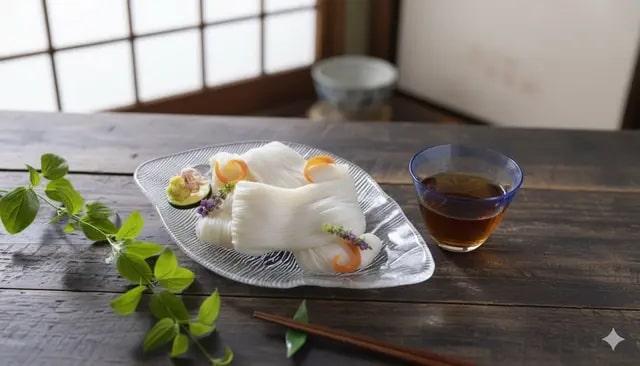
Ibonoito Somen Noodles (Generated by Artificial Intelligence)
Geographical Indication Name | Ibonoito Somen Noodles | ||||||||
|---|---|---|---|---|---|---|---|---|---|
Class | Processed Food Products | ||||||||
Production Area | Hyogo Prefecture (Harima Region) | ||||||||
Applicant Organization | Hyogo Prefecture Tenobe Somen Cooperative Association | ||||||||
Ibonoito somen noodles are a type of tenobe somen (hand-rolled thin noodles) produced using traditional methods, specific to the Harima region in Hyogo Prefecture, Japan. The product's geographical indication (GI) registration number is 154, it falls under the processed food category, and its protection date is August 27, 2024.
The production of Ibonoito somen noodles dates back approximately 600 years in the Harima region, to the Muromachi period. During this period, somen noodles were initially consumed only in temples and the imperial palace. By the Edo period (1603-1867), somen noodles had become popular among ordinary people, and farmers in the region increased production. According to historical records, somen producers during this period came together to agree on quality standards and even demanded penalties for contract violations to maintain product quality. In 1894, a somen production standards inspection system based on grading was implemented to unify quality and increase reliability. A unified brand called “Ibonoito,” named after the Ibogawa River that flows through the region, was created to bring together somen products sold under various names by different producers and sellers under one umbrella.
About Ibonoito Somen Noodles (soumenibonoito)
The production area for Ibonoito somen noodles is Hyogo Prefecture. This area is surrounded by farmland along the Ibogawa River. The presence of the river has enabled the cultivation of wheat, the raw material for the noodles, and the production of wheat flour using water mills. The salt used in noodle production is sourced from the nearby Banshu-Ako region. Raw materials and additional resources must comply with the “Purchased Raw Material Standards” and “Additional Resource Standards” managed by the Hyogo Prefecture Tenobe Somen Cooperative Association. Noodles are produced by Union members using only raw materials supplied by the Union, in accordance with the “Production Guidelines.”
Ibonoito somen noodles are produced using traditional methods that have been passed down for approximately 600 years in the Harima region. The taste and texture of the noodles are enhanced using a technique called “tenobe” (hand-stretching), which involves repeatedly stretching the dough into a rope shape, and a technique called “yaku,” which involves maturing the noodles in a special storage room during the hot and humid rainy season. The resulting noodles are characterized by their ability to retain their shape when boiled, leave a soft sensation on the tongue, and have a chewable, crisp texture. After production, the products must pass a grading test conducted by an inspector; noodles that pass this test are awarded an emblem and a certification of inspection. Noodles that pass quality control are then matured and stored in the association's special storage facility.
Tenobe somen noodles are made by kneading wheat flour with salted water, coating it with vegetable oil, stretching and twisting it into thin strips, and drying it. Ibonoito somen noodles, which are thin and pure white in color, are usually boiled, cooled in cold water, and served with sauce. Popular as a seasonal tradition in Japan during the summer months, somen can also be served as a hot soup called “nyumen” in the winter months. Starting in 2006, events featuring Ibonoito somen noodle recipes began to be held in Hawaii. The following year, sales promotion activities in the US, Southeast Asia, and the EU, launched in cities such as Los Angeles and New York, increased the product's international recognition.
PD – Japan Geographical Indications Center. “Entry 154 – IBONOITO.” PD – Japan Geographical Indications Center. Accessed October 24, 2025. https://pd.jgic.jp/en/register/entry/154.html
soumenibonoito. "組合概要英語版." Youtube. Accessed November 20, 2025. https://www.youtube.com/watch?v=jNFqEwNW354&t=5s

Ibonoito Somen Noodles (Generated by Artificial Intelligence)
Geographical Indication Name | Ibonoito Somen Noodles | ||||||||
|---|---|---|---|---|---|---|---|---|---|
Class | Processed Food Products | ||||||||
Production Area | Hyogo Prefecture (Harima Region) | ||||||||
Applicant Organization | Hyogo Prefecture Tenobe Somen Cooperative Association | ||||||||
No Discussion Added Yet
Start discussion for "Ibonoito Somen Noodles" article
History
Production Area and Raw Materials
Production Techniques and Quality Control
Consumption and Popularity
This article was created with the support of artificial intelligence.