

+2 More

During the modernization process of the Ottoman Empire, clothing styles reflected the evolving social structure, and one of the notable garments of this era was the İstanbulin. Introduced as official attire for civil servants during the reign of Sultan Abdülmecid, this jacket type was later adopted by different segments of society, earning a significant place in Ottoman fashion.
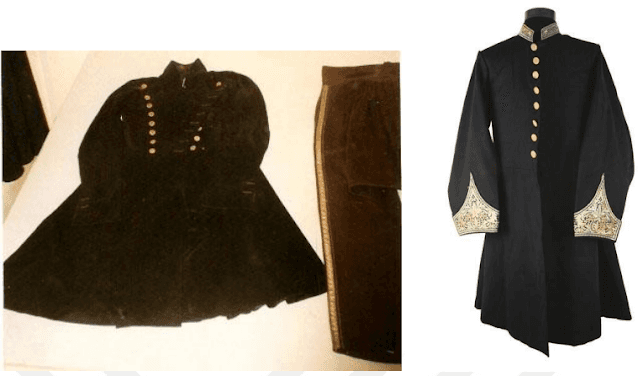
An İstanbulin Example
Named after Istanbul, the İstanbulin was a type of jacket designed in the late Ottoman period. Unlike the elaborate and heavy garments of the time, it featured a more practical, sleek, and modern design. Resembling a redingote, this attire was characterized by a stiff and straight collar, a closed chest, a single row of buttons down to the waist, and a length extending to the knees. It also included a starched inner collar and was considered a both stylish and comfortable option for civil servants.
İstanbulin was introduced during the reign of Sultan Abdülmecid as a formal uniform for civil servants. Reflecting the ongoing Westernization movement within the Ottoman bureaucracy, this attire was designed by tailors in Istanbul to provide elderly and civilian state officials with a more comfortable alternative to restrictive formal wear. According to Reşad Ekrem Koçu’s Turkish Clothing, Attire, and Adornment Dictionary, İstanbulin was created specifically to spare officials from the discomfort of wearing stiff, overly decorative clothing.
Following the Tanzimat reforms, wearing this jacket became mandatory for civil servants in state offices, effectively making it an official uniform. Over time, it also gained popularity among the general public and became part of everyday clothing. However, during the reign of Sultan Abdülhamid II, İstanbulin gradually lost its prominence and was largely replaced by redingote-style jackets.
More than just a piece of clothing, İstanbulin became a symbol of political and social status. In the Tanzimat and Constitutional periods, it was particularly associated with bureaucrats and state officials, making it a visual representation of the Ottoman Empire’s Westernization efforts.
This significance was reflected in Ottoman literature, where İstanbulin appeared as a defining element in works by authors such as Ahmet Rasim, Ahmet Hamdi Tanpınar, and Samiha Ayverdi. In many Tanzimat and Meşrutiyet (Constitutional Era) novels, characters wearing İstanbulin were often depicted as modernists or bureaucrats aligned with the state’s modernization policies.
Fikriyat. "Bir Şehrin Giysisi: İstanbul’un." Erişim 6 Şubat 2025. https://www.fikriyat.com/galeri/kultur-sanat/bir-sehrin-giysisi-istanbulin/4.
Koçu, Reşat Ekrem. Türk Giyim Kuşam ve Süslenme Sözlüğü. İstanbul: Sümberbank Kültür Yayınları, 1969.
Kumaş Bilgi. "Alafranga Setre (İstanbulin) Nedir?" Erişim 6 Şubat 2025. https://www.kumasbilgi.com/2022/01/alafranga-setre-istanbulin-nedir.html.
Lûgatim. "İstanbulîn – İstanbulin." Erişim 6 Şubat 2025. https://lugatim.com/s/%C4%B0STANBUL%C4%B0N%E2%80%93%C4%B0STANBOL%C4%B0N.
Sanat Kritik. "Yakup Kadri’den Fransız Basınına: İstanbul’un Üzerinden Toplumsal Analizler." Erişim 6 Şubat 2025. https://sanatkritik.com/yazilar/yakup-kadriden-fransiz-basinina-istanbulin-uzerinden-toplumsal-analizler/.
İstanbul.net. "Eski Erkek Kıyafetleri." Erişim 6 Şubat 2025. https://www.istanbul.net.tr/istanbul-rehberi/yazilar/eski-erkek-kiyafetleri/52/1.

What is İstanbulin?
Origins and Usage
Cultural and Social Significance of İstanbulin
This article was created with the support of artificial intelligence.