



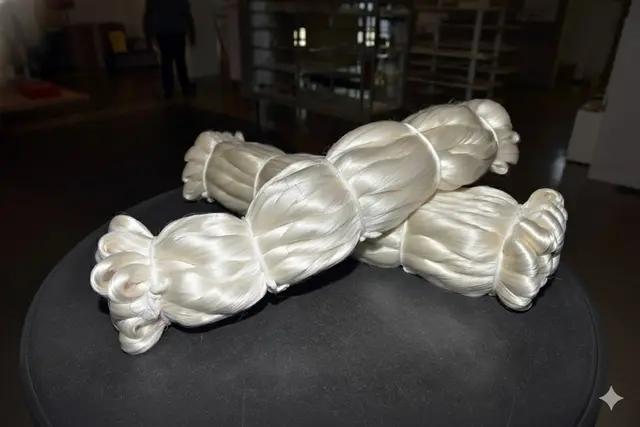
Iyo Raw Silk (Generated by Artificial Intelligence)
Iyo Raw Silk (originally known as Iyoito) is a traditional geographically indicated silk product produced in Seiyo City, Ehime Prefecture, Japan. It is known for its white camellia-like sheen, soft and fluffy texture, and voluminous structure compared to ordinary raw silk.
The production area for Iyo Raw Silk is Seiyo City, Ehime Prefecture. Thanks to the region's favorable geographic and climatic conditions, the sericulture industry began in the early Meiji Period (around 1900). The industry reached its peak in the early Shou Period (1930s-1940s). However, due to the decline in domestic demand for kimono and the proliferation of cheap foreign silk, this traditional industry eventually disappeared. Today, the traditional production method, culture, and production of Iyo Raw Silk are exhibited exclusively at the Nomura Silk Museum, which has also applied for a geographical indication.
About Iyo Raw Silk (地理的表示産品情報発信サイト)
Iyo Raw Silk possesses superior qualities compared to other raw silks thanks to its unique production methods. It offers a luster resembling a white camellia, a soft, fluffy texture, and a voluminous structure. When processed into fabric, it feels soft and warm. It is also known for its ability to stay loose when worn as a kimono and to tighten when worn as an obi (sash).
The fundamental and distinctive feature of Iyo Raw Silk production is the use of raw cocoons rather than heated and dried ones. In typical domestic silk production, heating and drying the cocoon prevents silkworm pupae from hatching as moths and prevents mold growth; this method is suitable for long-term storage of large quantities of harvested cocoons. However, Iyo Raw Silk producers believe that silk from raw cocoons is superior for optimal yields. Therefore, the cocoons are stored in their raw state in refrigerators and processed using an old-fashioned method. Because cocoons are a protein produced by insects, even the slightest heat hardens them. Using raw cocoons ensures that the ripples in the thread fibers, created by the silkworms' S-shaped ejection of silk, remain intact, resulting in a bulkier structure than raw silk from other production areas. The reeling process is carried out using water sourced from the Shikoku cordillera and traditional manual machinery.
Information Website on Japan Geographical Indication Products. “Kumamoto Kensan Igusa Tatami-omote for Rear Side”. Information Website on Japan Geographical Indication Products. Last access date 24 October 2025. https://pd.jgic.jp/en/register/entry/10.html.
Ministry of Agriculture, Forestry and Fisheries (MAFF). “Product Summary (Registration No. 10)”. MAFF. Accessed October 24, 2025. https://www.maff.go.jp/e/policies/intel/gi_act/register/s10.html.
地理的表示産品情報発信サイト. " 10 Iyoito." YouTube video. April 19, 2019. 03:11. Accessed 24 October 2025. https://www.youtube.com/watch?v=MtQ35huGqD4.

Iyo Raw Silk (Generated by Artificial Intelligence)
Production Area and History
Features and Quality
Production Method
This article was created with the support of artificial intelligence.