

+1 More

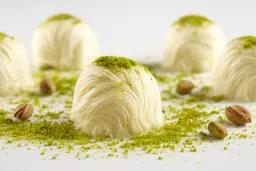
Izmit Pişmaniye
Registration Number | 34 | ||||||||
|---|---|---|---|---|---|---|---|---|---|
Application Number | C 2000/009 | ||||||||
Application Date | 2000-09-11 | ||||||||
Registration Date | 2001-06-13 | ||||||||
Applicant/Registrant(s) | Kocaeli Union of Chambers of Tradesmen and Craftsmen | ||||||||
Product / Product Group(s) | Pişmaniye | ||||||||
İzmit pişmaniye is a type of confectionery primarily obtained by processing sugar, flour, and butter with special techniques, resulting in a thin, fibrous, and stringy structure. In appearance, it is soft, cotton-like, and fringed; it separates into strands when pulled by hand. This structure ensures both easy melting in the mouth and the creation of a characteristic taste and texture. It is usually packaged in small, ball-shaped portions; it can be consumed plain or in varieties with hazelnut, cocoa, or vanilla.

Izmit Pişmaniye (Created by Artificial Intelligence)
The origin of pişmaniye dates back to the "tel helva" tradition rooted in Central Asian Turkic cuisine. This product, known by nomadic Turkic communities in Central Asia, gradually developed in Anatolia, especially in the Izmit region, reaching its present form. Ottoman sources indicate that pişmaniye has been produced in Izmit since the 15th century. This dessert, which also entered the palace cuisine, became particularly concentrated in the Izmit region, laying the groundwork for the formation of a local confectionery culture.
Izmit pişmaniye is not only a product that appeals to the palate, but has also become a part of the region's cultural heritage. Its serving during holidays, weddings, and traditional ceremonies has reinforced the socio-cultural aspect of this dessert.
The production of Izmit pişmaniye is a largely handcrafted process requiring mastery. The production stages are as follows:
Most of these processes are done by hand; therefore, the quality of Izmit pişmaniye is directly related to the producer's experience and mastery.

Izmit Pişmaniye Production Stage (AA)
An application for the geographical indication registration of Izmit pişmaniye was filed by the Kocaeli Union of Chambers of Tradesmen and Craftsmen. The application, numbered C 2000/009, was made on September 11, 2000. Following the evaluation process, the product was officially registered as a "designation of origin" on June 13, 2001, with registration number 34. It is registered as Yeni Perşembe Pazarı Birlik İşhanı No:117 Floor:5, İzmit, Kocaeli. According to the registration, the production of pişmaniye must be carried out within the borders of Izmit, adhering to the described production method.
Izmit pişmaniye is one of the well-known local products of the Kocaeli region and contributes to the local economy. It has a job and income-generating effect, especially in the souvenir and confectionery sectors. Due to the interest of local and foreign tourists, it is widely sold in Izmit bazaars and roadside rest stops.
Furthermore, this dessert, traditionally served during Ramadan and Kurban Bayram (Eid al-Fitr and Eid al-Adha), circumcision ceremonies, and engagements, has become a symbol of the region's cultural identity. Izmit pişmaniye is a well-known type of confectionery both in the domestic and international markets.
With the development of modern production technologies, Izmit pişmaniye is produced both in small workshops using traditional methods and in modern factories adhering to hygiene rules. However, ensuring the distinctive "strand-by-strand" structure of the product still largely depends on manual pulling and folding processes. This ensures that handmade production retains its importance.
Girgin, Metin. “İzmit Pişmaniyesi will Sweeten Mouths during the Holiday.” Anadolu Agency. Accessed Date July 13, 2025. https://www.aa.com.tr/tr/turkiye/izmit-pismaniyesi-bayramda-agizlari-tatlandiracak/895414
İzmit District Governorship. “İzmit Pişmaniyesi.” İzmit District Governorship Official Website. Accessed Date July 13, 2025. http://www.izmit.gov.tr/izmit-pismaniyesi
Kocaeli Governorship. “Pişmaniye.” Kocaeli Governorship Official Website. Accessed Date July 13, 2025.
Ministry of Culture and Tourism. “İzmit Pişmaniyesi - Kocaeli.” Culture Portal. Accessed Date July 13, 2025. https://www.kulturportali.gov.tr/turkiye/kocaeli/nealinir/zmit-pismaniyesi
Orhan, Ayhan. “The Use of ‘Geographical Indications’ in Transforming Local Values into Tourism Products: The Example of İzmit Pişmaniyesi.” Anatolia: Journal of Tourism Research 21, no. 2 (December 2010): 243-254. Accessed Date July 13, 2025. https://dergipark.org.tr/tr/pub/atad/issue/16800/174510
Turkish Patent and Trademark Office. “İzmit Pişmaniyesi - Geographical Indication Registration Information.” TÜRKPATENT Geographical Indications Portal. Accessed Date July 13, 2025. https://ci.turkpatent.gov.tr/cografi-isaretler/detay/37896

Izmit Pişmaniye
Registration Number | 34 | ||||||||
|---|---|---|---|---|---|---|---|---|---|
Application Number | C 2000/009 | ||||||||
Application Date | 2000-09-11 | ||||||||
Registration Date | 2001-06-13 | ||||||||
Applicant/Registrant(s) | Kocaeli Union of Chambers of Tradesmen and Craftsmen | ||||||||
Product / Product Group(s) | Pişmaniye | ||||||||
Historical Background and Cultural Origin
Production Process
Geographical Indication and Legal Protection
Economic and Socio-Cultural Importance
Production and Distribution Today
This article was created with the support of artificial intelligence.