

+1 More

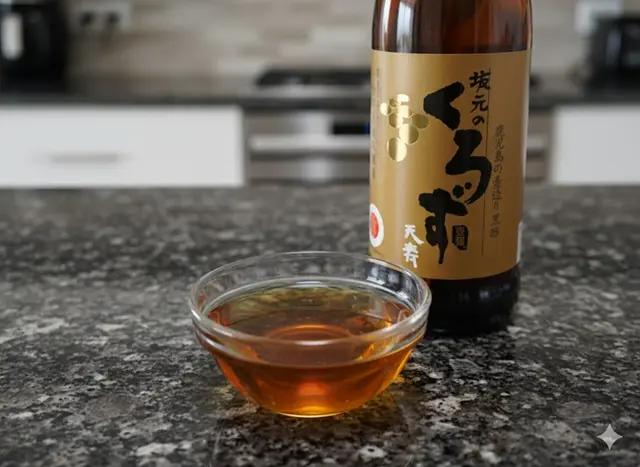
Kagoshima no Tsubozukuri Kurozu (Generated by Artificial Intelligence.)
Geographical Indication Name | Kagoshima no Tsubozukuri Kurozu | ||||||||
|---|---|---|---|---|---|---|---|---|---|
Class | Processed Foods | ||||||||
Production Area | Kagoshima Prefecture, Kirishima City (Fukuyama-cho and Hayato-cho) | ||||||||
Applicant | Kagoshima Traditional Jar Fermentation Vinegar Association | ||||||||
Main Ingredient | Rice | ||||||||
Kagoshima no Tsubozukuri Kurozu is a traditional rice vinegar with a geographical indication (GI) produced in Kagoshima Prefecture, Japan. With a history dating back to the Edo period (1600-1868), this product is made by steeping its raw material, rice, in special porcelain pots outdoors. It is named Kurozu, meaning "Kagoshima's black pot vinegar," because of the vinegar's amber color and its brownish-brown color upon maturation .
The production of Kagoshima no Tsubozukuri Kurozu begins with the preparation of highly polished rice. The rice is washed, cooked, cooled, and then dusted with yellow Aspergillus seed koji to create rice koji (malt). This rice koji, steamed rice, and water are then sequentially mixed in porcelain containers outside, and a special, highly spore-producing rice koji is sprinkled on top. The process is characterized by fermentation and maturation in open-air jars. Following preparation, the vinegar undergoes fermentation for at least six months or more, followed by a maturation phase lasting more than six months. Its rich acidity, compared to ordinary rice vinegar, stems from its abundant pyroglutamic acid and lactic acid, which contribute to its sourness.
About Kagoshima no Tsubozukuri Kurozu (地理的表示産品情報発信サイト)
The traditional pot used in making kurozu has remained unchanged since ancient times. These pots were fired in Narashirogawa, one of the representative kilns of Satsuma-yaki, the traditional pottery of the Kagoshima region. When black vinegar production began in the early 1800s, this pot was already being used as a daily cooking vessel in Satsuma, ensuring that a suitable vessel for preparing and fermenting the vinegar was readily available.
The vinegar production area encompasses the Fukuyama-cho and Hayato-cho districts of Kirishima Prefecture. This region is situated on the coast of the Makinohara Plateau, overlooking Kinko Bay. Its temperate climate is characterized by the absence of northerly winds and little frost in winter. The year-round warmth and small temperature differences provide an environment for microorganisms to thrive.
Japan Geographical Indication Center. ''Registered Geographical Indication''. Accessed 23 October 2025. https://pd.jgic.jp/en/register/entry/7.html.
MAFF. ''Tsubozukuri black vinegar.'' Accessed 23 October 2025. https://www.maff.go.jp/e/policies/market/dento_syoku/menu/tubozukuri_black_vinegar.html.
地理的表示産品情報発信サイト. " 07 Kagoshima no Tsubozukuri Kurozu." April 19, 2019. YouTube video, 2:11. Accessed 23 October 2025. https://www.youtube.com/watch?v=0hucG3pf_tY.

Kagoshima no Tsubozukuri Kurozu (Generated by Artificial Intelligence.)
Geographical Indication Name | Kagoshima no Tsubozukuri Kurozu | ||||||||
|---|---|---|---|---|---|---|---|---|---|
Class | Processed Foods | ||||||||
Production Area | Kagoshima Prefecture, Kirishima City (Fukuyama-cho and Hayato-cho) | ||||||||
Applicant | Kagoshima Traditional Jar Fermentation Vinegar Association | ||||||||
Main Ingredient | Rice | ||||||||
No Discussion Added Yet
Start discussion for "Kagoshima no Tsubozukuri Kurozu" article
Production Process and Characteristics
History and Equipment
Production Area
This article was created with the support of artificial intelligence.