Type of Geographical Indication | Mahreç Indication | ||||||||
|---|---|---|---|---|---|---|---|---|---|
Registration Number | 1517 | ||||||||
Registration Date | January 8, 2024 | ||||||||
Product / Product Group(s) | Bakery and Pastry Products / Dough-Based Products / Desserts | ||||||||
Province(s) | Karaman | ||||||||
Karaman mayalısı is a type of traditional bread produced using ancestral methods in Karaman province, located in Türkiye’s Central Anatolia Region. Protected as a geographical indication (mahreç işareti) under Law No. 6769 on Industrial Property, the product was registered on January 8, 2024. It holds geographical indication status on the condition that production takes place exclusively within the borders of Karaman province.
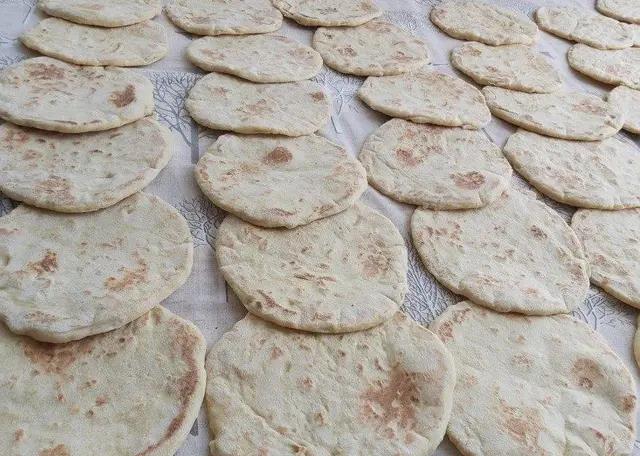
Karaman mayalısı is a round-shaped bread made with bread wheat flour, baker’s yeast, salt and water. The dough is rolled into a circular form and baked for a short time on a hot convex griddle (sac). Each piece of dough is rolled out to a diameter of 20–25 cm and a thickness of 2–2.5 mm, then baked on a griddle heated to 300–500°C for 1–3 minutes. During baking, the center of the bread puffs up into a dome shape before flattening again. The unbaked dough weighs between 100–200 grams, while the baked bread weighs 105–120 grams.
Karaman mayalısı holds an important place in Karaman’s culinary culture. It is especially consumed at breakfast but is enjoyed at all times of the day. This widespread use and historical continuity reinforce the product’s reputation linked to its geographical origin.
The traditional production stages of Karaman mayalısı are as follows:
Karaman mayalısı can be stored for 5 days in a cool, odorless and dry environment or for up to 6 months in a freezer. It can be consumed either warm or cold.
All production stages of Karaman mayalısı must be carried out exclusively within the borders of Karaman province. This geographical limitation is directly tied to the product’s historical origins and cultural prevalence.
To ensure protection after registration and maintain production standards, regular inspections are conducted at least once a year. The inspection committee consists of two expert representatives each from:
The inspections are based on the following criteria:
Expert support from public or private institutions may be utilized when necessary. The registering institution is responsible for managing all legal processes.
Türk Patent ve Marka Kurumu. “Karaman Mayalısı.” Registration Certificate. Accessed October 19, 2025. https://ci.turkpatent.gov.tr/Files/GeographicalSigns/f3db1b09-d3c3-431a-b5f5-e8b132d8434a.pdf
Türk Patent ve Marka Kurumu. “Karaman Mayalısı.” Geographical Indications Portal. Accessed October 19, 2025. https://ci.turkpatent.gov.tr/cografi-isaretler/detay/7591

Type of Geographical Indication | Mahreç Indication | ||||||||
|---|---|---|---|---|---|---|---|---|---|
Registration Number | 1517 | ||||||||
Registration Date | January 8, 2024 | ||||||||
Product / Product Group(s) | Bakery and Pastry Products / Dough-Based Products / Desserts | ||||||||
Province(s) | Karaman | ||||||||
Description and Distinctive Features
Preparation Process
Geographical Boundaries and Production Conditions
Inspection Process
This article was created with the support of artificial intelligence.