
+1 More

Karapınar Solar Power Plant
Location | Karapınar – Konya - Türkiye | ||||||||
|---|---|---|---|---|---|---|---|---|---|
Coordinate(s) | Approximately 37°45′N 33°33′E | ||||||||
Status | Operational | ||||||||
Plant Type | Photovoltaic (Solar Energy) | ||||||||
Installed Capacity | 1,350 MWp | ||||||||
Annual Generation | ~3 billion kWh | ||||||||
Number of Panels | ~3.5 million | ||||||||
Commissioning Year | 2020 (Initial Production) / 2023 (Full Capacity) | ||||||||
Land Area | 20,000,000 m² | ||||||||
Operator | Kalyon PV Solar Technologies Manufacturing Inc. | ||||||||
Tender Model | YEKA SPP-1 (Renewable Energy Resource Zone) | ||||||||
Domestic Production Rate | Target above 70% | ||||||||
Energy Transmission | Connected to the National Grid via Turkish Electricity Transmission Corporation (TEİAŞ) | ||||||||
The Karapınar Solar Power Plant (Karapınar SPP) represents a major initiative in Türkiye’s transition to renewable energy. Located in the Karapınar district of Konya Province, it is recognized as the largest solar power facility in the country.
The project was developed within the framework of the Renewable Energy Resource Zones (YEKA) model, with the objective of enhancing national energy supply security. Owing to its scale, domestic production components, and technology transfer mechanisms, the plant is regarded as a strategic investment in both the industrial and environmental domains.

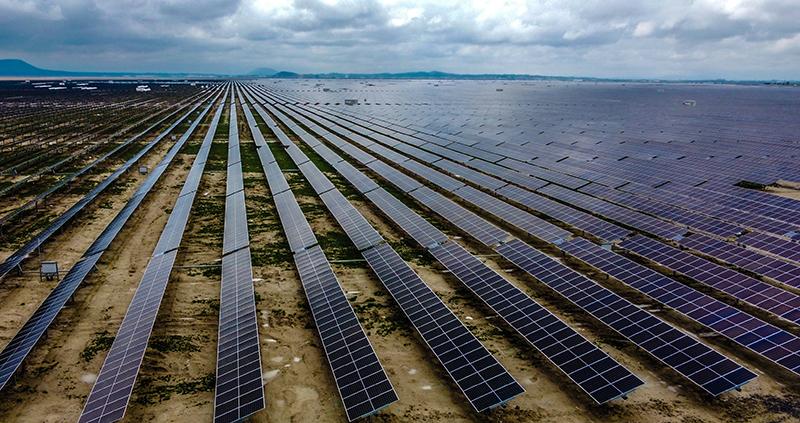
Visual of the Karapınar Solar Power Plant(AA)
The facility was constructed over an area of approximately 20 million square meters, selected due to its classification as non-arable and at risk of desertification. The plant comprises nearly 3.5 million photovoltaic panels, delivering a total installed capacity of 1,350 megawatts peak (MWp). With this capacity, the plant can produce approximately 3 billion kilowatt-hours (kWh) of electricity annually, equivalent to the average annual consumption of around 2 million households.
Panel installation was carried out in accordance with domestic production principles, targeting over 70% local content. The technologies used were supported by research and development efforts that met international standards. An integrated production approach was adopted, encompassing processes from cell manufacturing to module assembly.
The project originated from the YEKA SPP-1 tender issued in 2017 by the Ministry of Energy and Natural Resources. According to the tender terms, the investor received a 15-year fixed-price power purchase agreement in exchange for constructing a solar panel manufacturing plant in Türkiye and employing a specified number of local engineers. The selected company undertook the establishment of the solar power plant, a panel production facility, an R&D center, and engineering infrastructure.
This tender model marked the first of its kind in Türkiye by integrating energy generation with industrial development, technology transfer, employment creation, and capacity building.
The facility's capacity was increased gradually. In 2020, an initial 4 megawatts were connected to the national grid for test production. Additional panels were commissioned monthly, and the plant reached full capacity in 2023 after an installation period of about three years.
The electricity produced is transmitted directly to the national grid operated by the Turkish Electricity Transmission Corporation (TEİAŞ), thereby contributing to national energy supply. The plant thus plays a role not only at the regional but also at the national level.

Visual of Electricity Generation at the Karapınar Solar Power Plant (AA)
Karapınar SPP is among the world’s leading large-scale solar energy investments in terms of project structure. It was developed and financed by a single investor, who also oversaw implementation and operation. This integrated model illustrates institutional capacity and comprehensive project management.
The project demonstrates Türkiye’s ability to execute high-scale renewable energy initiatives, serving as a national and international reference point in terms of technical and strategic competence.
Prior to construction, the Karapınar region was identified as a flat, arid zone with low agricultural potential. An environmental management plan was implemented alongside energy production activities, including efforts for ecosystem rehabilitation. Windbreaks, green corridors, and pasture zones were established around the facility.
The project emphasized improvements to soil structure, water retention, and native vegetation restoration. These initiatives facilitated the return of agricultural and pastoral practices in the surrounding area, contributing to regional socioeconomic development. The project is considered a case of integrated land use and sustainable energy production.
Anadolu Agency. “4 Megawatts of Energy Transferred to the Grid at Karapınar SPP.” Anadolu Agency. Accessed July 18, 2025.
https://www.aa.com.tr/tr/ekonomi/karapinar-geste-4-megavatlik-enerji-sebekeye-aktariliyor-/1988061
Anadolu Agency. “Europe’s Largest Solar Power Plant Karapınar SPP Is Officially Inaugurated.” Yeşilhat. Accessed July 18, 2025.
Kalyon Enerji. “Karapınar SPP Transforms from Desert into Pasture | Kalyon Enerji.” kalyonenerji.com. Accessed July 18, 2025.
https://www.kalyonenerji.com/tr/haber-detay/kalyon-karapinar-ges-colden-meraya-donusuyor
Kalyon Holding. “Kalyon Karapınar SPP.” kalyonholding.com. Accessed July 18, 2025.
Çağatay, Gülşen. “The World’s Largest Single-Investor Solar Power Plant in Karapınar Has Started Full-Capacity Production.” Anadolu Agency, April 15, 2023. Accessed July 18, 2025.

Karapınar Solar Power Plant
Location | Karapınar – Konya - Türkiye | ||||||||
|---|---|---|---|---|---|---|---|---|---|
Coordinate(s) | Approximately 37°45′N 33°33′E | ||||||||
Status | Operational | ||||||||
Plant Type | Photovoltaic (Solar Energy) | ||||||||
Installed Capacity | 1,350 MWp | ||||||||
Annual Generation | ~3 billion kWh | ||||||||
Number of Panels | ~3.5 million | ||||||||
Commissioning Year | 2020 (Initial Production) / 2023 (Full Capacity) | ||||||||
Land Area | 20,000,000 m² | ||||||||
Operator | Kalyon PV Solar Technologies Manufacturing Inc. | ||||||||
Tender Model | YEKA SPP-1 (Renewable Energy Resource Zone) | ||||||||
Domestic Production Rate | Target above 70% | ||||||||
Energy Transmission | Connected to the National Grid via Turkish Electricity Transmission Corporation (TEİAŞ) | ||||||||
No Discussion Added Yet
Start discussion for "Karapınar Solar Power Plant" article
Installation and Capacity
Investment and Tender Process
Production and Integration
Investment Model and Organizational Structure
Environmental and Social Impact
This article was created with the support of artificial intelligence.