

+2 More


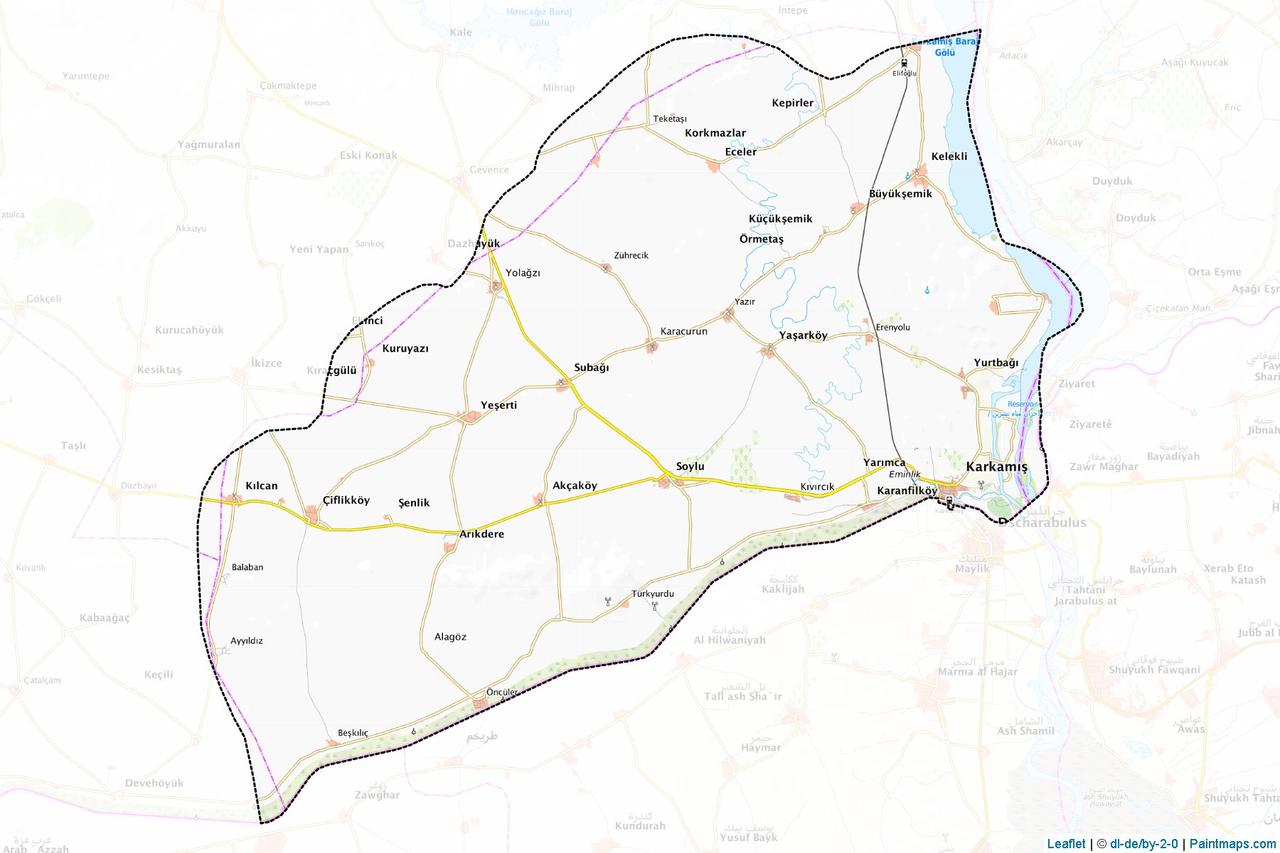
Karkamış is a district of Türkiye’s Gaziantep province. Known for its historical and geographical features, the district is significant both for its rich heritage dating back to antiquity and its strategic location as a modern-day border area.
The history of Karkamış can be approached in two ways: the ancient Karkamış that hosted early civilizations, and the present-day Karkamış which inherited this legacy. Ancient Karkamış was established on the right bank of the Euphrates River, at the intersection of the current Türkiye-Syria border. Situated at the crossroads of Mesopotamia, Anatolia, and Egypt, it became a strategic center throughout history. Settlements in Karkamış date back to the Neolithic era, with its golden age occurring around 2000 BCE. The city was first mentioned in cuneiform documents, particularly in the Mari archives, and during Hammurabi’s reign, it was known as a city under Mari’s rule. Various civilizations such as the Hittites, Mitanni, Egyptians, and Assyrians dominated the area. The Battle of Kadesh and the first recorded peace treaty in history, the Treaty of Kadesh, were signed here.
During the Hittite Empire (1400–1350 BCE), Karkamış was conquered by Suppiluliuma I and became a key administrative center for the empire in Syria. Following the collapse of the Hittite Empire due to the Mushki (Phrygian) invasions around 1200 BCE, it became the capital of the Neo-Hittite Kingdom. The city was then fortified and developed trade and political ties with neighboring kingdoms. In 717 BCE, Karkamış was sacked by Assyrian King Sargon II and turned into a province of the Assyrian Empire. In later periods, it fell under Babylonian, Persian, Roman, Byzantine, and Arab rule. During the Middle Ages, it was governed by the Seljuk Turks and the Mamluks.
Karkamış was annexed into the Ottoman Empire by Yavuz Sultan Selim following the Battle of Marj Dabiq in 1516. In the late 17th century, as part of Turkification policies, Turkish tribes from Central Anatolia were settled in the region. The construction of the Hejaz-Baghdad railway in the 19th century revitalized the area. During World War I and the Turkish War of Independence, Karkamış became a key point of resistance against French occupation. The 1921 Ankara Agreement established the Türkiye-Syria border, placing Karkamış right at the frontier. In the Republican era, it was first declared a subdistrict and became a district in 1990.
Ancient Karkamış was discovered by British archaeologist Hogarth in 1876. Excavations conducted between 1912–1915 and in 1923 brought many findings to light, later published in the three-volume work Carchemish 123. Today, the ancient site lies within a militarized minefield area and is closed to visitors.
Karkamış is located in the Southeastern Anatolia Region, approximately 75 km from Gaziantep city center. It has an area of 341,000 m² (341 km²) and an elevation of 365 meters. The Euphrates River lies to its east, Oğuzeli district to the west, Nizip district to the north, and Syria to the south. Its coordinates are between 36°37' north latitude and 37°38' east longitude.
About 95% of the district’s land consists of fertile plains suitable for agriculture. The Barak Plain, an extension of the Gaziantep Plain, descends towards the Euphrates and the Syrian border. The Aşağı Barak Plain near the Birecik border and the northeastern areas are more rugged. The Euphrates River, which forms the boundary between Karkamış and Birecik and flows into Syria, is the region’s most important water source. Smaller streams such as Karkamış, Kelekli, and Elifoğlu also flow through the area.
Although there is no direct information on Karkamış’s climate in sources, general characteristics of the Southeastern Anatolia Region suggest a transitional climate between continental and Mediterranean. Summers are hot and dry, while winters are cold and rainy. In terms of vegetation, steppe plants dominate due to the predominance of arable plains. The riverbanks of the Euphrates and surrounding streams support local biodiversity, but natural forest cover is limited.
The social fabric of Karkamış has been shaped by various cultures throughout history. During the Ottoman period, particularly in 1691, Turkification efforts brought Turkish tribes from Central Anatolia to settle in the area. This gave rise to Barak folklore, a rich cultural heritage composed of poems, songs, and legends. Karkamış is considered one of the centers of Barak culture. The school opened in 1926 marked a key step in the district’s social development. The establishment of the municipality in 1961 and its designation as a district in 1990 further contributed to modernization.
Due to its fertile plains, Karkamış's economy largely relies on agriculture. The district’s flatlands, which account for 95% of its area, are ideal for cultivating grains, cotton, and vegetables. The Euphrates River enhances agricultural productivity through irrigation. The construction of the Hejaz-Baghdad railway in the 19th century and an 870-meter-long bridge over the Euphrates made Karkamış a key hub for transportation and trade. The Karkamış–Çobanbey railway line, modernized in 2009, supports cargo transport between Europe and the Middle East, boosting the local economy. Its border location also stimulates trade activity.
With its rich historical and archaeological heritage, Karkamış holds great tourism potential. The ancient city is one of the most important centers of Near Eastern archaeology, with its Hittite-Assyrian style reliefs, temple remains, and Hilani-type structures. However, the site lies within a militarized and mined zone, requiring special permission from the Turkish General Staff to visit. The historical Karkamış train station and the 870-meter railway bridge over the Euphrates are significant examples of industrial heritage. Additionally, mounds (höyük) in surrounding villages (such as Akçaköy, Arıkdere, Ayıldız, Beşkılıç, Çiftlik, Subağı, Kelekli, and Yazır) have archaeological value and were registered as protected cultural assets in 1994.
Although exact population data is not available in sources, Karkamış is reported to include 36 villages. During the Ottoman period, Turkification policies increased the Turkish population, but border arrangements after the War of Independence caused migration, especially among Turkish families left on the Syrian side. Today, the district is home to a population engaged in agriculture and border trade. The Barak culture is the primary element shaping its ethnic and cultural identity.
Karkamış, a district where history and abundance meet, maintains its significance from its ancient legacy to its strategic role in the modern era. As a district built on agriculture, trade, and border dynamics, Karkamış could gain even more prominence if its tourism potential is further realized.

No Discussion Added Yet
Start discussion for "Karkamış (District)" article
History
Geographical Features
Climate and Vegetation
Social Structure
Economic Structure
Tourism Potential
Demographic Structure
This article was created with the support of artificial intelligence.