

Type of Geographical Indication | Protected Geographical Indication | ||||||||
|---|---|---|---|---|---|---|---|---|---|
Registration Number | 434 | ||||||||
Registration Date | 21 June 2019 | ||||||||
Product / Product Group(s) | Processed and Unprocessed Fruits and Mushrooms Vegetables | ||||||||
Province(s) | Manisa | ||||||||
Applicant / Registrant | Salihli Chamber of Commerce and Industry | ||||||||
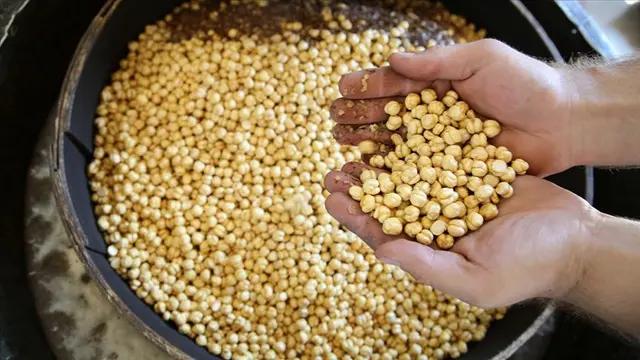
Kula roasted chickpeas are a local food product traditionally produced in the Kula district of Manisa province, Türkiye, and registered as a Protected Geographical Indication. Under the Industrial Property Law No. 6769, the product was registered on 21 June 2019 and is protected as a geographical indication by the Salihli Chamber of Commerce and Industry.
Kula roasted chickpeas are made from red, white, and yellow chickpeas with hairy and thick shells. Their production relies on cultural knowledge and expertise passed down through generations. Roasting chickpeas has long been a traditional craft in Kula, and the product’s distinctive quality results from a carefully executed, multi-stage process.
The chickpeas used for Kula roasted chickpeas have the following physical properties: average 100-grain weight of 43.58 g, length 9–11.2 mm, thickness 8–8.9 mm, and width 5–7.2 mm. Density ranges from 1.34–1.40 g/cm³, shell ratio 6.76–9.07 %, cooking time 58.5–97.5 minutes, and water absorption 23.4–54.7 %.
Chemically, moisture content ranges from 6.07–7.85 %, ash content averages 2.53 %, protein 24.63–27.08 %, fat 4.18–7.92 %, and starch 50.72–53.16 %.
The production of Kula roasted chickpeas involves a sequence of careful, skill-intensive operations. The process begins with removing debris and stones from the chickpeas. The first roasting occurs over a coal-heated stove for 25–30 minutes, followed by a 7–15 day resting period in hemp sacks. After a second roasting of 20–25 minutes, chickpeas are spread on a concrete floor and left for 20–40 days in a ventilated area, a stage locally called “sergi.”
Next, the chickpeas are moistened in watering machines for 25–30 minutes and rested for a day. Sorted by size, they are roasted for 3–5 minutes in a roasting pan to remove the shells. The chickpeas are then rested for 3 days in plastic containers with lid hoops. In the third roasting, shell removal is done using a “mafrak,” a wooden tool made from linden wood. Proper adjustment of the mafrak is critical to preserve the product’s unique structure and requires craftsmanship.
Throughout all stages, roasting time and temperature depend on the skill and observation of the artisan. Therefore, the production process is shaped not only by technical parameters but also by local knowledge.

Kula Roasted Chickpeas (AA)
All production stages of Kula roasted chickpeas must be carried out within the boundaries of Kula district, Manisa. The production process is closely tied to the local knowledge and skills, and producing outside this area would compromise the product’s authenticity.
Inspection of the geographical indication use is carried out under the coordination of the Salihli Chamber of Commerce and Industry by a board of at least three representatives from Kula Municipality, Kula Chamber of Tradesmen and Artisans, Kula Chamber of Agriculture, and Kula District Directorate of Agriculture and Forestry. Inspections are performed at least once a year regularly, as well as when needed or upon complaints.
Inspection criteria include: use of thick-shelled and hairy chickpeas, compliance of hemp sacks and plastic containers, control of resting areas, and correct use of the geographical indication.
Anadolu Ajansı. “Kendir Çuvalda Tatlanan Leblebi İhracatın Gözdesi.” Anadolu Ajansı. Accessed October 25, 2025. https://www.aa.com.tr/tr/ekonomi/kendir-cuvalda-tatlanan-leblebi-ihracatin-gozdesi/1597054
Türk Patent ve Marka Kurumu. Kula Leblebisi Coğrafi İşaret Sicil Belgesi. Accessed October 25, 2025. https://ci.turkpatent.gov.tr/Files/GeographicalSigns/a3ae89ad-c067-47a7-bf27-0b92f28cdb42.pdf
Türk Patent ve Marka Kurumu. “Kula Leblebisi” Coğrafi İşaretler Portalı. Accessed October 25, 2025. https://ci.turkpatent.gov.tr/cografi-isaretler/detay/38285

Type of Geographical Indication | Protected Geographical Indication | ||||||||
|---|---|---|---|---|---|---|---|---|---|
Registration Number | 434 | ||||||||
Registration Date | 21 June 2019 | ||||||||
Product / Product Group(s) | Processed and Unprocessed Fruits and Mushrooms Vegetables | ||||||||
Province(s) | Manisa | ||||||||
Applicant / Registrant | Salihli Chamber of Commerce and Industry | ||||||||
No Discussion Added Yet
Start discussion for "Kula Roasted Chickpeas" article
Distinctive Characteristics
Physical and Chemical Properties
Production Process
Geographical Area and Production Conditions
Inspection and Control
This article was created with the support of artificial intelligence.