


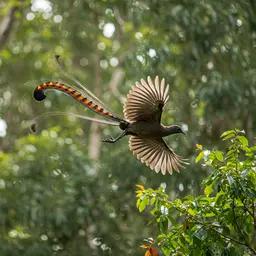
Lyrebird (Menura novaehollandiae)
Scientific Name(s) | Menura Novaehollandiae | ||||||||
|---|---|---|---|---|---|---|---|---|---|
Order | Passeriformes | ||||||||
Family | Menuridae | ||||||||
Average Length | Approximately 100 cm | ||||||||
Weight(s) | Approximately 1 kg | ||||||||
Distribution(s) | Southeastern Australia | ||||||||
Habitat | Moist Forested Areas | ||||||||
Diet(s) | Organic Material in Leaf Litter Seeds Invertebrates | ||||||||
Reproduction(s) | Females Build Nests and Raise the Chicks Alone | ||||||||
Lyrebirds (genus Menura) are terrestrial birds endemic to Australia, classified in the family Menuridae of the order Passeriformes. They are known for their notable morphological features and extraordinary ability to mimic natural and artificial sounds. This genus includes two species: Menura novaehollandiae (superb lyrebird) and Menura alberti (Albert's lyrebird). Both species are particularly remarkable for the ornate tail feathers and complex vocal repertoires of the males. These traits play a vital role in both intraspecific communication and mate selection.
Lyrebirds belong to the family Menuridae within the order Passeriformes. This family includes only the genus Menura, which comprises two extant species: Menura novaehollandiae and Menura alberti. M. novaehollandiae is widespread in the forested areas of southeastern Australia, while M. alberti has a more restricted distribution, typically inhabiting the rainforests of southeastern Queensland. Fossil records indicate that the history of the genus Menura extends back at least to the Early Miocene, suggesting an ancient evolutionary lineage.
The superb lyrebird, measuring approximately 100 cm in length, is one of the largest songbirds in the world. Male individuals possess tail feathers that curl into the shape of a lyre, forming a striking visual display. These feathers are used both to attract potential mates and to ward off rival males. Albert's lyrebird is smaller in size, and its tail plumage is less elaborate. Both species have strong legs and feet that are well-adapted for scratching and digging in the forest floor.

Representation of a Hunting Lyrebird (Created with Artificial Intelligence.)
The most remarkable feature of lyrebirds is their exceptional ability to mimic sounds. Male superb lyrebirds, in particular, are capable of imitating the calls of other bird species in their environment and even human-made sounds. These vocal imitations are typically used to attract females during the breeding season. Additionally, some studies suggest that such mimicry may also serve functions such as deterring predators or rival males.
The vocal repertoires of lyrebirds are largely shaped by learning. Juvenile individuals acquire sounds by listening to other lyrebirds in their vicinity, and the learning process evolves with the bird’s age and experience. As a result, the vocalizations of lyrebirds may show regional variation, reflecting localized "dialects" or traditions.
Lyrebirds predominantly inhabit moist forested environments and forage by scratching in the soil. Their digging behavior accelerates the decomposition of leaf litter on the forest floor, thereby playing a significant role in nutrient cycling. For this reason, lyrebirds are considered ecosystem engineers, as they modify and maintain the ecological structure of their habitats.
The superb lyrebird is currently classified as “Least Concern” by the International Union for Conservation of Nature (IUCN). However, factors such as habitat loss, bushfires, and climate change pose significant threats to its natural habitats. The 2019–2020 Australian bushfires, in particular, had a detrimental impact on lyrebird populations. Therefore, sustainable management and protection of their forest habitats are essential for the long-term survival of these species.

Lyrebird (Menura novaehollandiae)
Scientific Name(s) | Menura Novaehollandiae | ||||||||
|---|---|---|---|---|---|---|---|---|---|
Order | Passeriformes | ||||||||
Family | Menuridae | ||||||||
Average Length | Approximately 100 cm | ||||||||
Weight(s) | Approximately 1 kg | ||||||||
Distribution(s) | Southeastern Australia | ||||||||
Habitat | Moist Forested Areas | ||||||||
Diet(s) | Organic Material in Leaf Litter Seeds Invertebrates | ||||||||
Reproduction(s) | Females Build Nests and Raise the Chicks Alone | ||||||||
No Discussion Added Yet
Start discussion for "Lyrebird (Menura novaehollandiae)" article
Morphological Features and Systematic Position
Taxonomy and Evolutionary Placement
Physical Characteristics
Behavioral Characteristics and Vocal Mimicry
Vocal Mimicry Ability
Learning and Cultural Transmission
Ecological Role and Conservation Status
Habitat and Ecosystem Engineering
Conservation Status
This article was created with the support of artificial intelligence.