

+1 More


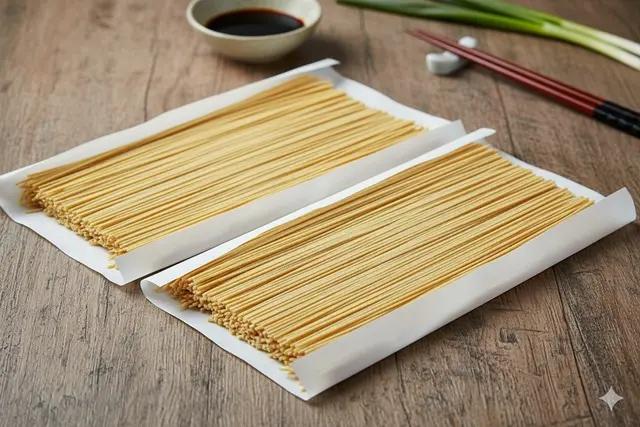
Maccheroncini di Campofilone (Created with Artificial Intelligence.)
Geographical Indication | Protected Geographical Indication | ||||||||
|---|---|---|---|---|---|---|---|---|---|
Raw Materials | Fresh eggs durum wheat semolina or double zero soft wheat flour | ||||||||
Control Organization | Assam - Agenzia Servizi Settore Agroalimentare delle Marche | ||||||||
Maccheroncini di Campofilone is a pasta with Protected Geographical Indication status. This pasta distinguishes itself from other pastas with its thinly rolled dough and very thin cut.
Maccheroncini di Campofilone is made from a dough made with fresh eggs and durum wheat semolina or double-zero soft wheat flour, and the addition of water is prohibited. It also contains a higher percentage of eggs than other types of pasta. This high egg content and slow drying process result in a high yield; for example, 250 grams of Maccheroncini di Campofilone yields four servings, compared to two servings of other pastas. This high yield also means the pasta has a greater ability to hold up to sauce.
Maccheroncini di Campofilone has a traditional history stretching back 600 years. This pasta was developed by the housewives of Campofilone to ensure its thin dough and delicate cuts would retain their shape when air-dried. Initially, it was a dish served at holidays and feasts, symbolizing the lady of the house's mastery, rather than a simple meal. In the early 1900s, housewives and innkeepers in Campofilone began serving the pasta. The name comes from the general term "Maccheroni," which refers to pasta, and "Maccheroncini," a diminutive of its long, thin strand shape. Its popularity has been further enhanced by a traditional festival ("sagra") held annually during the first ten days of August since 1964, attracting tourists nationwide.
About Maccheroncini di Campofilone ( Italian Quality Experience )
In the production of Maccheroncini di Campofilone, fresh eggs are mixed with durum wheat semolina or double-zero soft wheat flour. A minimum of 7 and a maximum of 10 whole eggs are used per kilogram of wheat product (which corresponds to a minimum of 33% by weight). The addition of water in the preparation of the dough is strictly prohibited, and the use of raw materials containing GMOs is not approved. The dough is extruded by hand or with a bronze mold, then rolled into a thin sheet using rollers. It is then cut to give it the required physical properties. The cut Maccheroncini are placed on sheets of white food paper, which are then folded using the traditional method, and then proceeded to the drying phase. Drying takes place in special rooms, a process that lasts 24 to 36 hours. After drying, packaging is carried out exclusively at the production facility to ensure the product's protection during transport and storage due to its fragility. This packaging, unique to Campofilone, is a distinctive feature of the product.
Maccheroncini di Campofilone's production area is limited to the administrative boundaries of the municipality of Campofilone, in the province of Fermo, Marche. Every stage of production (from raw material procurement to packaging) is controlled and monitored, guaranteeing product traceability.
Italian Quality Experience. " LA CAMPOFILONE SRL." Youtube video. June 22, 2015. 03:48. https://www.youtube.com/watch?v=kAQ51VtG-l8.
MASAF – Ministero delle Politiche Agricole Alimentari e Forestali. “Maccheroncini di Campofilone.” Accessed 21 October 2025. https://www.masaf.gov.it/flex/cm/pages/ServeAttachment.php/L/IT/D/f%252F9%252F3%252FD.b8637c16cff8627225de/P/BLOB%3AID%3D3348/E/pdf?mode=download.

Maccheroncini di Campofilone (Created with Artificial Intelligence.)
Geographical Indication | Protected Geographical Indication | ||||||||
|---|---|---|---|---|---|---|---|---|---|
Raw Materials | Fresh eggs durum wheat semolina or double zero soft wheat flour | ||||||||
Control Organization | Assam - Agenzia Servizi Settore Agroalimentare delle Marche | ||||||||
No Discussion Added Yet
Start discussion for "Maccheroncini di Campofilone" article
Features
History and Tradition
Production Method
Production Area
This article was created with the support of artificial intelligence.