

Type of Geographical Indication | Protected Geographical Indication | ||||||||
|---|---|---|---|---|---|---|---|---|---|
Registration Number | 349 | ||||||||
Registration Date | 07 May 2018 | ||||||||
Product / Product Group(s) | Bakery and Pastry Products Sweets Dough-based Foods | ||||||||
Province(s) | Manisa | ||||||||
Applicant/Registrant(s) | Msd Koza Eğitim Öğretim Gıda Turizm Nakliyat İnşaat Sosyal Tesisler Marketçilik Petrol Ürünleri Sanayi ve Ticaret Ltd. Şti. | ||||||||
Manisa taban simidi is a traditional bakery product unique to Manisa province in Türkiye, registered with a Protected Geographical Indication Under the Industrial Property Law No. 6769, the geographical indication application was submitted on 30 March 2010, and the product was officially registered as a Protected Geographical Indication on 7 May 2018. It falls under the “simit” category and is included in the group of bakery and pastry products, dough-based foods, and sweets.
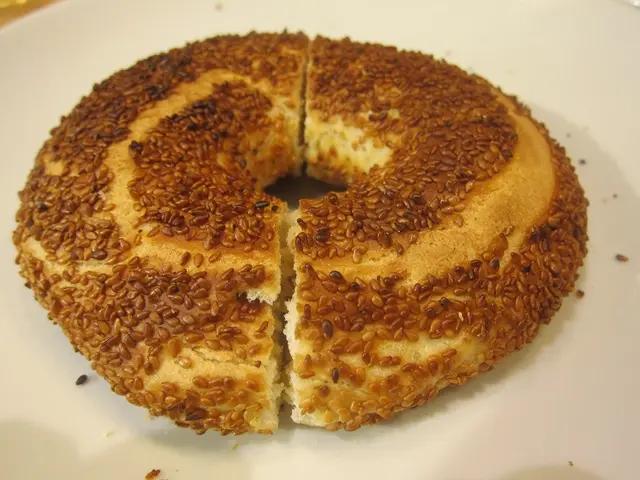
Manisa taban simidi is made from a mixture of flour, water, chickpea yeast, molasses, and sesame. It has a slightly sweet taste and a white interior. Its flat shape gives it the name “taban simidi” (literally “flat simit”). Salt is used only in the preparation of the chickpea yeast; no salt is added in other stages of the dough.
Distinctive features include the sweet aroma obtained from chickpea yeast, the adhesion of sesame to the surface due to molasses made from Sultaniye grapes, the coloration of the crust, the use of highly aromatic sesame with over 30% oil content, and physical attributes such as width, height, and acidity.
The production of Manisa taban simidi follows traditional methods and specific proportions. The most critical step is preparing the chickpea yeast. Small-grain chickpeas grown in Manisa are ground, placed in boiling water in glass bottles, and combined with the ground chickpeas and salt. After cooling to 35–40 °C, the mixture ferments for 6–8 hours, producing the yeast that imparts the simid’s sweet taste and delayed staling.
Flour, water, and chickpea yeast are mixed and kneaded for 10–15 minutes. Pre-fermentation occurs on wooden trays for 30–40 minutes. The dough is kneaded again and left for the main fermentation for 120–150 minutes. Properly fermented dough yields a white interior. The dough is then rolled into rings and rested for 10–15 minutes on wooden trays called “pasa.”
After fermentation, the dough rings are briefly boiled for 5–10 seconds, then coated with sesame mixed with molasses, giving the crust its shine and color. The sesame-coated dough is baked in a 180–200 °C oven for 10–15 minutes. The finished simids have a golden-brown crust. They are stored away from direct sunlight and moisture at room temperature. The packaging carries the “Manisa Taban Simidi” logo and Protected Geographical Indication mark; if packaging is not used, the mark must be clearly displayed in the establishment.
Production is restricted to Manisa province. This geographical limitation directly affects the product’s characteristics. Chickpeas grown in Manisa provide the sweet flavor and durability, while molasses from Sultaniye grapes gives the crust its shine and color. The semi-humid climate slows dough cooling, enhancing fermentation quality. Knowledge of production is traditionally passed from master to apprentice, and from father to son.
Compliance with the geographical indication criteria is ensured through annual inspections and additional checks if necessary. The inspection committee consists of the registered company, representatives from the Yunusemre District Directorate of Agriculture and Forestry, and the Manisa Grocers’ Association. The inspections focus on the origin of chickpeas and molasses, production methods, and proper use of the logo.
Türk Patent ve Marka Kurumu. “Manisa Taban Simidi Coğrafi İşaret Sicil Belgesi.” Türk Patent ve Marka Kurumu. Accessed October 25, 2025. https://ci.turkpatent.gov.tr/Files/GeographicalSigns/3b6716b8-5bb9-47d0-a242-2a07c59649bc.pdf
Türk Patent ve Marka Kurumu. “Manisa Taban Simidi – Coğrafi İşaretler Portalı.” Türk Patent ve Marka Kurumu. Accessed October 25, 2025. https://ci.turkpatent.gov.tr/cografi-isaretler/detay/38023

Type of Geographical Indication | Protected Geographical Indication | ||||||||
|---|---|---|---|---|---|---|---|---|---|
Registration Number | 349 | ||||||||
Registration Date | 07 May 2018 | ||||||||
Product / Product Group(s) | Bakery and Pastry Products Sweets Dough-based Foods | ||||||||
Province(s) | Manisa | ||||||||
Applicant/Registrant(s) | Msd Koza Eğitim Öğretim Gıda Turizm Nakliyat İnşaat Sosyal Tesisler Marketçilik Petrol Ürünleri Sanayi ve Ticaret Ltd. Şti. | ||||||||
No Discussion Added Yet
Start discussion for "Manisa Taban Simidi" article
Product Characteristics
Preparation
Geographical Context and Local Elements
Inspection
This article was created with the support of artificial intelligence.