Geographical Indication Type(s) | Protected Geographical Indication | ||||||||
|---|---|---|---|---|---|---|---|---|---|
Registration Number | 628 | ||||||||
Registration Date | 16.12.2020 | ||||||||
Product / Product Group(s) | Cheeses | ||||||||
Province(s) | Balıkesir | ||||||||
Applicant/Registrant(s) | Manyas District Governorate | ||||||||
Manyas kelle cheese is a local cheese variety closely associated with the Manyas, Bandırma, and Gönen districts of Balıkesir province, shaped using traditional production techniques. Protected Geographical Indication, the cheese derives its name from the production process in which the curd is hung in cloth bags to drain, forming a mass resembling a “kelle” (skull) shape.
Under Industrial Property Law No. 6769, Manyas kelle cheese is registered as a Protected Geographical Indication Following the application submitted on September 12, 2019, it was registered by the Turkish Patent and Trademark Office on December 16, 2020. The registration number is 628, and the applicant is the Manyas District Governorate. In products approved for registration, the label “Manyas Kelle Cheese” and the Protected Geographical Indication emblem must appear visibly on the packaging or at the establishment.
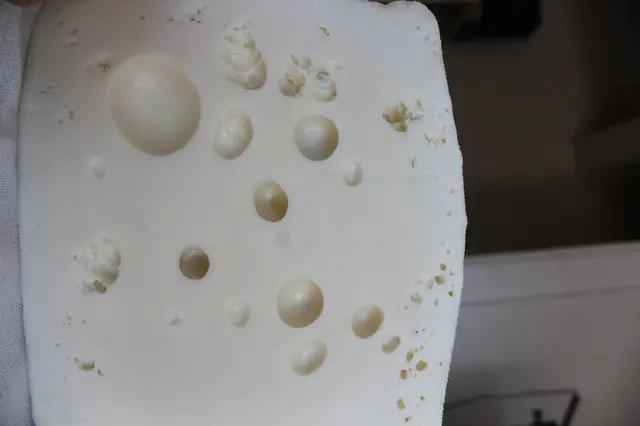
This cheese has a firm rind 2–3 mm thick. Its color ranges from white to light yellow. The texture is uniform and non-porous, with a distinctly salty taste and a characteristic aroma. It belongs to the hard cheese category in terms of firmness. Depending on the fat content of the milk used, it can be classified as full-fat or semi-fat.
The origins of Manyas kelle cheese date back to the Ottoman period. Although the exact production date is unknown, it is said to have a history of approximately 250 years. It is believed that the cheese was introduced to the region by Albanian immigrants.
The cheese is made from sheep and cow milk in the region, or a mixture of both. In spring, sheep milk predominates, while cow milk is preferred during other seasons. The milk comes from animals fed on seasonal fodder and the natural vegetation of the region.
The production process involves the following steps:
Finally, the cheese is packaged with appropriate materials and labeled according to regulations. All transport and storage operations are conducted below 10 °C.
Manyas kelle cheese has a strong connection to the region due to its specialized production techniques and craftsmanship. Therefore, all production stages must occur within the registered geographical boundaries.
Inspections are conducted at least once a year under the coordination of the Manyas District Governorate, with participation from relevant local authorities and experts from Balıkesir University. The inspections check compliance with the production method, sensory characteristics, maturation period, and proper use of the designation. Any non-compliance is reported to the relevant parties for corrective action.
Türk Patent ve Marka Kurumu. "Manyas Kelle Peyniri Coğrafi İşaret Sicil Belgesi." Coğrafi İşaretler Portalı. Accessed October 25, 2025. https://ci.turkpatent.gov.tr/Files/GeographicalSigns/2ac84230-f864-4ee2-835e-c530088a08d9.pdf
Türk Patent ve Marka Kurumu. "Manyas Kelle Peyniri." Coğrafi İşaretler Portalı. Accessed October 25, 2025. https://ci.turkpatent.gov.tr/cografi-isaretler/detay/926

Geographical Indication Type(s) | Protected Geographical Indication | ||||||||
|---|---|---|---|---|---|---|---|---|---|
Registration Number | 628 | ||||||||
Registration Date | 16.12.2020 | ||||||||
Product / Product Group(s) | Cheeses | ||||||||
Province(s) | Balıkesir | ||||||||
Applicant/Registrant(s) | Manyas District Governorate | ||||||||
No Discussion Added Yet
Start discussion for "Manyas Kelle Cheese " article
Physical and Sensory Characteristics
Historical Background
Production Process
Geographical Link and Inspection
This article was created with the support of artificial intelligence.