+1 More

Location | Mazı Village Ürgüp Nevşehir Türkiye | ||||||||
|---|---|---|---|---|---|---|---|---|---|
Ancient Name | Mataza | ||||||||
Number of Floors | 4 (2 floors open to visitors) | ||||||||
Number of Entrances | 4 | ||||||||
Period of Use | Byzantine | ||||||||
Purpose(s) | Protection Shelter Worship | ||||||||
Open to Visitors | 2 floors | ||||||||
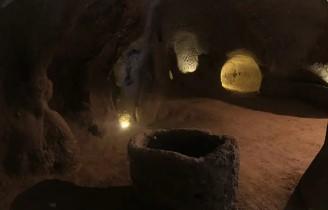
Mazı Underground City is located within the boundaries of Mazı Village in the Ürgüp district of Nevşehir Province, Türkiye. Known in ancient times as “Mataza,” this settlement is situated approximately 18 kilometers south of Ürgüp and 10 kilometers east of Kaymaklı Underground City. As one of the underground cities exhibiting the characteristic features of the Cappadocia region, Mazı functioned as a multi-purpose subterranean settlement used for defense, shelter, and worship.

Mazı Underground City (Türkiye Kültür Portalı)
The primary purpose of the extensive underground settlements in the Cappadocia region was to provide protection from frequent wars, invasions, and religious persecutions throughout history. The region’s soft tuff rock, which is easy to carve, enabled people to create secure spaces beneath the surface. Underground cities were used especially intensively during the Byzantine period, when increasing religious pressures led to the wider spread of such subterranean settlements. Mazı Underground City is considered one of these settlements within this historical context.
Mazı Underground City is believed to have four floors, although only two levels are currently open to visitors. Four entrances leading to different directions have been identified. One of these entrances is directly carved from the rock cavity, while the others are thought to have formed over time through openings created by fallen rocks. The main entrance is accessed via a short corridor constructed with irregular stones. At the end of this corridor, a large rolling stone functions as a door to control entry and exit. To facilitate the movement of this rolling stone, a small chamber is designed at the corridor’s end.
On the ground floor of the settlement, there are stables reserved for animals. The large number of these stables indicates a well-developed animal husbandry in the region. Unlike other underground cities, feeding troughs are located in the central parts of the stables. Behind the stables are the wineries, where grapes are poured down through chimneys in the ceilings. These areas were used for wine production.

Mazı Underground City (Türkiye Kültür Portalı)
Access to the church within Mazı Underground City is provided through short corridors passing by the stables. The entrance to the church can be closed with a sliding stone door. The church’s apse is carved into a corner and decorated with reliefs. Inside the church space, there is a water well approximately 20 meters deep, a central column, a large apse on the left side of the entrance, and two vaulted ceilings. The apses are designed vertically and feature large cross motifs on each side. On the front face of the central column is a large cross, while smaller interconnected cross motifs are located to the north. These elements symbolically reflect the Christian belief system of the period.
Near the church, there is a secret shaft that provides access to other parts of the underground city. This shaft is believed to have been designed for movement to the upper floors, with carved niches inside to facilitate climbing upward. Such structures demonstrate that the underground cities were designed in accordance with principles of protection and secrecy.
Akkuş, Suzan Mutlu. “Mazı Underground City.” Türkiye Tourism Encyclopedia. Accessed June 27, 2025. https://turkiyeturizmansiklopedisi.com/mazi-yeralti-sehri.
Republic of Türkiye Ministry of Culture and Tourism. “Nevşehir Mazı Underground City.” Accessed June 27, 2025. https://kvmgm.ktb.gov.tr/Eklenti/91120,nevsehir-mazi-yeralti-sehripdf.pdf?0.
Republic of Türkiye Ministry of Culture and Tourism. “Nevşehir Mazı Underground City.” Accessed June 27, 2025. https://muze.gov.tr/muze-detay?SectionId=MAZ01&DistId=MRK.
Turkish Museums. “Nevşehir Mazı Underground City.” Accessed June 27, 2025. https://www.turkishmuseums.com/museum/detail/2208-nevsehir-mazi-yeralti-sehri/2208/1.
ürkiye Culture Portal. “Mazı Underground City.” Accessed June 27, 2025. https://www.kulturportali.gov.tr/turkiye/nevsehir/gezilecekyer/mazi-yeralti-sehri.

Location | Mazı Village Ürgüp Nevşehir Türkiye | ||||||||
|---|---|---|---|---|---|---|---|---|---|
Ancient Name | Mataza | ||||||||
Number of Floors | 4 (2 floors open to visitors) | ||||||||
Number of Entrances | 4 | ||||||||
Period of Use | Byzantine | ||||||||
Purpose(s) | Protection Shelter Worship | ||||||||
Open to Visitors | 2 floors | ||||||||
No Discussion Added Yet
Start discussion for "Mazı Underground City" article
History
Architecture and Layout
Religious Structures
Internal Communication and Secret Passages
This article was created with the support of artificial intelligence.