


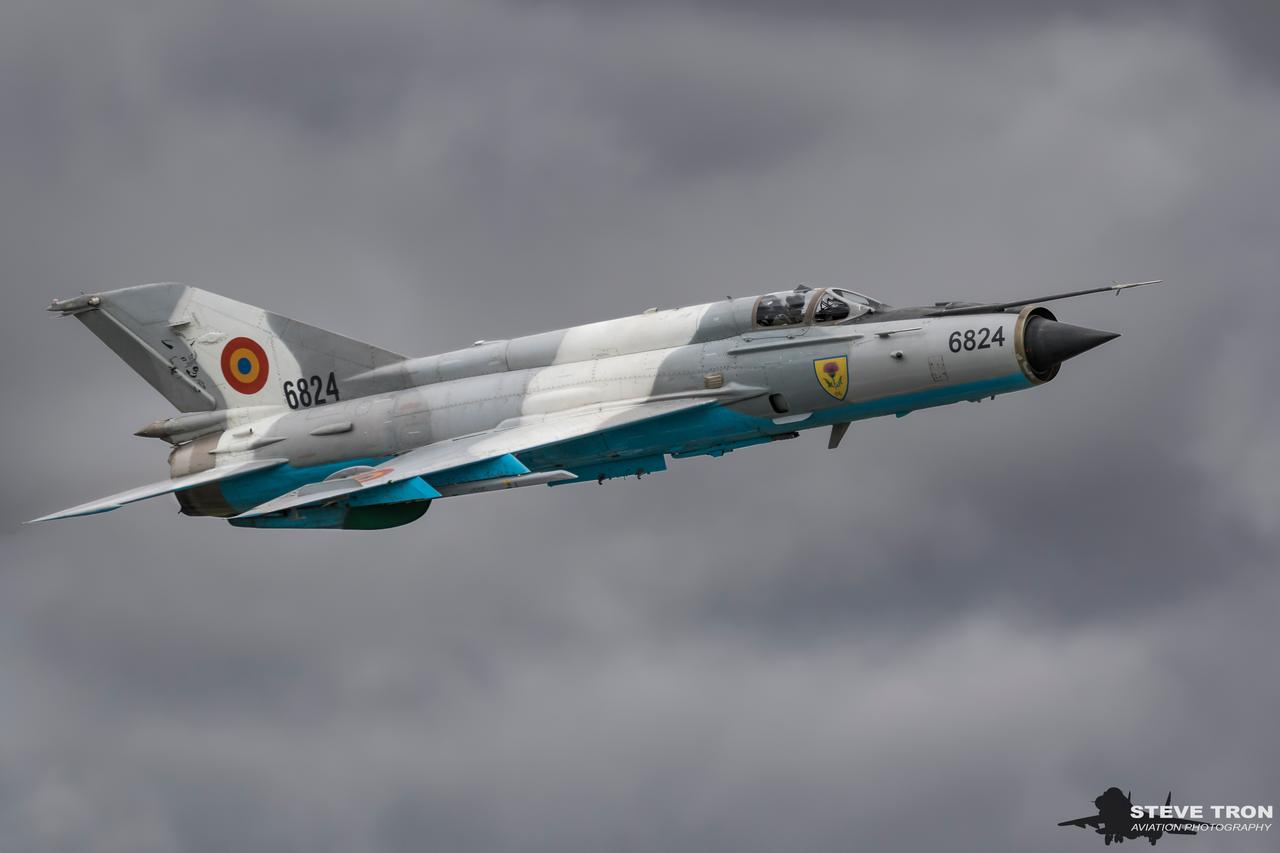
Mikoyan-Gurevich MiG-21 (Photo: Steve Tron)
Category | Interceptor | ||||||||
|---|---|---|---|---|---|---|---|---|---|
Origin(s) | Soviet Union | ||||||||
First Production Year | 1959 | ||||||||
Manufacturer(s) | and Czechoslovakia. China produced under license in countries such as India Mikoyan-Gurevich Design Bureau (Soviet Union) | ||||||||
Users | Approximately 50 countries (Russia, India, China, Vietnam, Egypt, Poland, etc.) | ||||||||
Production Number | 11.496 | ||||||||
Maximum Speed | Mach 2.05 (~2,175 km/h) | ||||||||
Climb Rate | Approximately 9,000 meters/minute | ||||||||
Takeoff Distance | Approximately 500 meters (at maximum weight) | ||||||||
Maximum Altitude | 19,000 meters | ||||||||
Turn Time | Approximately 18-22 seconds (full turn at specific speeds and altitudes) | ||||||||
Empty Weight | 5,800 kg | ||||||||
Loaded Weight | 8,800 kg (maximum takeoff weight 9,500 kg) | ||||||||
Engine and Power | Tumansky R-11F-300 turbojet engine / 5,700 kg thrust | ||||||||
Length(s) | 15 meters | ||||||||
Wingspan | 7.15 meters | ||||||||
Weapon | Fuel tanks and other various external loads Bomb payload capacity up to 500 kg 2-4 x R-3S/R-13/R-60 infrared-guided air-to-air missiles 1 x 23 mm GSh-23L twin-barrel cannon (some models have NR-30) | ||||||||
The Mikoyan-Gurevich MiG-21 is one of the most produced supersonic jet fighter aircraft developed by the Soviet Union. It first flew in 1955 and entered service in 1959. Known by NATO under the code name "Fishbed," this aircraft is notable for its high speed, agility, and relatively low production cost. Thanks to its delta wing design, supersonic flight capability, and compact structure, the MiG-21 is considered one of the most important fighter aircraft of the 20th century.
The Mikoyan-Gurevich MiG-21 was developed as a key part of the Soviet Union's jet fighter series, following the MiG-15, MiG-17, and MiG-19 models. These aircraft formed the foundation of Soviet supersonic air vehicle evolution and influenced the development of the MiG-21. In particular, experimental designs like the Sukhoi Su-7, with swept wings and nose air intakes, capable of reaching Mach 2, inspired the MiG-21’s success.
The development of the MiG-21 began in the early 1950s, with the Mikoyan Design Bureau (OKB) completing preliminary design work on a prototype named "Ye-1" in 1954. However, it became clear that the planned engine was inadequate, which led to a rapid reevaluation of the design. This resulted in the creation of a second prototype, called the "Ye-2." Early prototypes featured swept wings, while the delta wing design, used in the "Ye-4" prototype, formed the basis for the production models. The MiG-21 made its first flight on June 16, 1955, and was publicly introduced at the Soviet Aviation Day at Tushino Airport in Moscow in July 1956.
Due to limited access to Soviet aircraft information, early Western observers made misjudgments about the MiG-21. For example, Jane's All the World's Aircraft 1960-1961 mistakenly listed the "Fishbed" model under the Sukhoi design, using an image of the Su-9 "Fishpot." These confusions stemmed from the uncertainty surrounding Soviet warplanes during that time.
The development and innovative design of the MiG-21 made it a crucial part of not only the Soviet Air Force but also many countries' air forces worldwide, with production in China, India, and Czechoslovakia increasing its international presence.

(Photo: SDASM Archives, flickr.com)
The MiG-21 stood out as the first successful fighter jet in the Soviet Union to combine both interceptor and fighter roles. With a relatively low-powered turbojet engine, it could reach Mach 2 speeds, showcasing similar performance to American aircraft such as the Lockheed F-104 Starfighter, Northrop F-5 Freedom Fighter, and French Dassault Mirage III. Its delta wing design and nose air intake were notable features that also inspired numerous Soviet projects like the Su-9 interceptor, Su-7 fighter, and Mikoyan E-150. However, its design, which provided limited space for radar placement, hindered its expansion outside the USSR, limiting its potential for further development. Designed as a short-range interceptor, the MiG-21 faced instability due to the positioning of its internal fuel tanks, offering a flight time of only 45 minutes. Although Chinese variants improved the internal fuel configuration to increase range, the engine stalling issue during sharp maneuvers could not be fully eliminated. Fuel capacity limitations led to the development of variants like the MiG-21MT and SMT, which improved range but resulted in performance losses in altitude and acceleration. Despite some shortcomings, the MiG-21 proved to be an effective solution for the air forces of its time and became a significant milestone in Soviet aviation.
The MiG-21's delta wing design significantly improved its aerodynamic efficiency and supersonic speed capabilities. However, this design limited its maneuverability at low speeds and posed challenges for pilot skills during critical situations like takeoffs and landings. The aircraft featured a relatively simple cockpit with limited visibility, although various modernizations were made to its radar and avionics equipment over time.

Mikoyan-Gurevich MiG-21 Technical Drawing (Photo: blueprints)
The nose design of the MiG-21 is a remarkable feat of engineering. It seamlessly integrates the air intake and radar placement. The centrally located air intake optimizes airflow at high speeds, enhancing the aircraft's overall aerodynamics. The nose design ensured balance at supersonic speeds and positioned the center of gravity at an ideal point for the design.
Airflow directed to the engine is controlled by an intake cone. In early MiG-21 models, this cone had three different positions. At speeds up to Mach 1.5, the cone would fully retract to its maximum aft position. Between Mach 1.5 and Mach 1.9, it was adjusted to a middle position, and above Mach 1.9, the cone would be in its maximum forward position. In later models like the MiG-21PF, the intake cone was dynamically adjusted based on flight speed. The cone’s position at a given speed was calculated by the UVD-2M system using air pressures before and after the engine's compressor. Additionally, the gills located on both sides of the nose were designed to allow more air to reach the engine during ground operations and takeoff.

Mikoyan-Gurevich MiG-21 Nose Design (Photo: Lukas Plewnia, flickr.com)
The MiG-21 has played an active role in numerous military operations, from the Vietnam War to Arab-Israeli conflicts. It emerged as a serious rival to leading American aircraft of its time, such as the F-4 Phantom II, particularly excelling in close air combat due to its speed and climb capacity. During the Vietnam War, the MiG-21 achieved notable success with hit-and-run tactics against the larger and more complex enemy aircraft.
During the Vietnam War, the MiG-21 played one of the most remarkable roles in aviation history. In the 1972 "Linebacker II" operation, North Vietnamese pilot Pham Tuan, flying MiG-21MF No. 5121, shot down a USAF B-52D Stratofortress bomber on the night of December 27, 1972, over Moc Chau. Pham Tuan described the mission in MiG Aces of the Vietnam War by István Toperczer: "At 22:20, I was ordered to take off from Yen Bai at a 200-degree heading. After passing through a dense cloud layer at an altitude of 200-300 meters, I saw F-4s in the vicinity. At that time, we were informed that B-52s were approaching Moc Chau. GCI in Son La and Moc Chau constantly updated me with the distance to the bombers: 60 kilometers, 50 kilometers, and 40 kilometers. As planned, I jettisoned my fuel tank and climbed to 7,000 meters. B-52s were tracked by radar, and I was warned about the accompanying F-4s. When I saw a yellow light ahead, I turned 40 degrees left, accelerated to 1,200 km/h, and climbed to 10,000 meters where the B-52s were. I reported to command, 'I have a visual, requesting permission to engage.' GCI replied, 'You have permission for two shots, then evade quickly.' The Americans were flying in formation, maintaining a distance of about two to three kilometers. After making the final check, I fired two infrared-guided missiles at 2-kilometer range. A large flame appeared around the second B-52, and I sharply turned left, descending to 2,000 meters, then returned to Yen Bai. The attacked B-52 formation immediately jettisoned their payloads and returned to base.” This event clearly demonstrated the MiG-21's agility and speed, which allowed it to gain an upper hand over enemy aircraft.

Mikoyan-Gureviç MiG-21 (Fotoğraf: Steve Tron, flickr.com)
Despite being durable and reliable, the MiG-21 is not without its chronic issues. Its limited fuel capacity restricted its operational range, creating logistical challenges for long-range missions. Additionally, the cockpit's restricted visibility, poor energy efficiency, and relatively outdated avionics were significant criticisms.

Mikoyan-Gurevich MiG-21 Cockpit (Photo: r/hoggit, reddit.com)
Pilots generally described the MiG-21 not as "pilot-friendly" but rather as an aircraft that "tests the pilot's skills." Its simple design and easy maintenance were appreciated by technical personnel, but its sensitive balance and the challenges of flight caused mixed opinions about the aircraft.
MiG-21 pilots utilized its supersonic speed advantage to make quick strikes, employing hit-and-run tactics against larger, heavier enemy aircraft. These strategies helped balance the aircraft's limited fuel capacity while focusing on exploiting enemy weak points. With its high engine power and aerodynamic design, pilots could rapidly gain altitude and attack opponents from weak spots, then quickly evade due to the delta wing's excellent maneuverability at high speeds and altitudes.
Throughout its service life, the MiG-21 underwent numerous upgrades. Avionics updates, radar system improvements, and the integration of modern weapons were crucial factors that ensured the aircraft’s longevity. Variants like the J-7 developed in China and the MiG-21 Bison upgraded in India allowed the MiG-21 to remain in use.
The MiG-21 represents far more than an ordinary fighter aircraft. Historically, it shaped military strategies during the Cold War, laid the foundations for supersonic jet technology, and challenged the standards with its distinctive design. Despite its design limitations and operational challenges, the MiG-21 holds a significant place in aviation history.
Alexander, Mladenov. Mikoyan-Gurevich MiG-21. İngiltere: Bloomsbury Publishing, 2014.
Holger, Müller. The MiG-21 The Legendary Fighter/Interceptor in Soviet and Worldwide Use, 1956 to the Present. USA: Schiffer Publishing, 2019.
John Greenwood, Robin Higham, Von Hardesty. Russian Aviation and Air Power in the Twentieth Century. İngiltere: Taylor & Francis, 2014.
Kenneth, Whiting. Soviet Air Power. İngiltere: Taylor & Francis, 2020.
Steve, Tron (20 Temmuz 2019). Mikoyan-Gurevich MiG 21 [JPG]. Flickr. Erişim adresi: https://flic.kr/p/2hcnZzG
SDASM Archives (17 Haziran 2014). Mikoyan-Gurevich Mig-21 [JPG]. Flickr. Erişim adresi:https://flic.kr/p/nJ95Ms
Blueprint. Mikoyan-Gurevich MiG-21 Blueprint [PNG]. Blueprint. Erişim adresi: https://drawingdatabase.com/mikoyan-gurevich-mig-21/
Legitimate_Band56 (2022). MiG-21 Cockpit shots [JPG]. Reddit. Erişim adresi: https://www.reddit.com/r/hoggit/comments/s65wc3/mig21_cockpit_shots/?show=original
Lukas Plewnia (16 Ağustos 2014).Mig-21 [JPG]. Flickr. Erişim adresi: https://flic.kr/p/ompWdA

Mikoyan-Gurevich MiG-21 (Photo: Steve Tron)
Category | Interceptor | ||||||||
|---|---|---|---|---|---|---|---|---|---|
Origin(s) | Soviet Union | ||||||||
First Production Year | 1959 | ||||||||
Manufacturer(s) | and Czechoslovakia. China produced under license in countries such as India Mikoyan-Gurevich Design Bureau (Soviet Union) | ||||||||
Users | Approximately 50 countries (Russia, India, China, Vietnam, Egypt, Poland, etc.) | ||||||||
Production Number | 11.496 | ||||||||
Maximum Speed | Mach 2.05 (~2,175 km/h) | ||||||||
Climb Rate | Approximately 9,000 meters/minute | ||||||||
Takeoff Distance | Approximately 500 meters (at maximum weight) | ||||||||
Maximum Altitude | 19,000 meters | ||||||||
Turn Time | Approximately 18-22 seconds (full turn at specific speeds and altitudes) | ||||||||
Empty Weight | 5,800 kg | ||||||||
Loaded Weight | 8,800 kg (maximum takeoff weight 9,500 kg) | ||||||||
Engine and Power | Tumansky R-11F-300 turbojet engine / 5,700 kg thrust | ||||||||
Length(s) | 15 meters | ||||||||
Wingspan | 7.15 meters | ||||||||
Weapon | Fuel tanks and other various external loads Bomb payload capacity up to 500 kg 2-4 x R-3S/R-13/R-60 infrared-guided air-to-air missiles 1 x 23 mm GSh-23L twin-barrel cannon (some models have NR-30) | ||||||||
No Discussion Added Yet
Start discussion for "Mikoyan-Gurevich MiG-21" article
Historical Development and Early Prototypes
Design and Design Outcomes
MiG-21 Nose and Aerodynamic Features
Combat Aircraft, Achievements, and Missions
MiG-21 in the Vietnam War
Chronic Issues
Pilot Reviews
Pilots’ Combat Strategies
Modernization Processes