



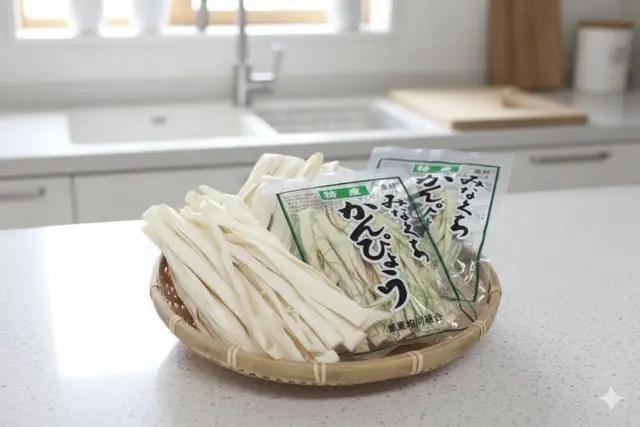
Minakuchi Kanpyo (Generated by Artificial Intelligence.)
Geographical Indication Name | Minakuchi Kanpyo | ||||||||
|---|---|---|---|---|---|---|---|---|---|
Class | Processed Foods | ||||||||
Production Area | Shiga Prefecture, Coca City, Minakuchi-cho | ||||||||
Applicant | JA Kouka | ||||||||
Minakuchi Kanpyo is a traditional vegetable product consisting of dried squash strips produced from a specific type of calabash grown locally in Minakuchi-cho, Koka City, Shiga Prefecture, Japan. It is also listed as a geographical indication in Japan.
Minakuchi-cho has been known for its kanpyo production since the Edo period (1603–1867). Its role in this product's production is documented in ukiyo-e artist Utagawa Hiroshige's work "Minakuchi: Kanpyo, A Local Specialty," from his series "Fifty-Three Stations of Tokaido." Feudal lords encouraged kanpyo production in the region, and the region's proximity to consumer centers like Kyoto and Osaka made the product marketable. Due to its light weight and long-term storage, Minakuchi kanpyo were also used as souvenirs for travelers during the period. Entrenched in the region's culinary culture, the product is a staple ingredient in the local dish "Ugawa zushi," a pressed sushi dish containing abundant kanpyo, especially enjoyed during spring festivals.

Minakuchi Kanpyo Generation (Generated by Artificial Intelligence.)
Minakuchi Kanpyo is produced from bottle gourds grown in Minakuchi-cho by members of the "Minakuchi Kanpyo Bukai," using seeds selected from local varieties and grown by themselves. The processing process involves peeling the ripe gourds into long strips, approximately 2-3 cm wide and 2-3 mm thick, and then hanging them on sticks to dry naturally in the sun, without using a hot air dryer. Sulfur fumigation is permitted when necessary to prevent quality deterioration. The product is in direct demand from sushi restaurants and other buyers in Tokyo and Osaka.
PD – Japan Geographical Indications Center. “Minakuchi Kanpyo.” PD – Japan Geographical Indications Center. Accessed October 24, 2025. https://pd.jgic.jp/en/register/entry/150.html

Minakuchi Kanpyo (Generated by Artificial Intelligence.)
Geographical Indication Name | Minakuchi Kanpyo | ||||||||
|---|---|---|---|---|---|---|---|---|---|
Class | Processed Foods | ||||||||
Production Area | Shiga Prefecture, Coca City, Minakuchi-cho | ||||||||
Applicant | JA Kouka | ||||||||
History and Cultural Significance
Production and Features
This article was created with the support of artificial intelligence.