


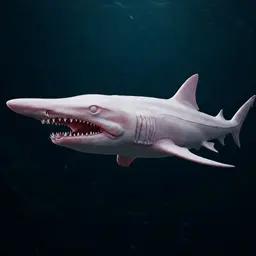
Mitsukurina Owstoni
Scientific Name(s) | Mitsukurina Owstoni | ||||||||
|---|---|---|---|---|---|---|---|---|---|
Order | Lamniformes | ||||||||
Family | Mitsukurinidae | ||||||||
Length(s) | 3–4 m Max. 6 m | ||||||||
Distribution(s) | Pacific Ocean Atlantic Ocean | ||||||||
Depth Range (M) | 100–1,200 | ||||||||
Diet(s) | Crustaceans Cephalopods Small Fish | ||||||||
Reproduction(s) | Ovoviviparous | ||||||||
The goblin shark (Mitsukurina owstoni) is a rarely encountered deep-sea species and the sole extant representative of the family Mitsukurinidae. With an evolutionary history spanning approximately 125 million years, it is often described as a "living fossil." This species is especially notable for its unique morphological characteristics. It is recognized by its long, flattened snout and protrusible jaws that can extend forward to capture prey. Typically, the goblin shark measures between 3 and 4 meters in length, but it can occasionally grow up to 6 meters. It inhabits deep waters globally, mainly in the Atlantic and Pacific Oceans, typically at depths ranging from 100 to 1,200 meters. Due to its rarity and deep-sea habitat, limited information is available about its biology and ecology.
The goblin shark is distinguished by its physical traits. Its most striking feature is the long, flattened snout equipped with electroreceptors, which play a crucial role in detecting prey. Additionally, its jaws can rapidly protrude forward to seize prey. The teeth are slender and pointed, adapted for capturing small fish and cephalopods.
The jaw structure of the goblin shark differs from that of other sharks. Its jaws can be rapidly projected forward to grasp prey, preventing escape. This mechanism provides a significant advantage for hunting in deep-sea environments.
The goblin shark inhabits deep-sea regions worldwide. It is commonly found at depths between 100 and 1,200 meters along continental slopes and submarine canyons. It has been recorded in the Atlantic and Pacific Oceans, particularly off the coasts of Japan, South Africa, Australia, and Brazil.
Although the species has a broad distribution globally, detailed knowledge about its range is limited due to its rarity and deep-sea lifestyle. One of the locations where goblin sharks are most frequently observed is the Tokyo Submarine Canyon area in Japan.
The goblin shark is carnivorous, feeding mainly on small fish, cephalopods, and crustaceans. It uses its electroreceptors on the snout to detect prey and captures it with a rapid jaw thrust.
This species detects prey using the electroreceptors on its snout. Upon locating prey, it extends its jaws forward swiftly to capture it. This rapid action prevents prey from escaping and ensures successful predation.

Goblin Shark Hunting (Created by Artificial Intelligence)
The goblin shark exhibits an ovoviviparous mode of reproduction. This means that the eggs develop inside the female's body, and the young are born live. Although detailed information on reproduction is limited, the large size attained by female individuals suggests a high reproductive capacity.
The International Union for Conservation of Nature (IUCN) currently classifies the goblin shark as a species of “Least Concern.” However, factors such as deep-sea fishing and habitat degradation pose potential threats to the future of this species. Therefore, the conservation of the goblin shark and the sustainability of its habitats are important.
Kukuev, I., ve F. Reiner. “Captures of the Goblin Shark Mitsukurina owstoni (Mitsukurinidae) off Portugal and in Other Areas of the Atlantic Ocean.” Journal of Ichthyology 62, no. 4 (2022): 543–547. https://link.springer.com/article/10.1134/S0032945222040129.
Nakaya, K., Tomita, T., Suda, K., Sato, K., Ogimoto, K., Chappell, A., Sato, T., Takano, K., ve Yuki, Y. “Slingshot Feeding of the Goblin Shark Mitsukurina owstoni (Pisces: Lamniformes: Mitsukurinidae).” Scientific Reports 6, no. 1 (2016). https://doi.org/10.1038/srep27786.
Shimada, K., ve J. A. Seigel. “The Relationship Between the Tooth Size and Total Body Length in the Goblin Shark, Mitsukurina owstoni (Lamniformes: Mitsukurinidae).” Journal of Fossil Research 38 (2005): 49–56. https://www.jstage.jst.go.jp/article/kasekiken/38/1/38_49/_article/-char/en.
Yano, K., Miya, M., Aizawa, M., ve T. Noichi. “Some Aspects of the Biology of the Goblin Shark, Mitsukurina owstoni, Collected from the Tokyo Submarine Canyon and Adjacent Waters, Japan.” Ichthyological Research 54, no. 4 (2007): 388–398. https://link.springer.com/article/10.1007/s10228-007-0414-2.

Mitsukurina Owstoni
Scientific Name(s) | Mitsukurina Owstoni | ||||||||
|---|---|---|---|---|---|---|---|---|---|
Order | Lamniformes | ||||||||
Family | Mitsukurinidae | ||||||||
Length(s) | 3–4 m Max. 6 m | ||||||||
Distribution(s) | Pacific Ocean Atlantic Ocean | ||||||||
Depth Range (M) | 100–1,200 | ||||||||
Diet(s) | Crustaceans Cephalopods Small Fish | ||||||||
Reproduction(s) | Ovoviviparous | ||||||||
No Discussion Added Yet
Start discussion for "Mitsukurina Owstoni" article
Morphology and Anatomical Features
Jaw Mechanism
Habitat and Distribution
Geographical Range
Feeding and Behavior
Hunting Strategy
Reproduction and Life Cycle
Conservation Status
This article was created with the support of artificial intelligence.