



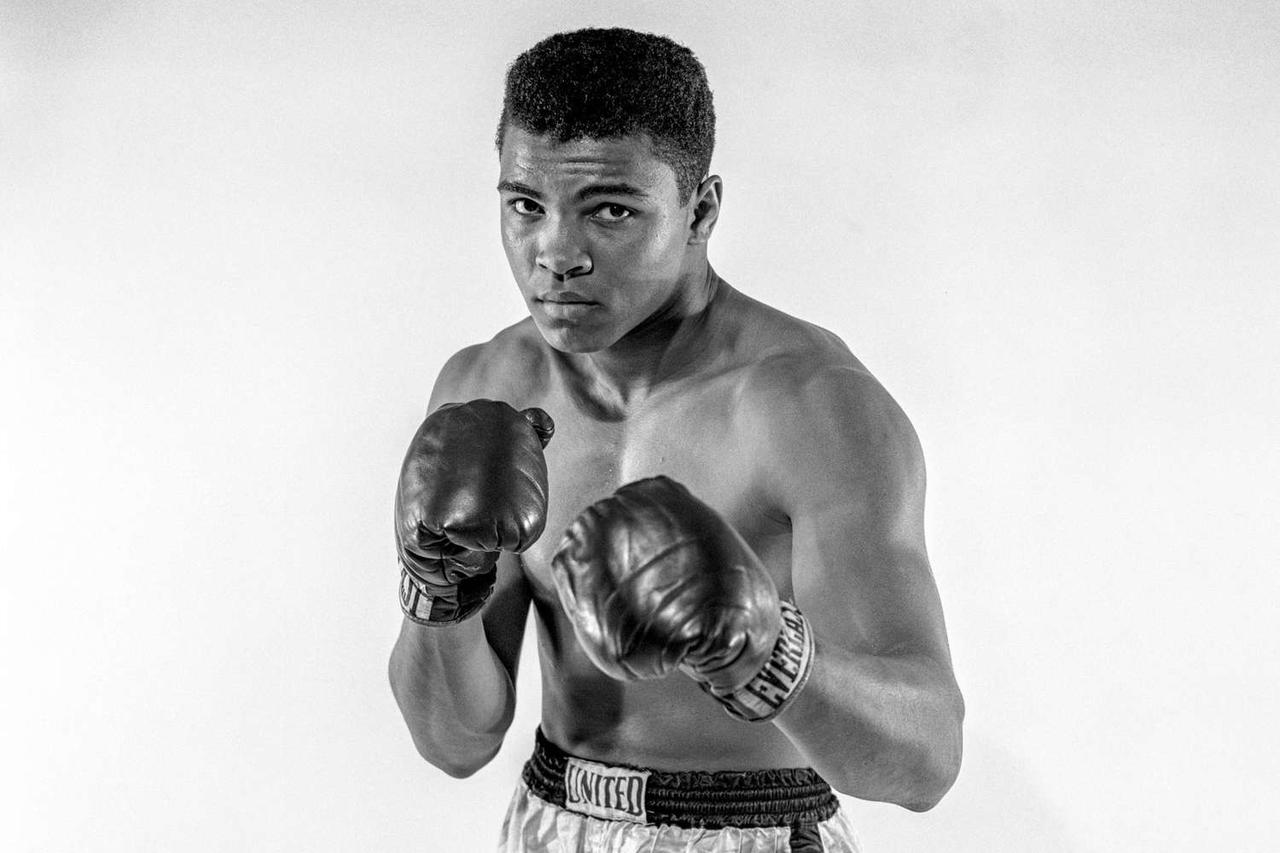
Muhammad Ali is renowned not only as one of the most significant athletes of the 20th century but also for his sensitivity to social issues and activism. Throughout his career, he garnered attention not only for his achievements in the boxing ring but also for his stance on societal matters. Born Cassius Marcellus Clay Jr., Ali's life extended far beyond the world of sports, creating a broad impact.

Muhammad Ali
Ali was born on January 17, 1942, in Louisville, Kentucky. His father, Cassius Marcellus Clay Sr., was a sign painter, and his mother, Odessa Grady Clay, was a homemaker. His childhood unfolded amidst the racial segregation and social inequality prevalent in the southern United States at the time. These conditions laid the groundwork for his later commitment to social justice.
Ali’s journey into boxing began at the age of 12 when his bicycle was stolen. Following this incident, he was introduced to boxing by police officer and trainer Joe Martin, marking a turning point in his life.
Ali’s amateur boxing career saw a meteoric rise, with a record of 100 wins and only 5 losses. He gained international recognition by winning a gold medal in the light heavyweight category at the 1960 Rome Olympics.
After returning to his home country, Ali experienced racial discrimination, which heightened his awareness of social issues. A story recounts how he threw his Olympic medal into the Ohio River after being denied service at a restaurant, symbolizing his stand against racial injustice.
In 1960, Ali began his professional boxing career, achieving 19 consecutive victories. His style, characterized by swift footwork and psychological tactics against opponents, stood out. In 1964, he defeated Sonny Liston to become the heavyweight world champion, a pivotal moment in his career.
Following his championship victory, Ali changed his name from Cassius Clay to “Muhammad Ali” and joined the Nation of Islam. This decision sparked widespread debate at the time. Ali’s religious beliefs and anti-war stance made a significant impact on public discourse.
His refusal to participate in the Vietnam War had both legal and professional consequences. Ali was stripped of his boxing license, his title was revoked, and he was barred from the ring for nearly three and a half years.
Ali’s boxing ban was lifted in 1970, allowing him to return to the ring. In 1971, he faced Joe Frazier in the “Fight of the Century,” where he suffered a loss. However, in 1974, he regained the world championship by defeating George Foreman in the “Rumble in the Jungle.” His use of the “rope-a-dope” strategy in this match gained significant attention.
Ali’s later years in the ring were marked by challenging matches and fluctuations in performance. His 1975 bout against Joe Frazier, known as the “Thrilla in Manila,” is considered one of the most intense fights in boxing history. After losing to Leon Spinks in 1978, he quickly reclaimed his title. In 1981, Ali retired from professional boxing with a career record of 61 fights, 56 of which were victories.
After retiring from boxing, Ali battled Parkinson’s disease but remained active in philanthropy and peace initiatives. His symbolic role was underscored when he lit the Olympic flame at the 1996 Atlanta Olympics.
Ali passed away on June 3, 2016, in Arizona. His funeral was widely attended and reflected the values he championed throughout his life.
Muhammad Ali is remembered not only as a sportsman but also as a prominent figure in societal issues. His legacy is built on two foundational elements: his achievements in the ring and his unwavering stance on social justice.
"Muhammad Ali: Biography, Bouts, Record, & Facts." Encyclopedia Britannica. https://www.britannica.com/biography/Muhammad-Ali-boxer.
"Muhammad Ali: Biography." Notable Biographies. https://www.notablebiographies.com/A-An/Ali-Muhammad.html.
Ali, Muhammad, and Hana Yasmeen Ali. The Soul of a Butterfly: Reflections on Life's Journey. New York: Simon & Schuster, 2004.
Ali, Muhammad, and Richard Durham. The Greatest: My Own Story. New York: Random House, 1975.
Dennis, Felix, and Don Atyeo. Muhammad Ali: The Glory Years. New York: Miramax Books, 2003.
Eig, Jonathan. Ali: A Life. Boston: Houghton Mifflin Harcourt, 2017.
Hauser, Thomas. Muhammad Ali: His Life and Times. New York: Simon & Schuster, 1991.

Early Life and Youth (1942-1958)
Amateur Boxing Career and Olympic Success (1958-1960)
Early Professional Boxing Career (1960-1964)
Conversion to Islam and Activism (1964-1967)
Return to the Ring and Resurgence (1970-1974)
Final Years and Retirement (1975-1981)
Philanthropy and Activism (1981-2016)