+2 More

Location | Demre District Mediterranean Region Antalya Province | ||||||||
|---|---|---|---|---|---|---|---|---|---|
Notable Structures | Rock Tombs, Acropolis, Andriake Port, Assembly Structure, Ancient Theater | ||||||||
Artifacts | Millefiori Glass Panels, Opus Sectile Designs, 2,200-Year-Old Terracotta Artifacts | ||||||||
Key Artistic Techniques | Millefiori Glasswork, Opus Sectile | ||||||||
Accessible Areas | Myra Ancient City, Andriake Port, Rock Tombs, Ancient Theater | ||||||||
Artifact Era | 5th–6th centuries CE | ||||||||
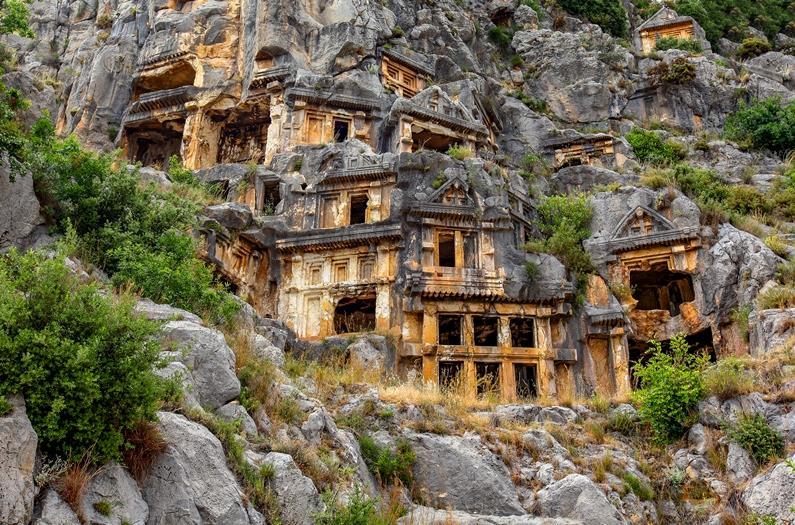
Myra Ancient City is located near the Demre district within Antalya Province, Türkiye, and is one of the most significant ancient cities of the Lycia region. It is renowned for its rich historical and cultural heritage, including rock-cut tombs, the ancient theater, and the port of Andriake. Myra was historically an important center for commerce and culture, and archaeological excavations at the site have revealed artifacts that shed light on the region’s artistic, religious, and cultural life.

Myra Ancient City (T.C. Kültür ve Turizm Bakanlığı)
The history of Myra is believed to date back to the 5th century BCE. The city is particularly known for its Roman and Byzantine ruins. Myra was among the first cities to join the Lycia League and served as a major religious and trade center during this period. The city’s rock-cut tombs, acropolis, and other structures reflect its historical richness. The port of Andriake facilitated maritime connections and became a hub of active commerce.

Myra Ancient City (Türkiye Kültür Portalı)
Andriake, the port of Myra, connected the city to the sea and served as Lycia’s gateway to the outside world. Recent archaeological excavations have revealed significant structures at the port, which played a central role in trade and cultural interactions in the region.

Myra Ancient City (Türkiye Kültür Portalı)
Excavations at Andriake uncovered Millefiori glass panels, a decorative technique whose name means “a thousand flowers.” Millefiori involves combining multi-colored glass rods to create intricate patterns, with each panel individually handmade. Such examples are rare in Türkiye, making these artifacts highly valuable.
In addition, Opus Sectile stone and marble designs were discovered at Andriake. This decorative art involves cutting stones and marble to create wall and floor patterns, often depicting birds, camels, and saints. The presence of saint figures, as noted by Çevik, highlights their artistic and religious significance, reflecting both aesthetic sensibilities and spiritual influences of the period.

Interior Decoration Panels Made Using the Millefiori (Thousand Flowers) Technique (AA)
The Acropolis was one of the key areas of Myra Ancient City, serving as a center for religious, social, and administrative activities. Many structures were carved directly into rock. One of the most notable buildings is the Assembly Structure, designed to host large gatherings and ceremonies. It could accommodate over 130 people. The niches, platforms, and seating arrangements indicate its function for significant public events, while the stone craftsmanship reflects the engineering and architectural knowledge of the time.
Excavations also uncovered 2,200-year-old terracotta artifacts, which provide valuable insight into the artistic, cultural, and religious practices of the era. Some of these pieces are unique and seen for the first time in this type.
Anadolu Ajansı. "Myra Antik Kenti'nde 2200 Yıllık Pişmiş Toprak Eserler Bulundu." Anadolu Ajansı. Accessed April 28, 2025. https://www.aa.com.tr/tr/kultur-sanat/myra-antik-kentinde-2200-yillik-pismis-toprak-eserler-bulundu/1966855.
Anadolu Ajansı. "Myra Antik Kentinin Limanı Andriakede Rengarenk Buluş." Anadolu Ajansı. Accessed April 28, 2025. https://www.aa.com.tr/tr/kultur/myra-antik-kentinin-limani-andriakede-rengarenk-bulus/3324647.
T.C. Kültür ve Turizm Bakanlığı. "Myra Antik Kenti." Antalya İl Kültür ve Turizm Müdürlüğü. Accessed April 28, 2025. https://muze.gov.tr/muze-detay?DistId=MYR&SectionId=MYR01.
Çevik, Nevzat. “Myra Klasik Çağ Toplanma Yapısı”. Cedrus 11, Haziran (Haziran 2023): 35-45. Accessed April 28, 2025. https://dergipark.org.tr/tr/pub/cedrus/issue/78147/1253772
T.C. Kültür ve Turizm Bakanlığı. "Myra Antik Kenti." Türkiye Kültür Portalı. Accessed April 28, 2025. https://www.kulturportali.gov.tr/turkiye/antalya/gezilecekyer/myra.


Location | Demre District Mediterranean Region Antalya Province | ||||||||
|---|---|---|---|---|---|---|---|---|---|
Notable Structures | Rock Tombs, Acropolis, Andriake Port, Assembly Structure, Ancient Theater | ||||||||
Artifacts | Millefiori Glass Panels, Opus Sectile Designs, 2,200-Year-Old Terracotta Artifacts | ||||||||
Key Artistic Techniques | Millefiori Glasswork, Opus Sectile | ||||||||
Accessible Areas | Myra Ancient City, Andriake Port, Rock Tombs, Ancient Theater | ||||||||
Artifact Era | 5th–6th centuries CE | ||||||||
History of Myra Ancient City
Andriake Port and Excavations
Millefiori Glass Panels and Opus Sectile Technique
Acropolis and Assembly Structures
2,200-Year-Old Terracotta Artifacts and Other Finds
This article was created with the support of artificial intelligence.