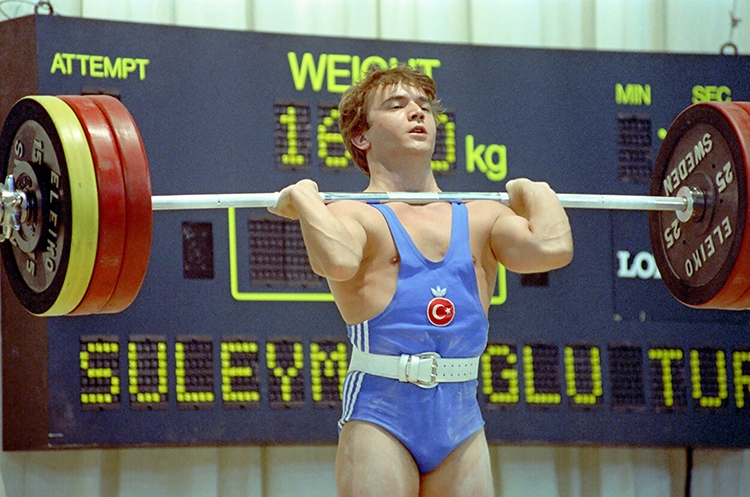


Naim Süleymanoğlu (born January 23, 1967, in the village of Ahatlı, Kardzhali, Bulgaria died November 18, 2017, in Istanbul) was an athlete known by the nickname "Pocket Hercules," holding a significant place in both world and Turkish weightlifting history. With the records he broke and the championships he won throughout his career, he is regarded as one of the greatest figures in the history of weightlifting.
Süleymanoğlu was born in the village of Ahatlı, located in the Kardzhali province of Bulgaria, a region with a dense Turkish population, to a family of Turkish descent. His father worked as a mine laborer. When Naim was still a young child, the family moved to the town of Mestanlı. During his childhood, he explored various sports, making use of a nearby stadium and swimming pool—engaging in swimming, athletics, and wrestling.
At around the age of 9 or 10, he was discovered in Mestanlı by weightlifting coach Hilmi Pekünlü, who directed him toward the sport of weightlifting. He began his first training sessions in a small gym, where he quickly drew attention for his rapid mastery of technical movements and his disciplined work ethic. Between 1977 and 1980, after training in Mestanlı, he was selected to join the Sofia Sports Schools Union, an institution established for promising athletes, and he continued his education there.
At the high school level, he received vocational training in agriculture. School records described him as a disciplined, responsible student with strong willpower and high psychological resilience.
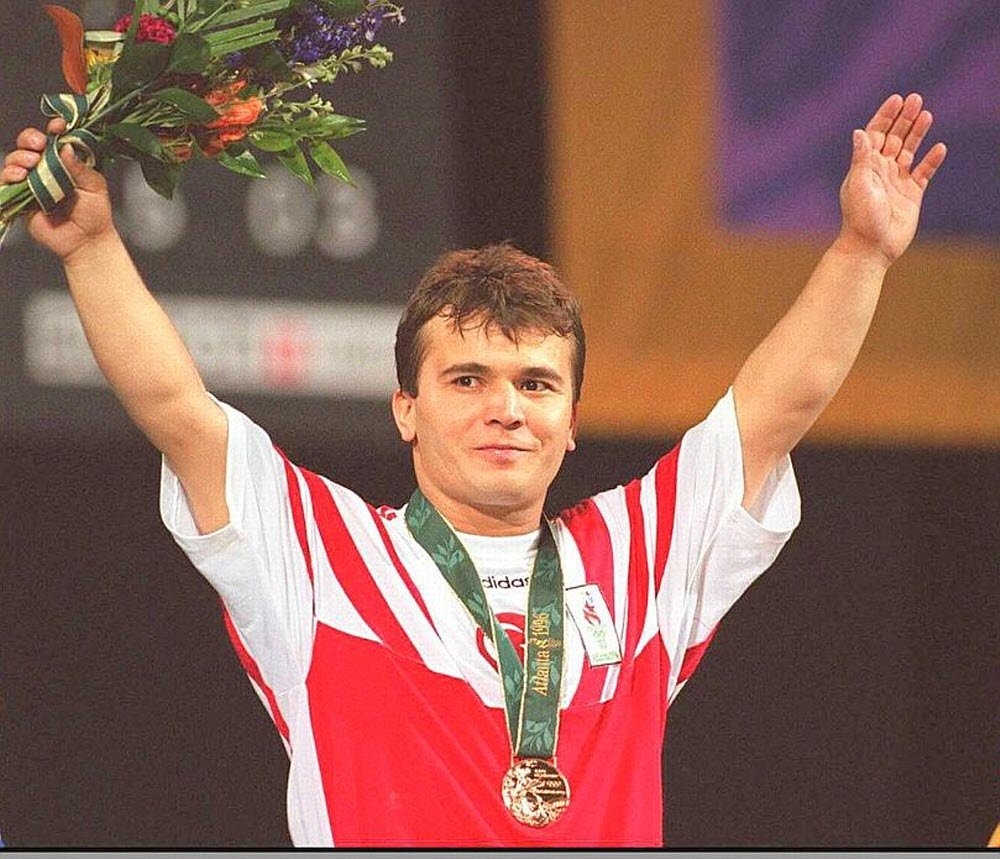
The successes Naim Süleymanoğlu achieved throughout his career highlight his exceptional talent and determination in weightlifting. At the 1988 Seoul Olympics, he won a gold medal in the 60 kg category, breaking six world records and making a significant mark in the weightlifting category. Süleymanoğlu also won gold medals at the 1992 Barcelona and 1996 Atlanta Olympics, becoming a three-time Olympic champion. Throughout his career, he broke a total of 46 world records and won seven world championships. He also won multiple gold medals in European championships. His remarkable achievements have solidified his status as a "legend" in weightlifting. At the 1988 World Weightlifting Championships in Japan, he lifted 190 kilograms at a body weight of only 60 kilograms, showcasing his incredible strength and talent once again.

Naim Süleymanoğlu. (Anadolu Agency)
Following the establishment of the communist regime in Bulgaria after 1944, minority rights violations intensified—especially during the rule of Todor Zhivkov. Between 1984 and 1989, the regime implemented the “Revival Process” policy, which aimed to forcibly assimilate the Turkish minority. As part of this campaign, Bulgarian Turks were prohibited from speaking Turkish, receiving education in their native language, practicing religious rituals, and engaging in cultural traditions such as weddings and circumcision ceremonies. Like many other Turkish families in Bulgaria, the Süleymanoğlu family also faced severe restrictions on their rights during this period.
In the mid-1980s, under the regime’s forced name-change campaign, Naim’s official name was changed to “Naum Shalamanov.” This action was part of a broader assimilation policy targeting the Turkish population. The increasing oppression led to widespread protests and resistance across the country. For the Turkish minority in Bulgaria, Naim Süleymanoğlu quickly emerged as a symbolic figure of this era, especially as he gained international success in a short time.
Following his inclusion in the sports school system, Naim Süleymanoğlu was admitted to the Bulgarian national weightlifting team’s training camp at a very young age. In 1982, at just 15 years old, he became the world junior champion in the lightweight category at the World Junior Weightlifting Championships held in São Paulo, Brazil, and set a new world record. This extraordinary accomplishment made him one of the youngest world record holders in history.
From 1983 onward, he began competing in senior-level events. Between 1983 and 1986, he shattered numerous world records across both junior and senior divisions, claiming first place in several World and European Championships in different weight classes (52 kg, 56 kg, and 60 kg). In 1983, during a tournament in the United States famously dubbed the “Tournament of Record Holders,” he broke yet another world record. This earned him international acclaim and the enduring nickname “Pocket Hercules.”
Due to the Eastern Bloc’s boycott of the 1984 Los Angeles Olympic Games in protest of the Soviet invasion of Afghanistan, Süleymanoğlu was unable to compete. Nevertheless, he won gold at the “Friendship Games,” an alternative competition organized among Eastern Bloc countries. He was named “Weightlifter of the Year” in international rankings for three consecutive years: 1984, 1985, and 1986.

Naim Süleymanoğlu. (Anadolu Agency)
In the mid-1980s, the intensifying assimilation policies and the forced name-change campaign diminished Süleymanoğlu’s willingness to continue competing on behalf of Bulgaria. As he later stated, he decided to seek asylum in Türkiye because he “did not want to sweat for those who denied the existence of Turks.”【1】
He traveled to Melbourne, Australia, in 1986 for the World Weightlifting Championships. After winning first place at the championship, he met with individuals who would assist him in the asylum process during the closing reception of the event, and then left his hotel as planned. He was kept at a confidential location for a period, after which he declared to Australian authorities that he wished to go to Türkiye of his own free will.
Several government officials and institutions in Türkiye played a role in facilitating his acceptance into the country. Diplomatic negotiations were conducted with Bulgaria in accordance with international rules concerning athlete licensing and representation rights. According to these rules, for an athlete to compete in the Olympics under a new nation’s flag, either the consent of the previous federation or the passage of a specific waiting period was required. In this context, it is reported that Türkiye made a compensation payment to the Bulgarian Weightlifting Federation, thereby enabling Süleymanoğlu to represent Türkiye at the 1988 Olympics.
After acquiring Turkish citizenship, he gained the right to compete under the Turkish Weightlifting Federation. During his time competing for Türkiye, he achieved results that were frequently cited in global weightlifting literature.

Naim Süleymanoğlu. (Anadolu Agency)
The first Olympic Games Naim Süleymanoğlu participated in representing Türkiye were the 1988 Seoul Summer Olympics. Competing in the 60 kg weight class, he broke multiple world and Olympic records in both the snatch and clean & jerk, lifting a total of 342.5 kg and winning the gold medal.
Throughout his career, Süleymanoğlu achieved:
In 1988, he became the first Turkish athlete to appear on the cover of Time magazine. He was featured in the issue titled “Everybody Wins”, following his dominant performance at the Seoul Olympics.
At the 1988 World Championships held in Japan, he lifted 190 kg in the 60 kg weight class, achieving a remarkable total score. This lift has been widely cited in the weightlifting literature as a prime example of an exceptional power-to-weight ratio.
Naim Süleymanoğlu and His Life – The Greatest of the Turkic World (TRT Avaz)
Although minor numerical discrepancies exist across different sources, it is widely acknowledged that Naim Süleymanoğlu broke dozens of world records throughout his career. From the mid-1980s through the 1990s, he was a dominant and defining figure in his weight class. He was named “Weightlifter of the Year” in international rankings for three consecutive years: 1984, 1985, and 1986. In 1988, he became the first Turkish athlete to appear on the cover of Time magazine and was frequently listed among the “best weightlifters of his era” in global assessments.
Following his triumph at the 1988 Seoul Olympics, he was invited to the White House by then–U.S. President Ronald Reagan. Additionally, Paraguay is reported to have issued a commemorative postage stamp in his honor, labeled “Super Turk.” Süleymanoğlu is also recognized as the first Turkish athlete to win an Olympic gold medal outside the sport of wrestling.
A table summarizing Naim Süleymanoğlu’s achievements.
In the 2000s, Naim Süleymanoğlu made attempts to enter politics. He ran as a mayoral candidate for the Nationalist Movement Party (MHP) in the 2004 local elections and as a parliamentary candidate in the 2007 general elections. However, he was not elected to any official position as a result of these campaigns.
On September 25, 2017, he was hospitalized due to liver failure. A liver transplant was performed on October 6, 2017, but complications following the surgery led to his passing on November 18, 2017, in Istanbul.
The life of Naim Süleymanoğlu was adapted for the big screen in the 2019 biographical film Pocket Hercules: Naim Süleymanoğlu. Directed by Özer Feyzioğlu, the screenplay was written by Barış Pirhasan and based on the memoir Kardeşim Cep Herkülü (My Brother, Pocket Hercules) by the athlete’s brother, Muharrem Süleymanoğlu. The film premiered on November 22, 2019.
The production covers Süleymanoğlu’s journey from his introduction to weightlifting at around age ten in the 1970s to his historic victory at the 1988 Seoul Olympics.
Pocket Hercules: Naim Süleymanoğlu – Trailer (CGV Mars Distribution)
[1]
Tamer Taşpınar. "Naim: Pocket Hercules." p. 11. Edited by Aslı Özaydın. July 2019.
No Discussion Added Yet
Start discussion for "Naim Süleymanoğlu (English)" article
Early Life and Introduction to Sports
Achievements and Competitions Won
1980–1986 Period: The Bulgaria Years
Defection to Türkiye and Naturalization Process in 1986
Olympic Games
World and European Championships
Notable Lifting Records
Other Major Achievements in His International Career
Post-Sport Career, Health Issues, and Passing
Süleymanoğlu’s Portrayal in Cinema
This article was created with the support of artificial intelligence.