

Constellation | Eridanus | ||||||||
|---|---|---|---|---|---|---|---|---|---|
Galaxy Type | SB(s)bc | ||||||||
Distance(s) | ~61 million light-years | ||||||||
Mass | ~10^11 solar masses | ||||||||
Radial Velocity | ~1,500 km/s | ||||||||
Central Bar Length | ~15,000 light-years | ||||||||
Optical Diameter | ~110,000 light-years | ||||||||
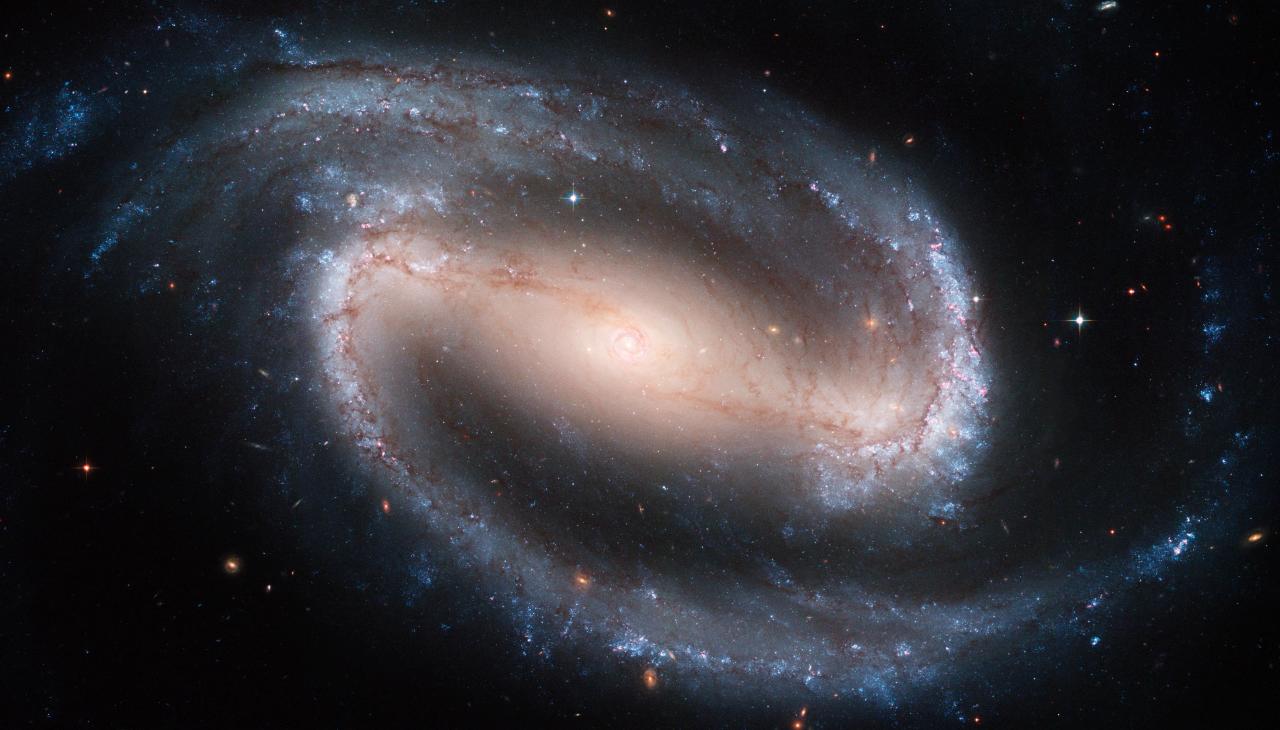
NGC 1300 Galaxy is a barred spiral galaxy with a prominent central bar structure, classified within the spiral galaxy category. It is considered a significant example, particularly in the classification of barred spiral galaxies. It was first discovered in 1835 by the English astronomer John Herschel. NGC 1300 is located in the direction of the constellation Eridanus and is approximately 61 million light-years away. This distance is significant in terms of the observation of the galaxy’s structural and dynamic characteristics, classifying it as a medium-sized galaxy.

NGC 1300 Galaxy (NASA)
NGC 1300 is classified as a typical barred spiral galaxy and is morphologically designated as SB(s)bc. In this classification:
The most prominent feature of the galaxy is its central bar, which is approximately 15,000 light-years long. This bar can be defined as a stellar structure shaped around the supermassive black hole located at the galaxy’s center. Spiral arms emerge from both ends of the bar and curve outward toward the outer regions of the galaxy.
The optical diameter of NGC 1300 is approximately 110,000 light-years, making it comparable in size to the Milky Way. The galaxy’s mass is around 10^11 solar masses. The star formation rate is at a moderate level and is particularly concentrated in the spiral arms.
The rotating structure of the galaxy is directly related to the dynamics of the bar and spiral arms. The bar structure directs the flow of stars and gas from the center outward, facilitating the transfer of gas to active regions in the center. This mechanism results in increased density of stars and gas around the central supermassive black hole. Radial velocity measurements indicate that NGC 1300 is receding from the Milky Way at approximately 1,500 km/s.
Observations by the Hubble Space Telescope and other advanced ground-based telescopes have revealed high-resolution details of NGC 1300’s bar structure. In particular, the distribution of star clusters and gas clouds within the bar provides important clues regarding galactic evolution. Additionally, this barred structure serves as a reference in modeling the galaxy’s mass distribution and dynamics.
Barred spiral galaxies are a frequently observed type in the galactic evolutionary process, and NGC 1300 is a typical example of this class. Bar structures regulate the flow of matter in the center of galaxies, influencing star formation processes and the galaxy’s overall dynamic equilibrium. Therefore, the study of galaxies like NGC 1300 is crucial for understanding the effects of bars on galactic evolution.
In conclusion, NGC 1300 represents a prominent example within the class of barred spiral galaxies with its structural and dynamic characteristics. The distinct central bar and its associated spiral arms determine the galaxy’s mass and star distribution and influence its evolutionary processes. From a technical standpoint, the dimensions, mass, and dynamic values of NGC 1300 indicate typical structural features when compared with similar galaxies. With these characteristics, NGC 1300 serves as a frequent reference in the structural and dynamic analysis of barred spiral galaxies.
NASA Science. "NGC 1300." NASA. Accessed July 2, 2025. https://science.nasa.gov/image-detail/ngc-1300/.
NASA. "Barred Spiral Galaxy NGC 1300." Astronomy Picture of the Day, June 22, 2008. Accessed July 2, 2025. https://apod.nasa.gov/apod/ap080622.html.
ESA/Hubble. "A poster-size image of the beautiful barred spiral galaxy NGC 1300." ESA Hubble Space Telescope. Accessed July 2, 2025. https://esahubble.org/images/opo0501a/.
NASA Science. "Barred Spiral Galaxy NGC 1300." NASA. Accessed July 2, 2025. https://science.nasa.gov/asset/hubble/barred-spiral-galaxy-ngc-1300/.

Constellation | Eridanus | ||||||||
|---|---|---|---|---|---|---|---|---|---|
Galaxy Type | SB(s)bc | ||||||||
Distance(s) | ~61 million light-years | ||||||||
Mass | ~10^11 solar masses | ||||||||
Radial Velocity | ~1,500 km/s | ||||||||
Central Bar Length | ~15,000 light-years | ||||||||
Optical Diameter | ~110,000 light-years | ||||||||
Structural Features
Dimensions and Dynamic Properties
Observational Data and Evolutionary Significance
This article was created with the support of artificial intelligence.