
Galaxy Type | SAB(r)bc pec | ||||||||
|---|---|---|---|---|---|---|---|---|---|
Constellation | Canes Venatici | ||||||||
Distance(s) | Approximately 50 million light-years | ||||||||
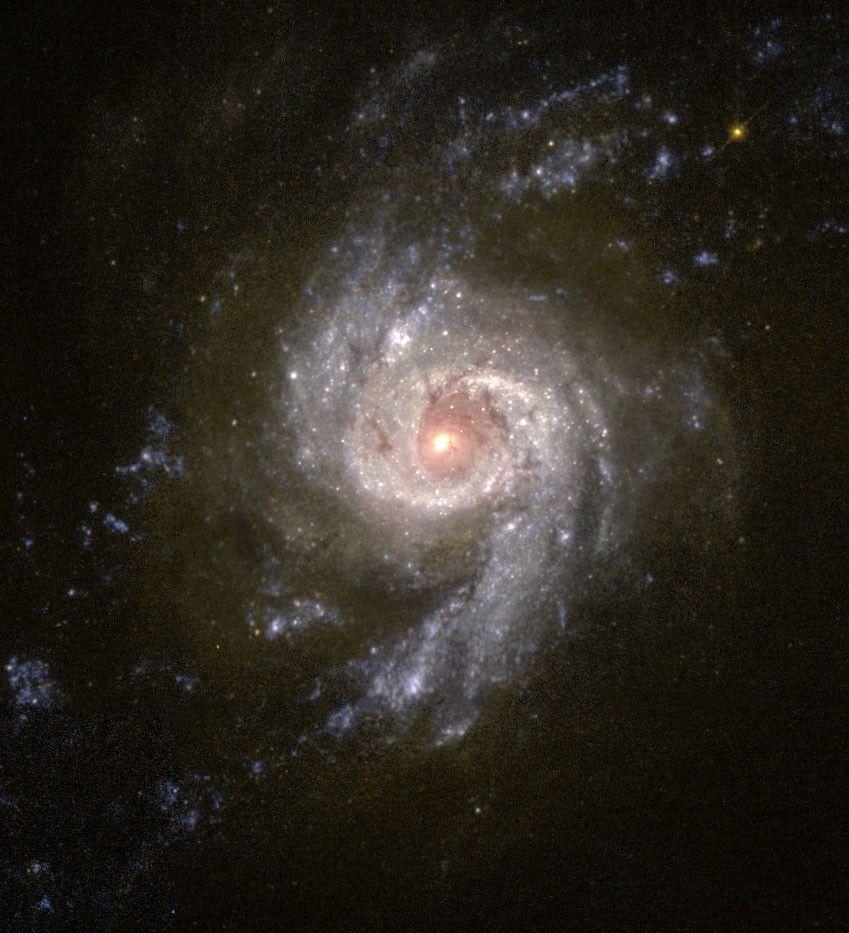
NGC 3310 is a spiral galaxy located in the constellation Canes Venatici. It is particularly classified as a starburst galaxy due to its intense star formation activity.
NGC 3310 was discovered by John Herschel in 1835 and is located approximately 50 million light-years away. The galaxy is notable for its distorted structure and widespread star-forming regions, likely resulting from a recent galactic merger or interaction. Images obtained by the NASA/ESA Hubble Space Telescope reveal irregular spiral arms and star clusters throughout the galaxy’s disk.
NGC 3310 is classified morphologically as SAB(r)bc pec. This classification indicates that the galaxy contains a weak bar structure (SAB), a prominent ring feature (r), and loosely wound spiral arms (bc). The term “pec” denotes that the galaxy is structurally peculiar and distorted.
NGC 3310 is a typical example of a starburst galaxy. Observations reveal the presence of widespread H II regions throughout the galaxy disk. These regions are formed by hydrogen gas ionized by newly formed hot, young stars. Spectroscopic data indicate that the star formation rate has significantly increased over the past few hundred million years.
This burst in star formation is likely caused by the collision or merger of NGC 3310 with a smaller satellite galaxy. Such galactic interactions are known to trigger star formation and disrupt the structural integrity of galaxies. The asymmetric arms and irregular star clusters near the core support this hypothesis.
Observations in ultraviolet, optical, and infrared wavelengths show that NGC 3310 has a multi-component star formation structure. Hubble Space Telescope images have detected hundreds of young star clusters. Data from Spitzer and GALEX reveal that many of these clusters are only a few million years old.
Additionally, no active nucleus has been observed at the center of NGC 3310; therefore, the galaxy is not classified as an AGN (Active Galactic Nucleus). Instead, the majority of its energy output results from star-forming activity.
NGC 3310, while retaining its spiral structure, stands out with its disturbed morphology and intense star formation due to galactic interaction. These features make it an important observational target for studies exploring the relationship between galactic mergers and star formation. NGC 3310 is a valuable example for understanding the role of collisions and mergers in galactic evolutionary processes.
NASA. “Starburst Galaxy NGC 3310 Blazes with Star Formation.” NASA Science, April 6, 2023. https://science.nasa.gov/asset/hubble/starburst-galaxy-ngc-3310-blazes-with-star-formation/. Accessed July 2, 2025.
NASA. “The Central Region of the Star-Burst Spiral Galaxy NGC 3310.” NASA Science, April 6, 2023. https://science.nasa.gov/asset/hubble/the-central-region-of-the-star-burst-spiral-galaxy-ngc-3310/. Accessed July 2, 2025.
ESA/Hubble. “The Galaxy NGC 3310.” ESA/Hubble, November 21, 2001. https://esahubble.org/images/opo0126a/. Accessed July 2, 2025.
NASA/JPL. “Starburst Galaxy NGC 3310.” Jet Propulsion Laboratory, August 19, 2004. https://www.jpl.nasa.gov/images/pia04229-starburst-galaxy-ngc-3310/. Accessed July 2, 2025.

Galaxy Type | SAB(r)bc pec | ||||||||
|---|---|---|---|---|---|---|---|---|---|
Constellation | Canes Venatici | ||||||||
Distance(s) | Approximately 50 million light-years | ||||||||
Morphological and Physical Characteristics
Star Formation and Galactic Evolution
Observational Data and Spectral Features
This article was created with the support of artificial intelligence.