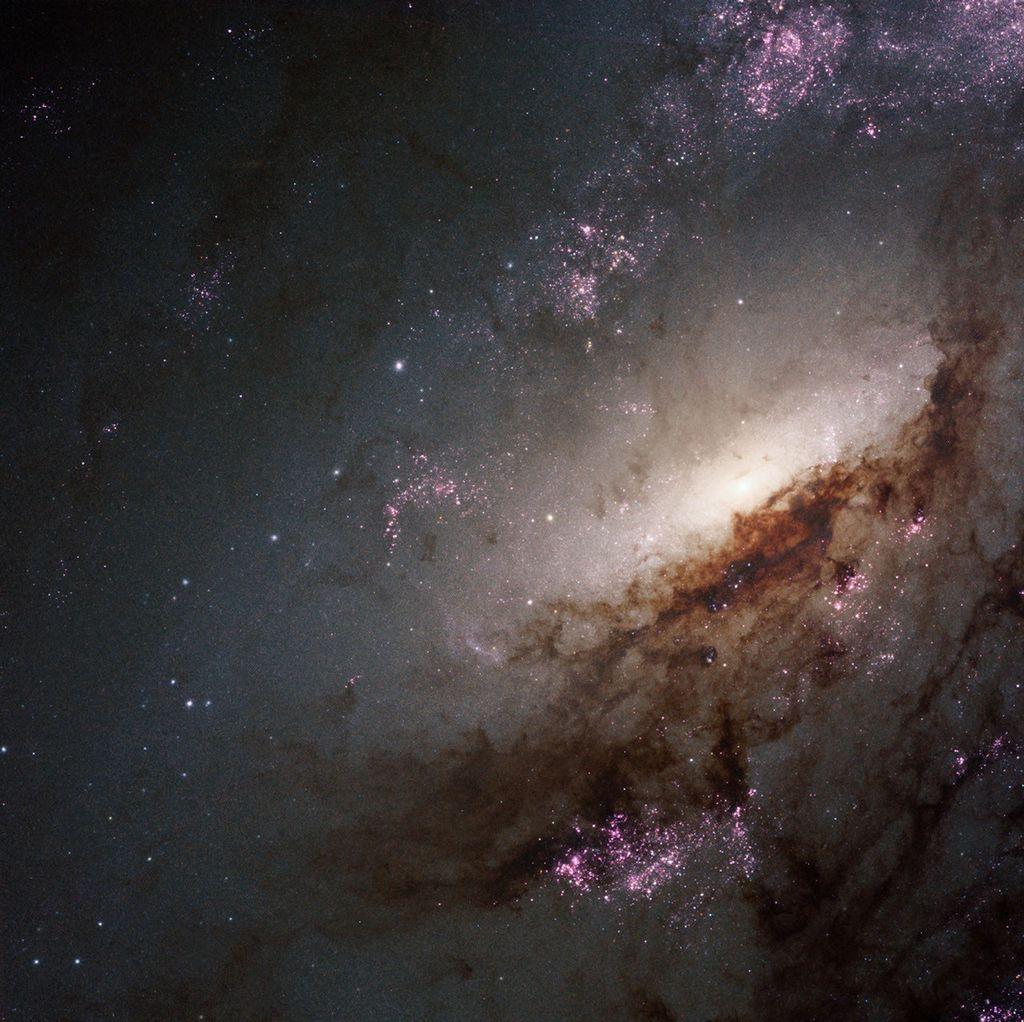



NGC 4258 Galaxy (Messier 106)
Names | PGC 39600 UGC 7353 Messier 106 (M106) NGC 4258 | ||||||||
|---|---|---|---|---|---|---|---|---|---|
Constellation | Canes Venatici | ||||||||
Galaxy Type | SAB(s)bc | ||||||||
Apparent Magnitude (V-Band) | +8.4 magnitude | ||||||||
Distance(s) | Approximately 23.5 million light-years | ||||||||
NGC 4258 is a spiral galaxy located relatively close to the Milky Way and possesses an active galactic nucleus. Also known as Messier 106, this celestial object has been the subject of observations particularly in the fields of radio astronomy and cosmology. Due to both its morphological characteristics and the presence of water masers, NGC 4258 is used as a fundamental reference in understanding galactic structure.

NGC 4258 (Messier 106). (NASA)
NGC 4258 was discovered by French astronomer Pierre Méchain in 1781 and was shortly thereafter included in the Messier Catalogue by Charles Messier. In the modern era, observations made with radio telescopes revealed the presence of a very strong radio source at the galaxy’s center. In the 1990s, observations by NASA’s Very Long Baseline Array (VLBA) determined that this source was, in fact, water masers associated with a supermassive black hole.
NGC 4258 is located approximately 23.5 million light-years away and can be observed in the constellation Canes Venatici. According to the Hubble classification, it is an SAB(s)bc type intermediate spiral galaxy. This classification indicates a lightly barred structure, prominent spiral arms, and a relatively dense central region.
The galaxy's diameter is estimated to be about 135,000 light-years. The total stellar mass of NGC 4258 is estimated to be approximately 1 × 10¹¹ solar masses. The galaxy is rich in both stars and interstellar gas and dust.
NGC 4258 is known for maser (microwave amplification) emissions from water vapor molecules located in its core. These water masers originate from a gas disk orbiting the supermassive black hole at the galaxy's center. Such high-resolution maser observations have allowed for the direct measurement of the black hole's mass.
Observations show that NGC 4258 hosts a supermassive black hole with a mass of approximately 3.9 × 10⁷ solar masses at its center. By using the Doppler shifts of the maser lines, this mass has been measured directly, providing one of the most definitive pieces of evidence for the existence of supermassive black holes.
The AGN at the center of the galaxy emits intense energy across different regions of the electromagnetic spectrum (radio, infrared, optical, X-ray). This energy production is largely related to matter falling into the black hole via an accretion disk.
The spiral arms of NGC 4258 exhibit some unusual features. Notably, the galaxy contains two "anomalous arms". These arms differ from regular star formation regions and are characterized by strong X-ray emission. It is believed that these arms are formed by plasma jets from the AGN interacting with the gas in the galactic disk.
NGC 4258 serves as a critical reference point in cosmological distance measurements. The orbital motions of the water masers enable a geometrically-based method to directly measure the distance to the galaxy. This method is considered a fundamental step in calibrating the cosmic distance ladder, playing a key role in determining the Hubble constant.
Studies on NGC 4258 have been conducted using various modern telescopes such as the Hubble Space Telescope (HST), Chandra X-ray Observatory, Spitzer Space Telescope, Very Large Array (VLA), and VLBA. These instruments have enabled detailed investigation of the galaxy’s multi-wavelength spectrum, revealing various physical processes.
The evolutionary history of NGC 4258 shows some distinctive features compared to other spiral galaxies. Characteristics such as star formation activity, the effects of the central AGN, and asymmetries in its spiral structure contribute to our understanding of how galaxies change structurally over time. Especially, the interaction of AGN-driven jets with the galactic environment provides important insights into the multi-component nature of galaxy evolution.
NGC 4258 holds a special place in astronomical research due to both its structural properties and its active galactic nucleus. Particularly through water maser observations, it has become a reliable tool in cosmic distance measurements and has formed the basis of numerous scientific studies on black hole physics, galactic dynamics, and galactic evolution. With future telescope missions, more detailed investigations of this galaxy are expected to continue making valuable contributions to modern astrophysics.
NASA. “Galactic Pyrotechnics from 23 Million Light-Years Away.” NASA Image Article. Accessed July 1, 2025. Access Address.
NASA. “NGC 4258 (Hubble Space Telescope).” NASA Science. Accessed July 1, 2025. Access Address.
NASA. “NGC 4258: Spiral Galaxy with a Strange Center.” Astronomy Picture of the Day (APOD), April 11, 2007. Accessed July 1, 2025. Access Address.
NASA/CXC/Univ. of Maryland/A. Wilson et al. “NGC 4258: More Images.” Chandra X-ray Observatory, April 23, 2014. Accessed July 1, 2025. Access Address.

NGC 4258 Galaxy (Messier 106)
Names | PGC 39600 UGC 7353 Messier 106 (M106) NGC 4258 | ||||||||
|---|---|---|---|---|---|---|---|---|---|
Constellation | Canes Venatici | ||||||||
Galaxy Type | SAB(s)bc | ||||||||
Apparent Magnitude (V-Band) | +8.4 magnitude | ||||||||
Distance(s) | Approximately 23.5 million light-years | ||||||||
No Discussion Added Yet
Start discussion for "NGC 4258 Galaxy (Messier 106)" article
Discovery and History
Physical Characteristics
General Structure
Size and Mass
Active Galactic Nucleus (AGN)
Water Maser Emissions
Supermassive Black Hole
Energy Production
Spiral Arms and Anomalous Features
Use in Distance Measurement
Observational Instruments and Spectrum
Evolutionary Processes
This article was created with the support of artificial intelligence.