

+2 More

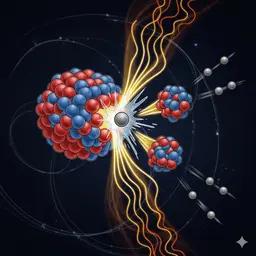
Nuclear Fission (Generated with AI)
Fission Fuel | Uranium-235 (U-235) Plutonium-239 (Pu-239) | ||||||||
|---|---|---|---|---|---|---|---|---|---|
Technological Applications | Peaceful application: Nuclear power plants (controlled fission for heat and electricity) Military application: Atomic (fission) bombs (uncontrolled, explosive fission) | ||||||||
Waste Status | Fission produces long-lived radioactive waste that requires secure handling and long-term management. | ||||||||
Nuclear fission is the process in which a heavy atomic nucleus splits into smaller and more stable nuclei. Typically, the nuclei of heavy elements such as uranium-235 or plutonium-239 become unstable when struck by a neutron and divide into two or more fragments. During this division, free neutrons are also released, which can interact with surrounding nuclei to initiate chain reactions. The energy released in this process arises from the difference in nuclear binding energy and appears primarily as heat and radiation.
The scientific discovery of nuclear fission was made in 1938 by German chemists Otto Hahn and Fritz Strassmann. While bombarding uranium with neutrons, they unexpectedly observed the formation of lighter elements. This finding generated significant debate within the scientific community and required a theoretical explanation.
In early 1939, Austrian physicist Lise Meitner and her nephew Otto Robert Frisch provided a theoretical interpretation, demonstrating that the uranium nucleus had split into two smaller nuclei, releasing a large amount of energy. Their explanation also led to the adoption of the term “fission” to describe the process.
The understanding of nuclear fission soon gained major importance not only in basic science but also in military and energy applications. During World War II, the Manhattan Project—led by the United States—resulted in the first use of nuclear fission for military purposes. The atomic bombings of Hiroshima and Nagasaki in 1945 revealed the destructive potential of fission energy.
After the war, attention shifted toward peaceful applications. From the 1950s onward, efforts to utilize nuclear energy for electricity generation accelerated. In 1954, the Obninsk Nuclear Power Plant in the Soviet Union became the first commercial nuclear power station to generate electricity, followed soon by projects in the United States, the United Kingdom, and France.
These developments established nuclear fission as a permanent component of modern energy systems. Today, it remains both the physical basis of nuclear power generation and the fundamental process underlying nuclear weapons.
Nuclear fission is the underlying physical mechanism used in commercial nuclear power plants. In reactors, fissile isotopes such as uranium-235 or plutonium-239 undergo controlled chain reactions, releasing large amounts of thermal energy. This heat is used to produce steam, which drives turbines to generate electricity.
The importance of fission in electricity production lies in its high energy density and operational continuity. Compared with fossil fuels, a very small quantity of nuclear fuel can produce a large amount of energy, making it a key component of many countries’ energy security strategies. Nations such as France, South Korea, and Sweden rely heavily on nuclear power in their national energy policies. In the 21st century, the dual challenges of rising global energy demand and climate change have renewed interest in fission-based energy production.
In terms of carbon emissions, nuclear fission offers a significant advantage over fossil fuels: its electricity generation process produces almost no greenhouse gases. This makes nuclear energy a low-carbon source, contributing to global climate change mitigation. However, the environmental impacts of fission extend beyond emissions. The formation of high-level radioactive waste creates long-term environmental and societal challenges, as such materials must be securely stored for thousands of years. Radioactive waste management remains one of the most complex and debated issues in nuclear energy policy.
Historical nuclear accidents have also demonstrated the potential risks associated with fission-based systems. The Chernobyl disaster (1986) caused widespread environmental and health effects, while the Fukushima Daiichi accident (2011) highlighted the vulnerability of nuclear facilities to natural disasters. These events have had lasting effects on public perception and have prompted many countries to reassess their nuclear energy policies.
Etymologically, fission means “splitting” or “division.” In nuclear physics, it refers to the process by which an unstable, heavy atomic nucleus—such as uranium or plutonium—absorbs a neutron, becomes more unstable, and then divides into two or more lighter nuclei. The phenomenon was first observed experimentally in 1938 by Otto Hahn and Fritz Strassmann and was later explained theoretically by Lise Meitner and Otto Frisch. Following these discoveries, research intensified, and in 1942, Enrico Fermi’s team at the University of Chicago achieved the first controlled nuclear chain reaction, leading to the development of the first nuclear reactor.
Fission is typically triggered when an unstable isotope (e.g., uranium-235) is bombarded with a neutron. The nucleus captures the neutron, forming a more unstable intermediate (uranium-236), which rapidly splits. This division produces lighter nuclei (fission products such as barium and krypton), two to three free neutrons, and a large amount of energy—about 200 MeV per fission event. This energy is millions of times greater than that produced by burning the same mass of coal. The released energy originates from the difference in nuclear binding energy.
The free neutrons emitted during fission can induce further fission events, creating a self-sustaining chain reaction.
To maintain balance and safety in reactors, several engineering mechanisms are employed:
The most widespread application of fission technology is in nuclear power generation. Various reactor types have been developed, including:
Beyond energy production, fission has crucial roles in defense, medicine, and scientific research:
The main drawback of nuclear fission is the production of highly radioactive waste. Isotopes such as cesium-137 and strontium-90 have half-lives ranging from decades to thousands of years. These materials require specialized handling and long-term geological storage to prevent harm to human health and the environment. Nuclear waste management remains a central technical and social challenge for the future of nuclear energy.
Fission, as the splitting of a heavy and unstable atomic nucleus (e.g., uranium-235 or plutonium-239) after absorbing a neutron, remains the core process of electricity generation in today’s nuclear power plants because the required conditions are relatively achievable. However, it produces long-lived radioactive waste, necessitating secure storage and monitoring. Moreover, uncontrolled fission reactions, as seen in atomic weapons, can lead to catastrophic outcomes, underscoring both the power and peril inherent in nuclear fission.
APS News. “December 1938: Discovery of Nuclear Fission.” December 2007. Accessed 27 November 2025. https://www.aps.org/apsnews/2007/12/december-1938-discovery-nuclear-fission
International Atomic Energy Agency (IAEA). “Frequently Asked Questions on Fusion Energy.” Accessed 27 November 2025. https://www.iaea.org/topics/energy/fusion/faqs
International Atomic Energy Agency (IAEA). “Pioneering Nuclear Science: Discovery of Nuclear Fission.” Accessed 27 November 2025. https://www.iaea.org/newscenter/news/pioneering-nuclear-science-discovery-nuclear-fission
Reports on Progress in Physics. Schunck, Nicolas, and L. M. Robledo. “Microscopic Theory of Nuclear Fission: A Review.” 79, no. 11 (October 2016): 116301. https://doi.org/10.1088/0034-4885/79/11/116301
. Accessed 27 November 2025.
Princeton University Andlinger Center for Energy and the Environment (ACEE). “Understanding Nuclear Fusion.” PDF, 2016. Accessed 27 November 2025. https://acee.princeton.edu/wp-content/uploads/2016/05/ACEE-Fusion-Distillate-Article-5.pdf


Nuclear Fission (Generated with AI)
Fission Fuel | Uranium-235 (U-235) Plutonium-239 (Pu-239) | ||||||||
|---|---|---|---|---|---|---|---|---|---|
Technological Applications | Peaceful application: Nuclear power plants (controlled fission for heat and electricity) Military application: Atomic (fission) bombs (uncontrolled, explosive fission) | ||||||||
Waste Status | Fission produces long-lived radioactive waste that requires secure handling and long-term management. | ||||||||
Historical Development
Role in Energy Production
Environmental Impact
Fission (Nuclear Division)
The Fission Process
Chain Reactions and Control Mechanisms
Applications of Fission
Fission Waste and Environmental Challenges
This article was created with the support of artificial intelligence.