

+2 More

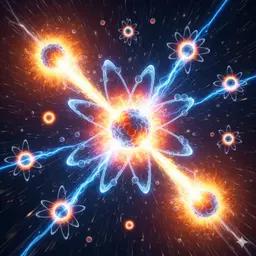
Nuclear Reactions (Generated by Artificial Intelligence)
Main Type(s) | Fission Radioactive Decay Fusion | ||||||||
|---|---|---|---|---|---|---|---|---|---|
Fission | The splitting of a heavy nucleus into smaller nuclei | ||||||||
Fusion | The combination of light nuclei to form a heavier nucleus | ||||||||
Fundamental Forces | Strong Nuclear Force, Weak Nuclear Force | ||||||||
Applications | Nuclear Energy Production, Nuclear Weapons Medicine (Isotopes), Radiocarbon Dating | ||||||||
Natural Examples | The Sun and Stars (Fusion), Earth’s Core (Decay), Living Organisms (Decay) | ||||||||
A nuclear reaction is a process in which an atomic nucleus - or more than one nucleus - interacts with another particle, producing new nuclei or particles different from the initial ones. This process involves a structural transformation of atomic nuclei and, in this respect, fundamentally differs from chemical reactions. In chemical reactions, the rearrangement of electrons around atoms is at issue, whereas in nuclear reactions the protons and neutrons located at the center of the atom are directly affected.
During such reactions, the amount of energy released can be millions of times greater than that obtained in chemical reactions. The reason is the involvement of the strong nuclear forces within the nucleus. Nuclear reactions are generally divided into three main categories: fission, fusion, and radioactive decay. In fission, heavy nuclei split into smaller nuclei; in fusion, light nuclei combine to form a heavier nucleus. Radioactive decay occurs when unstable nuclei transform into more stable states.
The outcomes of these reactions can be observed in various domains. In natural processes, the energy production of stars is based on fusion reactions. On Earth, electricity generation in nuclear power plants is generally achieved through fission. Nuclear reactions also play a fundamental role in the operation of nuclear weapons, in the production of radioactive isotopes used in medicine, in radiotherapy methods for cancer treatment, and in scientific research. Consequently, nuclear reactions are of great importance both for understanding the functioning of the natural universe and for developing technological applications.
Understanding nuclear reactions is one of the most significant milestones of twentieth-century science. The equation E=mc², developed by Albert Einstein in 1905 within the framework of special relativity, showed that mass can be converted into energy and laid the theoretical foundation of nuclear energy. This idea revealed that very large amounts of energy can be released even with the loss of a very small amount of mass.
In 1938, Otto Hahn and Fritz Strassmann experimentally discovered nuclear fission by observing that uranium, when bombarded with neutrons, split into smaller nuclei. Lise Meitner and Otto Frisch provided the theoretical explanation of this phenomenon, thereby inaugurating the modern era of nuclear physics. In 1942, Enrico Fermi and his team carried out the first controlled chain nuclear reaction in human history in the experimental reactor known as Chicago Pile-1 at the University of Chicago. This achievement is regarded as the beginning of the nuclear age.
Today, research on nuclear reactions is not limited to energy production; it also focuses on understanding the nature of the strong nuclear force that holds the atomic nucleus together and on explaining the behavior of fundamental particles. Experiments conducted at Argonne National Laboratory in the United States have observed that the nickel-64 (Ni-64) nucleus, under high-energy excitation, loses its spherical shape and transforms into oblate or prolate forms. Such studies contribute to the development of models that explain nuclear structure and play a fundamental role in understanding astrophysical processes.
Particle accelerators are among the principal tools in nuclear-reaction research. By accelerating protons, electrons, or heavy ions to very high speeds and colliding them with target nuclei, one can probe the internal structure of the nucleus, observe rare reactions, and discover new particles. The Large Hadron Collider (LHC) at the European Organization for Nuclear Research (CERN) provides important data not only for particle physics but also for nuclear physics. Similarly, the Facility for Antiproton and Ion Research (FAIR) in Germany is a globally significant center for heavy-ion physics and the study of nuclear matter.
Understanding nuclear reactions is critically important for explaining astrophysical phenomena such as the life cycles of stars, supernova explosions, and the origin of the elements in the universe. In particular, the rapid neutron-capture process (r-process) occurring in supernovae explains the formation mechanism of heavy elements in the cosmos. Nuclear-physics research therefore directly intersects with cosmology and astrophysics.
With respect to energy production, the most intensively studied topic today is controlled fusion. Hot-fusion research aims to replicate the processes in the Sun by enabling the fusion of hydrogen isotopes at temperatures of millions of degrees. The main methods used in this area are magnetic confinement (tokamak and stellarator systems) and inertial confinement (compressing a target with powerful lasers).
Cold fusion, on the other hand, is based on the claim that fusion can occur under conditions close to room temperature. The experiments announced in 1989 by Martin Fleischmann and Stanley Pons caused a great stir in the scientific community, but the results could not be reproduced and therefore did not gain general acceptance. Nevertheless, fusion research remains among the most intensively pursued scientific endeavors today.
These institutions develop not only the theoretical dimension of nuclear science but also its practical applications in fields such as energy, medicine, materials science, and space research.
All matter in the universe is composed of atoms, the smallest units that can retain the chemical properties of an element. The atom consists essentially of a positively charged nucleus at the center and negatively charged electrons moving in specific energy levels around this nucleus. Nearly all of the atom’s mass is concentrated in the nucleus. The nucleus is made up of two types of fundamental particles called nucleons: positively charged protons and electrically neutral neutrons. While protons and neutrons together form the atomic nucleus, electrons occupy different energy levels around the nucleus. These three particles -proton, neutron, and electron - are the fundamental building blocks of all known matter in the universe.
The number of protons, i.e., the atomic number, determines an element’s identity and its position in the periodic table. Differences in the number of neutrons give rise to different isotopes of the same element. Under normal conditions, the number of electrons equals the number of protons, keeping the atom electrically neutral. However, increases or decreases in the number of electrons lead to the formation of ions.
Chemical reactions occur through the sharing, transfer, or rearrangement of the electrons around atoms. In these processes, the structure of the atomic nucleus remains unchanged, and transformations occur only in the bonds between atoms. The formation of molecules and the making or breaking of ionic and covalent bonds are examples of such reactions.
Nuclear reactions, by contrast, take place in the atomic nucleus and cause changes in the internal structure of the nucleus. In such reactions, the numbers of protons or neutrons may change; consequently, the atom can transform into the nucleus of a different element. Because strong nuclear forces are involved at the nuclear level, this transformation releases much larger amounts of energy than chemical reactions.
For example, a change in the number of protons in the nucleus as a result of a nuclear reaction means that the atom’s identity transforms into a completely different element. This fundamental difference explains why nuclear reactions are used in large-scale energy conversions in nature and technology. Nuclear reactions are observed across a wide range, from energy production in stars to human-made nuclear power plants, and from radioisotopes used in medicine to defense technologies.
Nuclear reactions are classified according to the nature of the changes occurring in the atomic nucleus. These reactions include processes such as the splitting, combining, or spontaneous transformation of the nucleus. The best-known types are fission (nuclear splitting), fusion (nuclear combining), and radioactive decay. These three basic categories are observed both in nature and in human-engineered applications.
Fission is a type of nuclear reaction initiated when the nucleus of a heavy element is excited by an incoming neutron. Isotopes suitable for fission, such as uranium-235 (U-235) or plutonium-239 (Pu-239), become unstable when they absorb a neutron and soon split into two or more smaller nuclei. In this splitting, fission products consisting of fragments emerge, and a large amount of energy is released. In addition, several free neutrons are emitted. Most fission products are radioactive and consist of isotopes with various half-lives.
Fission plays an important role today both in energy production and in the fundamental mechanisms of nuclear weapons used for military purposes. In nuclear power plants, controlled fission reactions provide stable electricity generation. By contrast, uncontrolled fission chains underlie the operation of atomic bombs.
The free neutrons released during a fission reaction can interact with other fissile nuclei present in the environment and initiate new fission reactions. This phenomenon is called a chain reaction. Because more than one neutron is emitted in each split, the number of reactions can increase exponentially. If this process continues without any control mechanism, an enormous amount of energy is released in a very short time. This is the basis of atomic bombs.
Conversely, nuclear power plants use control rods and coolant systems to regulate the rate of the chain reaction. Parameters such as critical mass and the neutron multiplication factor are decisive for the reaction’s ability to sustain itself. By ensuring that the reaction proceeds neither too fast nor too slow, energy production is kept in balance.
Fusion is a type of nuclear reaction in which two light atomic nuclei combine to form a heavier nucleus. In terms of the energy released per unit mass, this process is much more efficient than fission. Fusion is the energy source of the Sun and other stars. In the cores of stars, temperatures reach millions of degrees and pressures are extremely high; under these conditions, hydrogen nuclei overcome the electrostatic repulsion known as the Coulomb barrier and fuse to form helium nuclei.
Achieving controlled fusion reactions on Earth involves major technical challenges. The difficulty lies in creating the temperature and pressure conditions necessary for nuclei to combine. Research generally focuses on two methods: magnetic confinement systems such as tokamaks and stellarators, which aim to confine plasma using magnetic fields, and inertial confinement methods, in which target material is compressed by powerful laser pulses. If fusion can be used for energy production, it is projected to provide a nearly inexhaustible and clean energy source.
Radioactive decay occurs when unstable nuclei transform into more stable states without any external influence. In this process, the nucleus may emit particles (e.g., alpha particles, beta particles) or electromagnetic energy (e.g., gamma rays). Instability generally arises from an imbalance between protons and neutrons in the nucleus or from the nucleus being very large.
Radioactive decay is the most common type of nuclear reaction that occurs spontaneously in nature. It is the source of natural radiation on Earth and of the low-level radiation measured in living organisms. This process also plays an important role in scientific applications such as radiocarbon dating used in archaeology and geology, and in medical imaging technologies.
Nuclear reactions are fundamental physical processes that occur spontaneously in nature as well as in laboratories or power plants. These reactions provide beneficial sources of energy and technology for humanity, yet pose great dangers when used in an uncontrolled manner.
One of the most important fields of modern energy production is nuclear power plants, where nuclear fission is used in a controlled manner. In these facilities, fissile isotopes such as uranium-235 or plutonium-239 are used as fuel. The heat released by fission reactions in the reactor core heats water to high temperatures. The pressurized water reactor (PWR) is one of the most common designs. In this system, water kept under pressure is heated without boiling, and this heat is transferred to a secondary water circuit. The water in the secondary circuit turns into steam, the steam drives turbines, and the turbines, connected to generators, produce electricity.
Designs that operate on similar principles, such as boiling water reactors (BWRs) and gas-cooled reactors, have also been developed. The most important advantages of these plants are preventing carbon emissions from the combustion of fossil fuels and enabling long-term, large-scale energy production. However, the safe storage of radioactive waste and potential accident risks constitute the controversial aspects of nuclear energy.
The destructive potential of nuclear reactions underlies nuclear weapons. Atomic bombs operate by inducing uncontrolled chain fission reactions in fissile heavy nuclei. In such weapons, an enormous amount of energy is released in a very short time. Hydrogen bombs (thermonuclear bombs) are even more powerful; in these, a fission explosion first creates extremely high temperature and pressure, under which the fusion of deuterium and tritium nuclei is triggered. The energy released is many times greater than that of pure fission weapons.
Historically, nuclear weapons were used in World War II in Hiroshima and Nagasaki, causing the deaths of hundreds of thousands of people and creating enduring global awareness of the danger of nuclear arms. Today, the existence of these weapons remains at the center of international security policies.
Stars and the Sun: The most common nuclear reactions in the universe are the fusion processes occurring in the cores of stars. In the Sun’s core, millions of tons of hydrogen transform into helium every second, and this process is the source of the heat and light energy that reaches Earth. Stellar evolution, supernova explosions, and the formation of heavy elements are among the natural consequences of fusion.
Earth’s Interior: Although Earth is not a star, part of the planet’s internal heat is known to originate from the radioactive decay occurring in the nuclei of elements such as uranium, thorium, and potassium. These processes cause Earth’s interior to cool more slowly than expected and, together with the geodynamo mechanism, play an indirect role in the formation of the planet’s magnetic field.
Living Organisms: All living organisms, including humans, are exposed to naturally occurring radioactive isotopes in the environment. Isotopes such as carbon-14 and potassium-40 enter organisms through the food chain and respiration. The transformation of carbon-14 into stable nitrogen over time forms the basis of radiocarbon dating used in archaeology and geology. With this method, the ages of fossils, bones, and organic remains can be calculated.
Natural Nuclear Reactor: The most important example showing that nuclear reactions can occur spontaneously in nature, not only in laboratory settings or man-made plants, is the Oklo natural reactor in Gabon. Approximately 2 billion years ago, chain fission reactions began in regions rich in uranium ore through the moderating effect of groundwater and continued in a controlled manner for thousands of years. This example demonstrates that nature can create reactor-like systems under certain conditions.
Adelberger, E. G., A. García, R. G. Hamish Robertson, K. A. Snover, A. B. Balantekin, K. Heeger, M. J. Ramsey-Musolf, et al. “Solar Fusion Cross Sections. II. The pp Chain and CNO Cycles.” Reviews of Modern Physics 83, no. 1 (April 2011): 195–245. Accessed November 27, 2025. https://doi.org/10.1103/revmodphys.83.195.
Balasubramanian, Viswanathan. “Nuclear Fusion.” In Energy Sources, 127–137. Amsterdam: Elsevier, 2017. Accessed November 27, 2025. https://doi.org/10.1016/B978-0-444-56353-8.00006-X.
Max Planck Institute for Chemistry. “Die Entdeckung der Kernspaltung.” Accessed November 27, 2025. https://www.mpic.de/4469988/die-entdeckung-der-kernspaltung.
University of Chicago. “First Nuclear Reactor Explained.” Accessed November 27, 2025. https://news.uchicago.edu/explainer/first-nuclear-reactor-explained.
U.S. Department of Energy, Office of Nuclear Energy, Science and Technology. The History of Nuclear Energy. Washington, D.C., 1994. Accessed November 27, 2025. https://www.energy.gov/ne/articles/history-nuclear-energy.
U.S. Department of Energy, Office of Nuclear Energy, Science and Technology. “The Discovery of Fission.” Washington, D.C. Accessed November 27, 2025. https://www.osti.gov/opennet/manhattan-project-history/Events/1890s-1939/discovery_fission.htm.
World Nuclear Association. “The Outline History of Nuclear Energy.” Accessed November 27, 2025. https://world-nuclear.org/information-library/current-and-future-generation/outline-history-of-nuclear-energy.
Zoia, A., A. Gagnepain, and D. Mancusi. “The Chicago Piles Unearthed.” Scientific Reports 15, no. 1 (July 23, 2025): 26850. Accessed November 27, 2025. https://doi.org/10.1038/s41598-025-10901-6.

Nuclear Reactions (Generated by Artificial Intelligence)
Main Type(s) | Fission Radioactive Decay Fusion | ||||||||
|---|---|---|---|---|---|---|---|---|---|
Fission | The splitting of a heavy nucleus into smaller nuclei | ||||||||
Fusion | The combination of light nuclei to form a heavier nucleus | ||||||||
Fundamental Forces | Strong Nuclear Force, Weak Nuclear Force | ||||||||
Applications | Nuclear Energy Production, Nuclear Weapons Medicine (Isotopes), Radiocarbon Dating | ||||||||
Natural Examples | The Sun and Stars (Fusion), Earth’s Core (Decay), Living Organisms (Decay) | ||||||||
Historical Development and Investigation of Nuclear Reactions
Modern Research and Key Findings
The Role of Particle Accelerators
The Relationship Between Nuclear Physics and Astrophysics
Fusion Research: Cold and Hot Fusion
International Nuclear Research Centers and Collaborations
Structure of the Atom and Fundamental Concepts
Types of Nuclear Reactions
Fission (Nuclear Splitting)
Chain Reaction
Fusion (Nuclear Combining)
Radioactive Decay
Applications and Occurrence of Nuclear Reactions
Nuclear Power Plants
Nuclear Weapons
Natural Nuclear Reactions
This article was created with the support of artificial intelligence.