

Pazar (District - Tokat)
Province(s) | Tokat | ||||||||
|---|---|---|---|---|---|---|---|---|---|
Area(s) | Black Sea | ||||||||
Altitude | 623 meters | ||||||||
Population (2024) | 12,992 | ||||||||
Mayor(s) | Şerafettin Pervanlar | ||||||||
District Governor | Ramazan Teke | ||||||||
Postal Code | 60800 | ||||||||
Climate(s) | Black Sea and continental climate transition | ||||||||
Economy | Agriculture and animal husbandry | ||||||||
Pazar is a district located west of Tokat province, on the Kazova Plain. Agriculture and livestock farming are prominent activities in the district. Historical structures and natural areas reflect the district's cultural and geographical makeup.
The district of Pazar has been located near one of Anatolia's major transportation routes (the ancient Royal Road and the Silk Road) since ancient times. Known as "Kazova" in ancient times, this region is referred to as Dazimonitis in Greco-Roman sources, while the district center was known as Cellarion. Pazar came under Danishmend rule in the 11th century; in later periods, it fell under the control of the Seljuks and various Anatolian principalities, and in 1392, it was incorporated into the Ottoman Empire. Mehmed the Conqueror passed through this route on his way to the Battle of Otlukbeli with Uzun Hasan, while Yavuz Sultan Selim passed through this route on his way to the battle with Shah Ismail.
A magnificent plane tree, dating from 1884, still stands in the town center. Just outside the center stands a significant structure from the Seljuk period: the Seljuk caravanserai, commissioned by Mahperi Hatun, wife of Alaeddin Keykubad I, in 1238. Built in the tradition of the "Sultan Hans," the Seljuk caravanserai is now in ruins, but its original layout has largely been preserved. The historic stone bridge over the Yeşilırmak River at the town's exit, formerly known as the Tavukçu Bridge, also dates to the same period. These structures are examples of Pazar's pre-Ottoman architectural heritage.
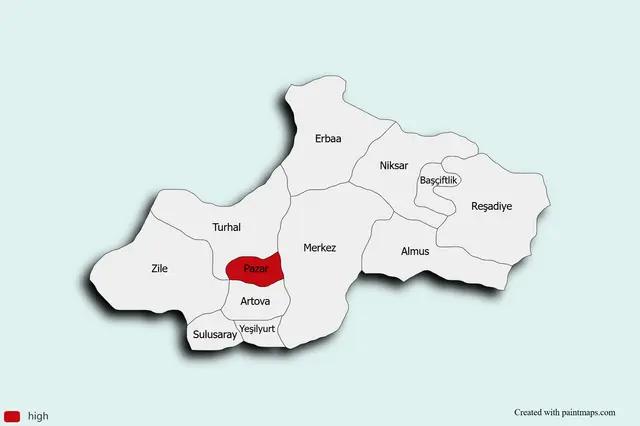
The district of Pazar is located on the Kazova Plain, approximately 25 km west of Tokat city center. The district has an area of 276 km² and an average elevation of 623 meters. It is bordered by Tokat city center to the east, Turhal to the northwest, Zile to the west, and Artova to the south. The district is bordered by east-west mountain ranges to the south and by the Yeşilırmak River, which irrigates the Kazova Plain, to the north. This location places Pazar in a transitional zone between the Black Sea climate and the continental climate of Central Anatolia; the district's terrain generally blends the characteristics of a continental climate with a temperate, rainy climate. The Yeşilırmak River and its tributaries irrigate the region's soil, supporting its agricultural potential. The district has two towns and 15 villages.
The population of Pazar district was 15,361 in 2007 and decreased to 12,992 in 2024. During this period, increases of 478, 765, and 576 people were recorded in 2011–2012, 2017–2018, and 2022–2023, respectively, while decreases were recorded at different levels in the other years. According to 2024 data, the male population was 6,514 (50.14%) and the female population was 6,478 (49.86%), with the gender gap generally remaining at a few dozen people. Annual population changes have fluctuated due to local registry updates, migration movements, and other demographic dynamics.
The Pazar district's economy is largely based on agriculture and animal husbandry. The Kazova Plain's fertile soil and irrigation infrastructure allow for the cultivation of sugar beets, wheat, sunflowers, potatoes, legumes, and fruits and vegetables; livestock farming (especially small ruminants) is a common source of income for the local population. It has also been noted that the district possesses suitable agricultural lands for organic and good agricultural practices. This agricultural production provides raw materials for the local food and sugar factories and is the main source of villagers' income. While the district has limited industrial infrastructure, the most important non-agricultural activities are trade and services.
Tourism activities in Pazar are carried out by opening natural structures and historical monuments to visitors. Ballıca Cave, 7 km from the town center, has a geological history of 3–4 million years and comprises approximately 680 m of navigable space; onion stalactite formations and dwarf bat colonies have been recorded within the cave. Opened to visitors in 1996, the cave and its surrounding 483 hectares are protected as a Nature Park under Law No. 2873. Building examples such as the Mahperi Hatun Caravanserai, dating from 1238, and the Tavukçu Bridge (Taşköprü), reflecting Seljuk-era architecture, are located on the Silk Road route. Kaz Lake, 11 km from the town, serves as a breeding and stopover site for migratory birds between late March and early July, covering 274 hectares of water within a 1,170 hectare wildlife development area. The recreation areas around Munamak Waterfall, traditional village rooms and nomadic tent displays also complete the tourism diversity.

Ballıca Cave (Tokat Provincial Directorate of Culture and Tourism)
Cultural practices in Pazar are based on folk dances, handicrafts, and oral tradition. Dances such as the Omuz Halayi, Maşat Halayi, and Semah are carried on by local communities, while carpet and rug weaving, coppersmithing, and kerchief making are also conducted through workshops. Narratives about migratory birds and Tokat folk songs constitute the oral culture material in the region.
Culinary practices reflect the ingredients and cooking methods unique to the Tokat region. Lamb Tokat Kebab, Bat soup made with lentils and wedding rice, and Keşkek and knotgrass are staple dishes; stuffed broad beans and meat, walnut buns, and local sherbets offer additional options. Wine made from the mahlep grape is also a popular regional beverage.
Paintmaps. “Turkey Provinces Map – Highlighting Pazar , Tokat .” Access date: April 15, 2025. https://paintmaps.com .
Pazar District Governorship. “Mahperi Hatun Caravanserai.” Pazar District Governorship. Access date: May 5, 2025. http://www.tokatpazar.gov.tr/mahperi-hatun-kervansarayi
Republic of Turkey Ministry of Culture and Tourism Tokat Provincial Directorate of Culture and Tourism. “Pazar.” Tokat Provincial Directorate of Culture and Tourism. Access date: May 5, 2025. https://tokat.ktb.gov.tr/TR-141050/pazar.html
Republic of Turkey Ministry of National Education, Pazar District National Education Directorate. “About Our District.” Pazar District National Education Directorate. Access date: May 5, 2025. https://pazar60.meb.gov.tr/www/ilcemiz-hakkinda/icerik/716
Republic of Turkey Pazar District Governorship. “Our District: Pazar.” Pazar District Governorship. Access date: May 5, 2025. http://www.tokatpazar.gov.tr/ilcemiz-pazar
Republic of Turkey Tokat Governorship. “Pazar.” Tokat Governorship. Access date: May 5, 2025. http://www.tokat.gov.tr/pazar
TC Pazar Municipality. “Ballıca Cave.” Pazar Municipality. Access date: May 5, 2025. https://www.tokatpazar.bel.tr/ballica-magarasi/
TC Pazar Municipality. “About Pazar District.” Pazar Municipality. Access date: May 5, 2025. https://www.tokatpazar.bel.tr/pazar-ilcesi-hakkinda/
Turkish Statistical Institute (TurkStat). Address Based Population Registration System Results, 2024. Access date: April 20, 2025. https://data.tuik.gov.tr/Bulten/Index?p=Adrese-Dayali-Nufus-Kayit-Sistemi-Sonuclari-2024-53783

Pazar (District - Tokat)
Province(s) | Tokat | ||||||||
|---|---|---|---|---|---|---|---|---|---|
Area(s) | Black Sea | ||||||||
Altitude | 623 meters | ||||||||
Population (2024) | 12,992 | ||||||||
Mayor(s) | Şerafettin Pervanlar | ||||||||
District Governor | Ramazan Teke | ||||||||
Postal Code | 60800 | ||||||||
Climate(s) | Black Sea and continental climate transition | ||||||||
Economy | Agriculture and animal husbandry | ||||||||
No Discussion Added Yet
Start discussion for "Pazar (District - Tokat)" article
History
Geography and Climate
Population and Demography
Economy
Tourism–Culture–Cuisine
This article was created with the support of artificial intelligence.