

+1 More


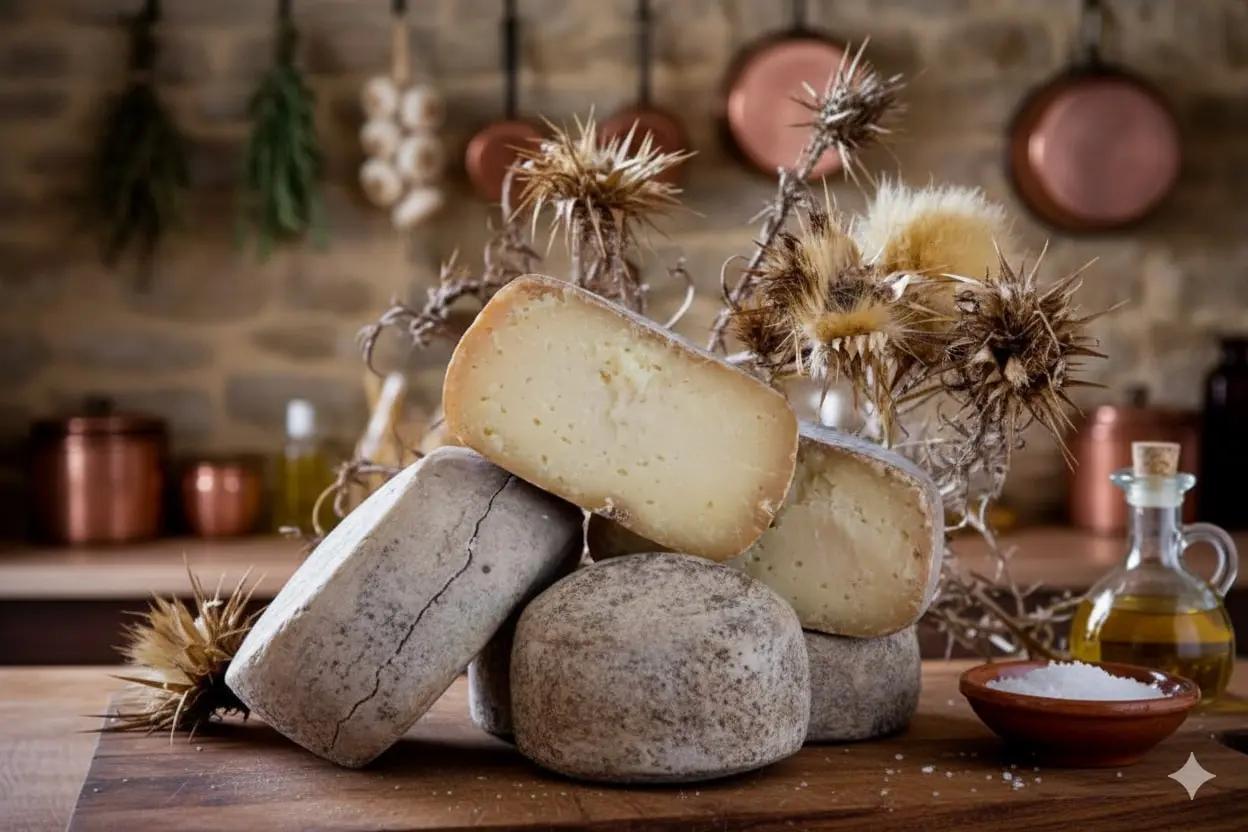
Pecorino delle Balze Volterrane (Generated by Artificial Intelligence.)
Pecorino delle Balze Volterrane is a cheese produced using traditional methods in the land of Volterra and its surrounding communes in the province of Pisa, in the Tuscany region of Italy, and registered with the status of Protected Designation of Origin (Denominazione di Origine Protetta - DOP) by the European Union.
The cheese production area encompasses a limited, geographically defined area for sheep farming, milk processing, and cheese ripening. This area comprises the communes of Volterra, Pomarance, Montecatini Val di Cecina, Castelnuovo Val di Cecina, and Monteverdi, all located in the province of Pisa. Despite its inland location, the area exhibits subtropical climate characteristics thanks to its proximity to the sea, receiving abundant rainfall in autumn and spring. The region's geological structure, resulting from intense erosion, features morphologies such as "biancane" (small, mammoth hills), "calanchi" (steep, contiguous small valleys), and "balze" (giant crevices). These environmental conditions, combined with the surface's mobility, low organic matter content, and periods of drought, support the development of sparse, salinity-tolerant pastures and vegetation such as wild thistle, which are particularly important for cheesemaking. Shepherding and agricultural activities in the region have been integral to this natural environment for centuries.
The main ingredient in Pecorino delle Balze Volterrane is raw, whole sheep's milk from Sarda sheep, sourced exclusively from farms in this region. The animals are raised in a semi-free range (semi-brado) system. At least two-thirds of the sheep's nutritional needs must be met by grazing in the geographic area of origin. Grains such as barley, oats, and broad beans, as well as preserved forages, can also be used in the diet, but feeding with genetically modified organisms (GMOs) is strictly prohibited. The ingredient used in cheese production is vegetable rennet obtained from the flowers of wild thistle or wild artichoke, which grow abundantly in the region. Fine salt is also used.
Milk to be turned into cheese must be processed within 48 hours of the first milking and must not undergo any heat treatment. The milk is heated to a temperature between 30 and 40 degrees Celsius, and herbal rennet is added. The coagulation time varies from 30 to 60 minutes. Once the curd reaches a solid consistency, it is cut with a tool called a "spino," creating hazelnut-sized particles for "fresco," "semistagionato," and "stagionato," and the size of a grain of rice for "da asserbo." After this stage, the curd can be kept in a warm environment at a temperature between 20 and 40 degrees Celsius for 60 to 180 minutes (the "cottura" process). The curd is then manually pressed into cylindrical molds and transferred to spreading tables (tavoli spersori) to remove the whey. Salting is done manually by sprinkling salt over the surface of the cheese, which is then turned. The cheeses are matured in cool rooms, typically on boards made of poplar or fir wood, at temperatures between 6 and 16 degrees Celsius . During ripening, the cheese molds are turned over at least once a week, brushed, and washed with water to remove any mold. For cheeses matured for more than thirty days, part of the ripening process may take place in tufa caves, clay pits, or cellars in the Volterra region, which maintain constant humidity levels that help preserve the cheese's unique characteristics. For "da asserbo" cheese, which has the longest ripening period, the surface may be treated with olive oil or a mixture of olive oil, salt, oak, or poplar ash.
Cheese is offered in four different types, depending on the ripening time:
The cheese's outer rind ranges from yellow-straw to dark yellow; it can be gray if treated with olive oil and ash. The cheese's interior (pasta) is compact and minimally brittle, with irregularly distributed light holes (occhiatura) visible. When cut, the color changes from white in the "fresco" variety to a more intense straw yellow in the "semistagoionato," "stagionato," and "da asserbo" varieties.
In terms of sensory properties, Pecorino delle Balze Volterrane has a persistent aroma, evoking the scent of milk and wild thistle, with aromatic herbs and floral notes. The initial taste is sweet, with hints of milk and floral notes and thistle, and a long and persistent herbal, fresh retrogusto. The slightly bitter (piccante) finish becomes more intense with prolonged ripening, accompanied by a slight saltiness and a slight astringency in the "stagionato" and "da asserbo" varieties. The sweetness, particularly in other cheeses, and the herbaceous and floral aromas preserved through low-temperature processing distinguish the product from other cheeses.
Pecorino delle Balze Volterrane holds a place in local gastronomy and is known for its delicate flavor. It is used in many dishes in Pisa's traditional cuisine. Its consumption varies depending on its degree of ripeness:

Pecorino delle Balze Volterrane (Generated by Artificial Intelligence.)
No Discussion Added Yet
Start discussion for "Pecorino delle Balze Volterrane" article
Production Area and Natural Environment
Raw Ingredients and Animal Nutrition
Production Method and Maturation
Product Types and Sensory Properties
Consumption and Gastronomy
This article was created with the support of artificial intelligence.