
+1 More


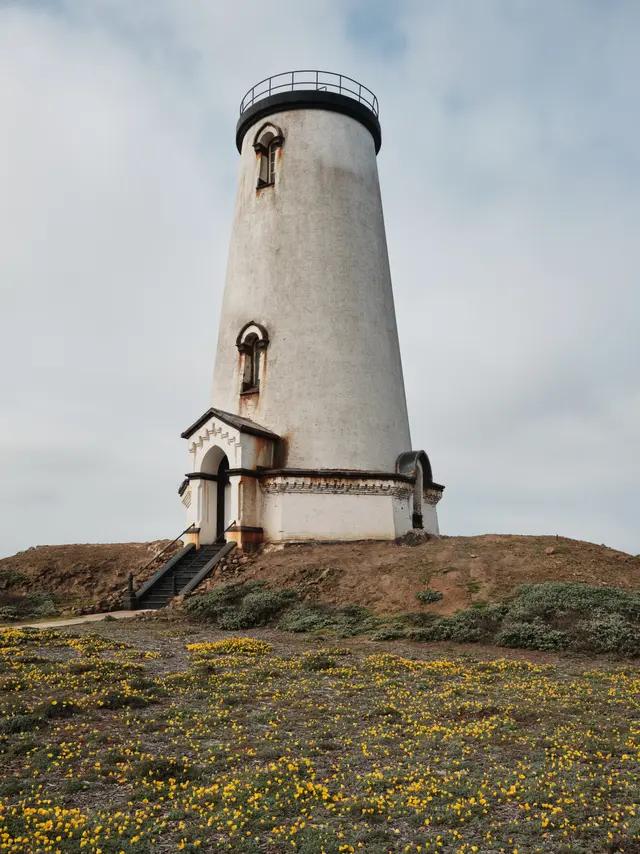
Piedras Blancas Lighthouse is a historic structure located near San Simeon, California, United States, built to assist sailors in safe navigation.
It takes its name from a nearby rock ("Piedra Blanca") that appears white due to the accumulation of bird droppings ("guano").
Construction of the Piedras Blancas Light Station began in April 1874, coinciding with a period of increasing maritime trade in the region. Construction of this structure, crucial for maritime safety, progressed, and the lighthouse became operational, illuminated for the first time on February 15, 1875, just ten months after its inception.
When it first entered service, the lighthouse tower was initially approximately 30 meters (100 feet) tall. It housed a First Order Fresnel lens, one of the most advanced systems in lighthouse technology at the time. This lens produced a steady, pulsating light that emitted a white flash every 15 seconds to guide ships.
To help sailors distinguish between lights even in daylight, lighthouses were assigned unique "daymarks." The Piedras Blancas Lighthouse's daymark was created by painting its conical tower white and accenting it with black trim.
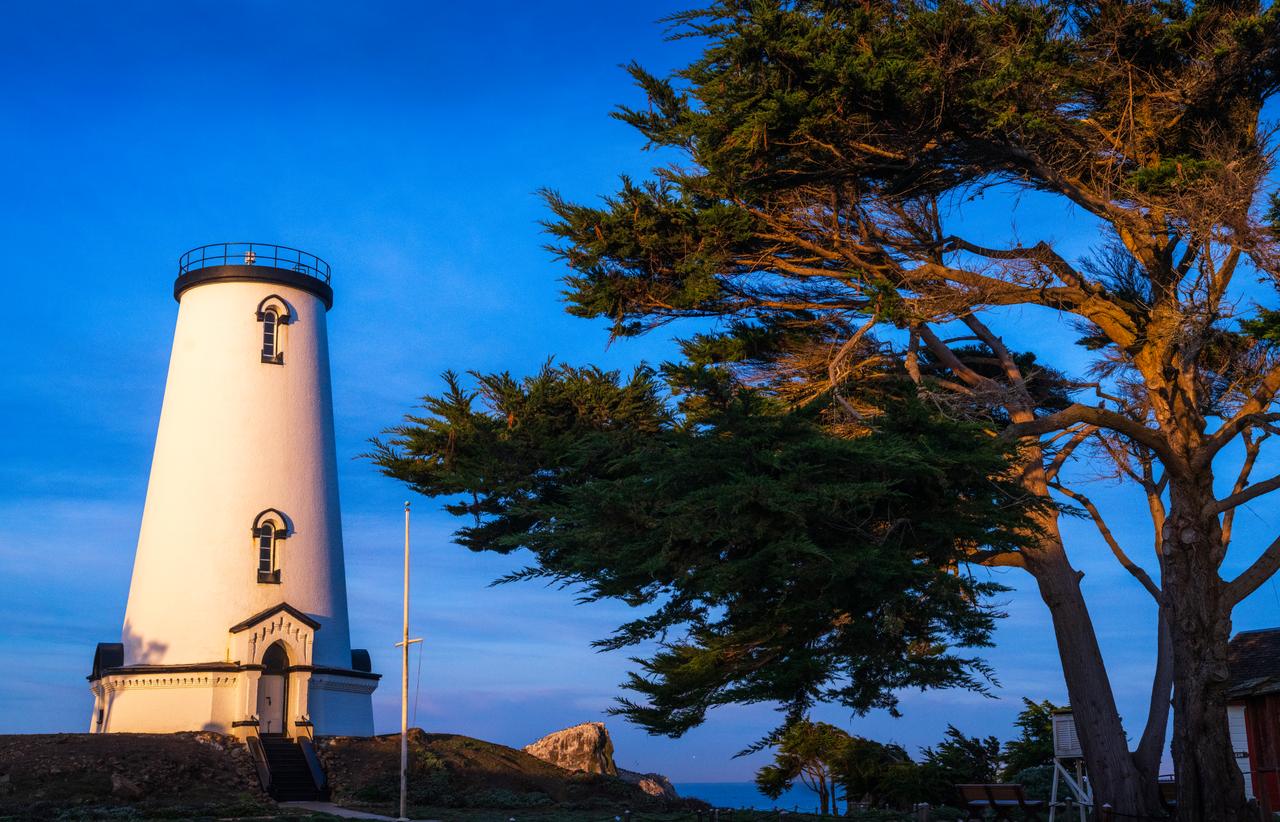
Piedras Blancas Lighthouse ( Flickr )
The main purpose of lighthouses is to guide ships navigating the sea and warn them of dangers.
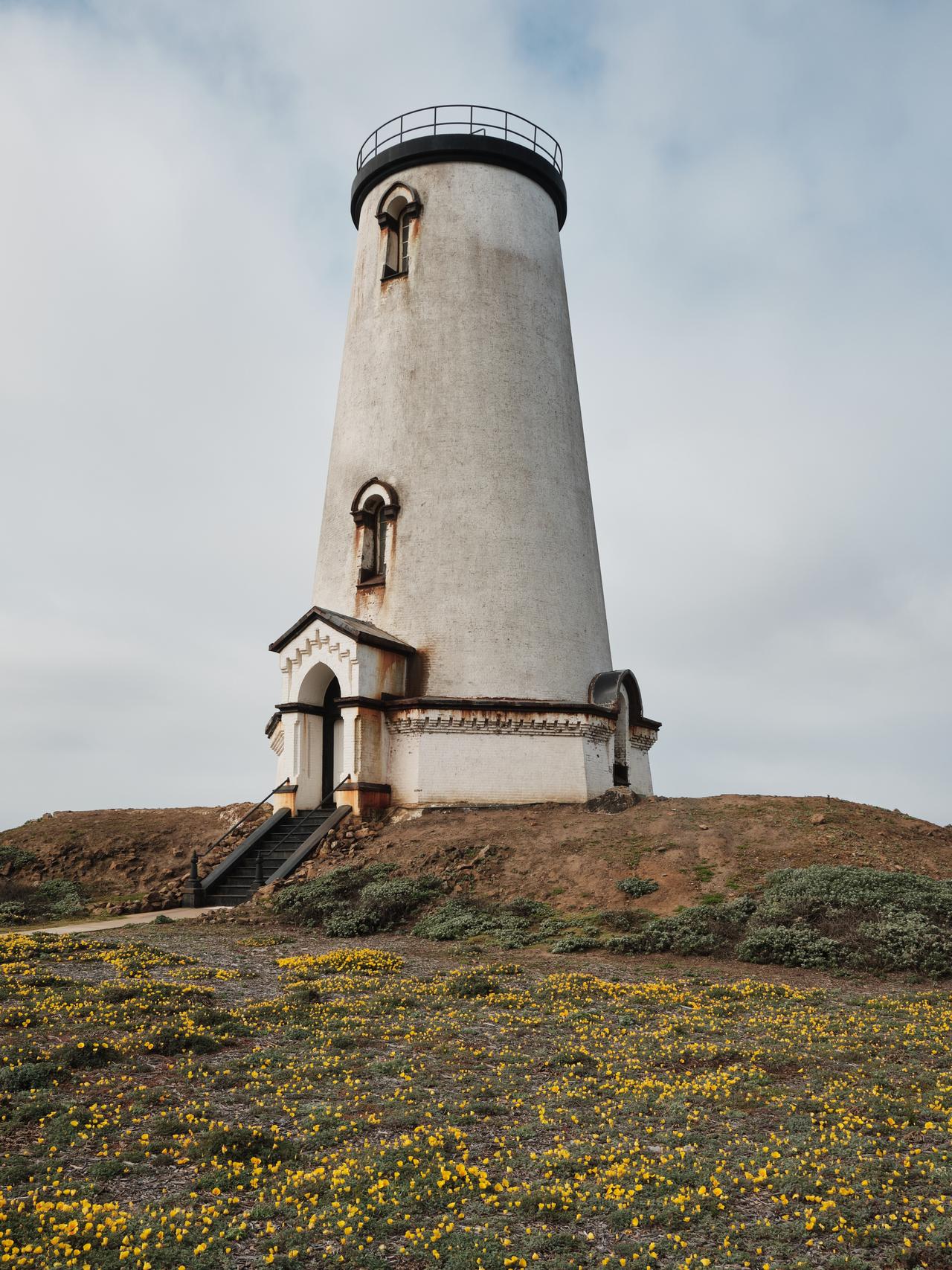
Piedras Blancas Lighthouse Image ( Flickr )
Throughout its long service, the Piedras Blancas Lighthouse was exposed to the region's geological activity and earthquakes, resulting in various structural damages to the tower. The most devastating of these damages occurred in an earthquake that occurred on the last day of 1948. This earthquake caused irreparable structural weakness in the upper section of the lighthouse, leading to the conclusion that the tower's top was unsafe.
Following the investigation, the United States Coast Guard (USCG) made the decision to completely remove the tower's upper three levels in 1949. These three levels included the lighthouse's fourth landing, the observation room, and the lantern (kandil) section, which housed the light at the top.
The historic tower, originally approximately 30 meters (100 feet) tall, was shortened as a result of this operation, reducing its height to approximately 21 meters (70 feet). Another result of this physical modification of the tower was the installation of a First Order Fresnel lens. This decommissioned optical equipment was loaned to the Cambria Lions Club with the approval and agreement of the United States Coast Guard. This historic lens is now on public display as a monument to maritime history, adjacent to the Veterans Memorial Building on Main Street in Cambria, California.
Following the revision, the lighthouse's elevation above sea level was fixed at approximately 142 feet. The lighthouse's lighting system also adapted to this structural change: starting in 1949, the light characteristic was updated to emit a white flash every 10 seconds. With technological advancements, the lighthouse has been using the Vega marine rotating flare (VRB-25), a modern and efficient lighting system, since 2002, with a reported visibility range of 19 to 20 nautical miles.
In addition to its historical mission, the Light Station also functions as a conservation area. In 2008, Congress officially designated it as a 476-acre expanse of public land and conservation area. Today, the Piedras Blancas Light Station continues to serve as a headquarters managed by the United States Bureau of Land Management (BLM).
Bureau of Land Management California. “Piedras Blancas Light Station (54422719415) JPG.” March 31, 2025. Photo. Flickr. Accessed 19 October 2025. https://www.flickr.com/photos/blmcalifornia/54422719415/.
Bureau of Land Management. ''Piedras Blancas Light Station''. Accessed October 21, 2025. https://www.blm.gov/programs/national-conservation-lands/california/piedras-blancas-light-station.
Bureau of Land Management. “Piedras Blancas Light Station History.” Accessed 19 October 2025. https://www.blm.gov/programs/national-conservation-lands/california/piedras-blancas-light-station/history-1.
Piedras Blancas Light Station. “Lighthouse History.” Accessed 19 October 2025. https://piedrasblancas.org/lighthouse-history.html.
Two21. “Piedras Blancas Lighthouse JPG.” June 18, 2024. Photo. Flickr. Accessed 19 October 2025. https://www.flickr.com/photos/asdf/53798644601/.

No Discussion Added Yet
Start discussion for "Piedras Blancas Lighthouse" article
History and Construction
Light and Fog Signals
Evolution of Light Characteristics
Fog Signals
Structural Damage and Height Reduction
Post-Earthquake Changes and the New Era
This article was created with the support of artificial intelligence.