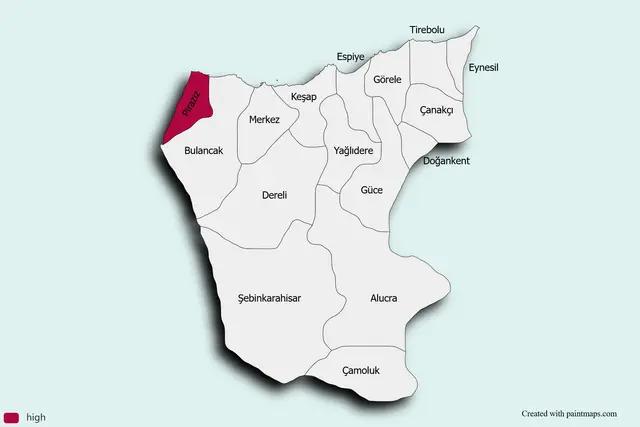


Piraziz (District)
Province(s) | Giresun | ||||||||
|---|---|---|---|---|---|---|---|---|---|
Area(s) | Eastern Black Sea Region | ||||||||
Population (2024) | 14162 | ||||||||
Postal Code | 28340 | ||||||||
Mayor(s) | Mahmut Esat Ayyildiz | ||||||||
District Governor | Burak Oz | ||||||||
Piraziz is a tourism and cultural center located on the western border of Giresun Province in Türkiye's Black Sea Region. Named after the Turkish lord Pir Aziz, who lived between the 14th and 15th centuries, the district was officially established by Law No. 3392 dated July 4, 1987. Bordering Bulancak to the east and the Gülyalı district of Ordu to the west, Piraziz has a population of 7,462 in its center and 5,313 in its towns and villages. Encompassing twenty-one villages, the settlement largely relies on hazelnut production for its economy; highland tourism, particularly in Paşakonağı, Bektaş, Çambaşı, and Sarıalan, is also gaining importance. Connected to all directions by road, the district is also accessible by air via Ordu-Giresun Airport. The region's cuisine, shaped by its rich variety of vegetables, herbs, and seafood, offers visitors unique flavors with its local pide and köfte (Turkish meatballs).

Piraziz ( Source: Piraziz Municipality )
Piraziz's historical development, geographical location, and administrative transformations follow an intermittent course from the pre-Ottoman period to the present. While there are no direct archaeological or written sources from the period before the region was opened to Muslim Turkish settlement, the settlement movements initiated by Chepni groups in the second half of the 14th century led to new arrangements in the valley systems covering the high hills along the coast. The presence of a small castle known as Bendehor and the surrounding Christian settlement suggests that the region was unaware of traces of settlement dating back to antiquity. However, Ottoman census records from 1455 indicate that the area around the castle became a neighborhood known as "Kaleyanı," and that a non-Muslim population continued there.
The district's name comes from a local bey, Pir Aziz, son of İbrahim, who ruled during the classical Ottoman period. According to records from 1455, the area known as Nefs-i Piraziz was named after its role as a tax district for the principality. Pir Aziz's center of power became the general name for the region in subsequent centuries. The spiritual influence of Sheikh Idris, a local opinion leader as well as the state, also influenced the shaping of the resettlement movement. Described as an Ahi leader, Sheikh Idris, along with his dervishes, organized the tribal groups settled in the region in 1397. Place names such as Abdal, Hasan Sheikh, Erenköy, and Sheikh Musa appear to reflect the memory of this period.
The mission of the Hacıemiroğulları, a minor Seljuk principality in the late 14th century, to open the region to Muslim Turkish settlement was decisive in the finalization of this line. The deployment of tribal forces here in 1397 by Davut Kethüda, son of Beğmiş and a commander of Süleyman Bey, the Hacıemiroğulları ruler, played a critical role in the formation of the villages and hamlets at the entrances to the valley. Indeed, Ottoman census records dating back to the mid-15th century reveal that an independent tax unit called the "Davut Kethüda Division" was established in the area between Pazarsuyu and Piraziz Creek, and that the area surrounding Bendehor Castle was organized within this system.
The settlement core, extending down to the coastline, took on a town identity with the construction of a pier, mosque, and weekly market in the second half of the 19th century. The Abdal Pier Market, which began to be established on Fridays (1869), accelerated the centralization of the region by intensifying both commercial activity and social interaction. The area, recorded as "Abdar" by the British traveler Hamilton in his 1836 travel notes, continued as the district center of the former Pazarsuyu District. The empowerment of Tiralizade Emin Ağa as a notable during the reign of Sultan Mahmud II provides clues about the shaping of the regional administrative structure in the provinces.
The foundations of modern municipal organization were laid in 1892 with the appointment of Abdullah Bey as mayor of the Piraziz district; and with the election of Halis Ağa to the council in 1904, a period of full-fledged civic participation in local government institutions began. Piraziz, which gained sub-district status in the early years of the Republic, remained affiliated with Bulancak from 1934 to 1988. The administrative boundaries were restructured with the law passed on June 19, 1987, and the district status officially came into effect on August 16, 1988.
This process reveals not only local population dynamics but also the socio-administrative evolution of Black Sea coastal settlements during the transitional periods from the Ottoman Empire to the Republic. Piraziz's historical development creates a multilayered pattern that allows for a concurrent evaluation of economic activities (fishing, agriculture, trade), the initiatives of spiritual leaders, and central state policies. In the years to come, the district's identity construction will be shaped by regional development plans supported by sea and land transportation options.
The district of Piraziz stands out as a 130 km² geographical unit located west of Giresun province, on the typical coastline of the Eastern Black Sea Region. The district center is surrounded by the Black Sea to the north, Bulancak to the east, Gülyalı, a district of Ordu, to the west, and the Bulancak Gölkıran Plateau to the south. This location, as a site of interaction between both marine influences and high land masses, results in Piraziz exhibiting considerable climatic and topographic diversity.
Geomorphologically, Piraziz is situated on the steeply descending slopes of a young mountain range, dissected by deep valleys. The terrain begins at an elevation of 50–100 m from the coast and rises southward, with the peaks of the Karagöl Mountains reaching up to 3,107 m. Alluvial plains are extremely limited within these steep and rugged massifs; only a narrow plain formation is observed around the Pazarsuyu Delta. Numerous streams in the district, from the Pig Stream to the Piraziz Stream, also known as Çiftedeğirmen, and from the Kelek, Bozat, and Çayırağacı streams to Pazarsuyu Stream, have formed short but deep valleys that flow into the Black Sea. These valleys almost completely reduce the flat areas suitable for hillside agriculture.
Differences in elevation and slope have a significant impact on natural vegetation. Dense hazelnut orchards can be found on the slopes immediately behind the coastal plains up to an altitude of 800 m, while broad-leaved forests such as alder, chestnut, hornbeam, oak, and beech dominate the middle elevations (800–1,600 m). Fir, spruce, and Scots pine become dominant in the zone above 1,600 m; forest cover can persist up to 2,000 m. At higher elevations, alpine meadows and plateaus are found. On the southern slopes of the district, on the slopes overlooking the Çoruh-Kelkit valley trough, xeric oak species and steppe plants are prominent. Agricultural land accounts for 25% of total land use, forest and heathland for 34%, meadows and pastures for 18%, and non-agricultural land for 23%.
Piraziz's climate is typical of the Black Sea region, with mild, rainy winters and cool summers. Annual precipitation ranges from 1,100 to 1,300 mm, spread over four seasons. Due to the maritime influence, snow rarely falls along the coast during the winter months, while higher elevations experience consistent snow cover. River flows vary slightly throughout the year; while water levels drop slightly in summer, they do not reach scarcity levels, and Pazarsuyu Stream is the most important source of drinking water. The average sea temperature is 16.9 °C, with peaks reaching 25 °C in July and August. These climatic conditions are favorable for both hillside agriculture (especially hazelnut production) and the vitality of forest ecosystems.
Located on the Black Sea coast of Giresun, the district of Piraziz gained district status with Law No. 3392, dated July 4, 1987. Bordered by Bulancak to the east, Ordu-Gülyalı to the west, the Bulancak Gölkıran Plateau to the south, and the Black Sea to the north, Piraziz is a settlement whose geographical boundaries and economic fabric closely reflect regional population dynamics.
As of 2024, the district's total population was 14,162. Of this population, 7,026 were male and 7,136 were female, with a gender distribution of 49.61% male and 50.39% female. While there is a modest female majority overall, the proportions of both genders are similar.
When population data for the period 2007–2024 is examined, it is noticeable that Piraziz's population has followed a fluctuating course, with periods of increase and decrease alternating from time to time. The total population, which peaked between 14,832 and 14,834 in 2007 and 2008, declined to 14,041 in 2009; in the following years, the decline continued until 2015, falling to 12,775, and rising again to 14,659 in 2018. After fluctuating between 14,310 and 14,138 in the 2019–2021 period, it decreased to 13,825 in 2022, reached its highest level in the last eighteen years at 15,151 in 2023, and then declined to 14,162 in 2024. These fluctuations reflect population movements in rural settlements due to migration, economic conditions, and agricultural seasonality.
The primary economic activities influencing the district's demographics include hazelnut and tea cultivation, as well as the production of the geographically indicated Piraziz apple. These agricultural products directly contribute to the region's survival and sustainability by shaping both seasonal labor demand and the income sources of the resident population. As agricultural productivity and the commercial value of products increase, the tendency for the rural population to reside in the district center can strengthen.
The economic fabric of Piraziz district has been shaped by the opportunities offered by the typical geographical and climatic conditions of the Black Sea coastline. With its narrow surface area and topography dotted with deep valleys and steep slopes, the scarcity of flat land in the district has forced the intensification of agricultural activities. This has led to hazelnut cultivation, particularly suited to the humid Black Sea climate, emerging as an indispensable source of income for the region.
Hazelnut production, the primary economic activity, constitutes the main source of income for households in the district's rural settlements; four existing hazelnut processing factories directly contribute to local employment and commercial volume by providing a seamless value chain from farm to factory. In addition to hazelnut farming, small livestock farming, aquaculture, which complements the Black Sea's rich fish stocks, beekeeping, and, to a lesser extent, forestry serve as supporting sectors that diversify the region's economic productivity.
The district's residents also cultivate corn, vegetables, and fruit for their own consumption. These products not only support the food security needs of rural family businesses but also offer opportunities for barter or sale in seasonal local markets. These secondary agricultural products have the potential to balance the one-way income structure of hazelnuts.
Registered as a product unique to the region, the "Piraziz Apple" is a fruit variety that grows naturally among hazelnut orchards, attracting attention with its slightly tart flavor profile and juicy, firm white flesh. Developed without chemical fertilization, pruning, or pesticide application, this local apple contributes to both rural production diversity and the preservation of the local agricultural heritage.
In line with the seasonality of economic activity, the highlands within the district (Paşakonağı, Bektaş, Çambaşı, Sarıalan, etc.) are used by local people for accommodation and animal husbandry during the summer months; temporary settlements in the highland nomads (İnboynu, Bozattaşı, Rızvan, Murtaz, Kaleboynu, Semen, etc.) provide additional income opportunities for family economies. This highland mobility is an important element of social capital, fostering both tourism potential and rural development dynamics.
The integration of the highway infrastructure with the nationwide networks and the close access to Ordu–Giresun Airport facilitate the transportation of Piraziz products to regional and national markets, while also supporting the district's tourism and commercial activity.
The local gastronomy, with its rich variety of vegetables and vegetation, offers a culinary culture suitable for vegetarian diets. The Black Sea's diverse seafood, along with local delicacies like pide and köfte, contributes to food tourism within the service sector. These elements create added value by introducing a different facet of the district's economy to visitors focused on gastronomy.
The Piraziz district, situated in a narrow area along the steep coastline of the Eastern Black Sea, offers visitors a blend of natural and historical riches with its geography of deep valleys, steep slopes, and limited plains. The region's tourism potential is primarily shaped by pristine paths extending from forest-covered slopes and scenic routes leading to the cool waters of the Black Sea. Small facilities built along the Domuz, Pazarsuyu, and Çayırağzı streams provide suitable areas for hiking and birdwatching, while the Abdal Pier and Cuma Mosque area on the rocky shores offer visitors the opportunity to experience both the sea and the historical atmosphere simultaneously.
In terms of cultural heritage, Piraziz stands out with a number of monuments dating from the Ottoman period. The tomb of Pir Aziz, son of İbrahim, who gave the district its name, has survived to this day as the site of the city's founding mythology. The Şeyh İdris Lodge and Tomb is a rare example of authentic wood and stonework, preserving the traces of the Ottoman Sufi movements of the late 14th century. The Tiralizade Hasan Bey Mansion, with its two-story, spacious courtyard and distinctive Black Sea civil architecture, has become both a symbol of mansion life and a center of social solidarity for the local community. These historic structures have survived thanks to restoration efforts and have played a significant role in revitalizing cultural tourism.
In addition to its local architectural fabric, Piraziz's socio-cultural structure is based on traditional lifestyles, traces of which still remain in the daily lives of its inhabitants. Over time, the settlement rose from sub-district to district status, gaining official institutionalization. The squares, marketplaces, and social spaces surrounding the mosque, where people gather, have retained their importance as venues for religious and social rituals. These spaces host ceremonies such as religious festivals, religious ceremonies, and weddings, as well as venues for the performance of traditional handicrafts and musical practices.
The culinary culture is closely linked to the hazelnut orchards that form the economic basis of Piraziz, beekeeping, fishing, and agricultural production. In addition to dishes prepared using fresh corn, vegetables, and fruit, the locals are known for their homemade steamed fish made from stream fish and honey-based desserts made with bee products. The oil and flour obtained during hazelnut processing find their way into both sweet and savory recipes. Seasonal markets offer visitors a unique culinary experience with organic products from local producers, while traditional jams and pickles prepared by family businesses contribute to the preservation of regional flavors.
Giresun Governorship . “Piraziz.” Giresun Governorship. Access date: April 22, 2025. http://www.giresun.gov.tr/piraziz
Paintmaps. “Turkey Provinces Map – Highlighting Piraziz, Giresun.” Access date: April 15, 2025. https://paintmaps.com .
Piraziz Municipality . “Geographical Structure.” Piraziz Municipality. Access date April 22, 2025. https://piraziz.bel.tr/piraziz/cografi-yapi/
Piraziz Municipality . “Photo Gallery.” Piraziz Municipality. Access date April 22, 2025. https://piraziz.bel.tr/foto-galeri/
Piraziz Municipality . “Historical Information.” Piraziz Municipality. Access date April 22, 2025. https://piraziz.bel.tr/piraziz/tarihi-bilgiler/
Piraziz Municipality . “Historical Monuments.” Piraziz Municipality. Access date April 22, 2025. https://piraziz.bel.tr/piraziz/tarihi-eserler/
Republic of Turkey Ministry of Culture and Tourism, Giresun Provincial Directorate of Culture and Tourism . “Piraziz.” Republic of Turkey Ministry of Culture and Tourism, Giresun Provincial Directorate of Culture and Tourism. Access date 22 April 2025. https://giresun.ktb.gov.tr/TR-58025/piraziz.html
Republic of Turkey Ministry of National Education . “History of Piraziz.” Piraziz District Directorate of National Education. Access date April 22, 2025. https://piraziz.meb.gov.tr/www/piraziz-tarihcesi/icerik/288
Republic of Turkey Piraziz District Governorship . “Piraziz Diamond.” Piraziz District Governorship. Access date April 22, 2025. http://www.piraziz.gov.tr/piraziz-elmasi
Republic of Turkey Piraziz District Governorship . “History.” Piraziz District Governorship. Access date April 22, 2025. http://www.piraziz.gov.tr/tarih
Republic of Turkey Piraziz District Governorship . “History.” Piraziz District Governorship. Access date April 22, 2025. http://www.piraziz.gov.tr/tarihce
Turkish Statistical Institute (TurkStat). Address Based Population Registration System Results, 2024. Access date: April 20, 2025. https://data.tuik.gov.tr/Bulten/Index?p=Adrese-Dayali-Nufus-Kayit-Sistemi-Sonuclari-2024-53783

Piraziz (District)
Province(s) | Giresun | ||||||||
|---|---|---|---|---|---|---|---|---|---|
Area(s) | Eastern Black Sea Region | ||||||||
Population (2024) | 14162 | ||||||||
Postal Code | 28340 | ||||||||
Mayor(s) | Mahmut Esat Ayyildiz | ||||||||
District Governor | Burak Oz | ||||||||
History
Geography and Climate
Population and Demography
Economy
Tourism - Culture - Cuisine
This article was created with the support of artificial intelligence.