

+1 More

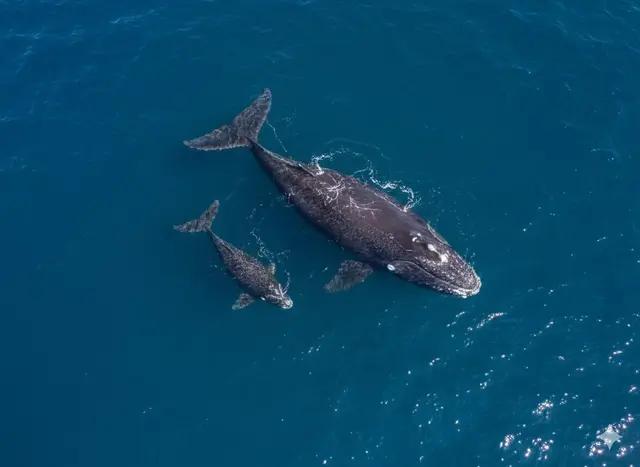
Right Whale (Generated by Artificial Intelligence.)
Common Name | North Atlantic right whale | ||||||||
|---|---|---|---|---|---|---|---|---|---|
Kingdom(s) | Animalia | ||||||||
Phylum | Chordata | ||||||||
Class | Mammalia | ||||||||
Order | Cetacea | ||||||||
Family | Balaenidae | ||||||||
Genus | Eubalaena | ||||||||
Specie(s) | E. glacialis | ||||||||
Conservation Status | Critically Endangered (IUCN) | ||||||||
The North Atlantic right whale (Eubalaena glacialis) is a baleen whale belonging to the genus Eubalaena, one of three extant species of right whales. Once hunted by commercial whalers for their surface swimming and whale oil production, this species was considered the “right” whale to hunt. Today, it is among the world's most endangered large whale species.
Right Whale have stocky black bodies without dorsal fins, and their water-spouting motions are in a "V" shape. Their tails are broad, deeply notched, and completely black. Their bellies may be completely black or have irregularly shaped white markings. Newborn calves are about 4.2 meters (14 feet) long. Average adults range in length from 13 to 18 meters (43 to 59 feet) and weigh about 40,000 to 90,000 kg (88,000 to 198,000 pounds); their maximum length can reach up to 52 feet (about 15.8 meters) and their weight can reach up to 140,000 pounds (about 63.5 tons).
The species is characterized by the rough, white, keratinized patches called callosities on their heads, which form distinctive patterns . These callosities can appear white, orange, yellow, or pink because they harbor crustaceans called cyamids , and scientists use these patterns to identify individuals.
About the Right Whale ( Rumble Viral )
Right whales are primarily found in coastal waters along the continental shelf of the North Atlantic, but they are also known to travel offshore in deep waters. They generally inhabit the North Atlantic between approximately 30 and 75 degrees north latitude. These seasonally migratory whales occur off New England and as far north as Canadian waters during the spring, summer, and early fall for feeding and mating. Each fall, some individuals travel over a thousand miles (approximately 1,600 km) from these feeding grounds to their maternity grounds in the shallow, coastal waters off South Carolina, Georgia, and northeastern Florida. With the onset of winter, these whales migrate from the sub-polar regions to lower latitudes, remaining near land masses.
Right whales (Blunger whales) feed primarily on copepods (small crustaceans) and other zooplankton. To feed, they slowly swim through areas densely populated by these small organisms and open their mouths. This structure, which filters water through its baleen plates, traps the copepods. Whales can feed at any depth, from the surface to the bottom of the water column. Socialization and mating occur year-round and in all habitats, in groups known as surface-active groups (SAGs). Whales communicate using low-frequency moans, grunts, and blows to maintain interpersonal contact, convey threats, or for other social purposes. They may also engage in surface activity, such as breaching , by leaping at the ocean surface and falling back into the water with a crash . Their only known natural predator is the orca, and there has been only one recorded predation.
Right whales are estimated to live up to 70 years. However, due to human-related mortality, females have been shown to live up to an average of 45 years, while males live up to an average of 65 years. Females reach sexual maturity at around 10 years of age. They give birth to a single calf after a one-year gestation period. While three years is considered a normal or healthy interval between births, females now give birth on average every six to ten years.
Right whale has been listed as critically endangered under the Endangered Species Act (ESA) since 1970. It is listed as Critically Endangered on the IUCN Red List . Its population status is critical; as of 2023, there are approximately 370 surviving individuals, of which only about 70 are breeding-age females. Mortality rates exceed birth rates. Human interactions continue to pose a threat to the species.
The primary threats include entanglement in fishing gear, ship strikes, the effects of climate change on prey distribution, ocean noise, and small population sizes. Entanglement in fishing gear and ship strikes, in particular, are the leading causes of right whale mortality. An Unusual Mortality Event ( UME ) has been occurring since 2017, and the whales affected represent more than 20% of the population.
Crane, Jonathan, and Rebecca Scott. “Eubalaena glacialis (North Atlantic right whale).” Accessed October 20, 2025. https://animaldiversity.org/accounts/Eubalaena_glacialis/.
National Oceanic and Atmospheric Administration (NOAA). “North Atlantic Right Whale.” Accessed October 20, 2025. https://www.fisheries.noaa.gov/species/north-atlantic-right-whale.
Rumble Viral. “Incredibly rare encounter with North Atlantic Right Whale.” October 30, 2018. YouTube video. 00:44. https://www.youtube.com/watch?v=xoqn7JjJofM.


Right Whale (Generated by Artificial Intelligence.)
Common Name | North Atlantic right whale | ||||||||
|---|---|---|---|---|---|---|---|---|---|
Kingdom(s) | Animalia | ||||||||
Phylum | Chordata | ||||||||
Class | Mammalia | ||||||||
Order | Cetacea | ||||||||
Family | Balaenidae | ||||||||
Genus | Eubalaena | ||||||||
Specie(s) | E. glacialis | ||||||||
Conservation Status | Critically Endangered (IUCN) | ||||||||
No Discussion Added Yet
Start discussion for "Right Whale (Eubalaena glacialis)" article
Morphological Features
Geographic Distribution and Habitat
Behavior and Nutrition
Reproduction and Life Span
Conservation Status and Threats
This article was created with the support of artificial intelligence.