This article was automatically translated from the original Turkish version.
Year of Construction | 1555–1561 | ||||||||
|---|---|---|---|---|---|---|---|---|---|
Patron | Rüstem Pasha (son-in-law of Kanuni Sultan Süleyman) | ||||||||
Architect(s) | Mimar Sinan | ||||||||
Location | Eminönü Istanbul (Tahtakale - Hasırcılar Street) | ||||||||
Architectural Feature(s) | Superstructure centrally planned dome supported by eight pillars | ||||||||
Distinguishing Feature | Sinan's mosque with the highest concentration of Iznik tiles | ||||||||
Building Components | Mosque, shops, vaulted warehouses, two hans, cemetery, fountain | ||||||||
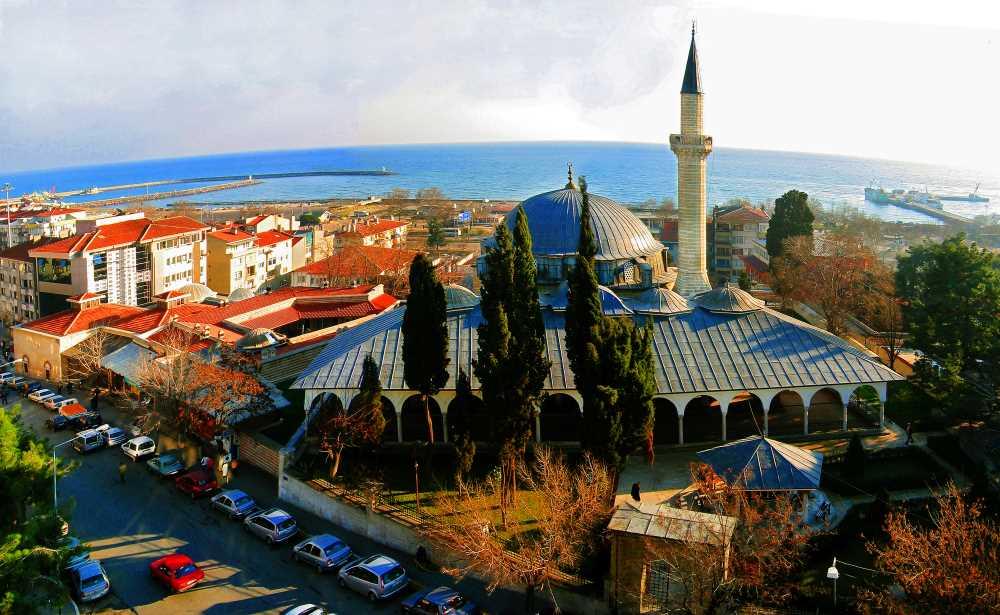
Rüstem Paşa Camii is a significant classical-era work built in the 16th century in the Eminönü district of Istanbul by Grand Vizier Rüstem Paşa. Designed by Mimar Sinan, this mosque holds a unique place in Ottoman art not only for its architectural structure but also for its extraordinary tile decorations. The building, prominently situated along the Golden Horn shoreline in the city’s silhouette, constitutes a külliye comprising a mosque, fountain, cemetery, shops, vaulted storage rooms, and two hans.

Rüstem Paşa Camii (Türkiye Culture Portal)
The founder of the mosque is Rüstem Paşa, son-in-law and Grand Vizier of Kanuni Sultan Süleyman. Construction is generally dated between 1555 and 1561. After Rüstem Paşa’s death in 1561, his wife Mihrimah Sultan oversaw the completion of the mosque and its külliye. While some sources cite the construction period as 1550–1560, other documents highlight the years 1554 and 1560. Prior to the mosque’s construction, the site housed the Attar Halil (Hacı Halil Ağa) Mosque. The acquisition and demolition of this structure and surrounding buildings made the mosque’s construction possible.
Rüstem Paşa Camii is a raised structure with shops and vaulted storage rooms located beneath it. This elevated design was intended to accommodate the mosque’s location within a dense commercial area and to generate income through its commercial units. The prayer hall has a rectangular plan with a central dome supported by an octagonal system of eight piers. Four of these piers are attached to the side walls in rectangular plans, while the other four are freestanding and octagonal. These piers are connected by arches to form an octagonal base supporting the main dome.
Half-domes are placed in the four corners, and the side walls are extended transversely by three units each, covered with arched vaults and domes with mirrors. These units beneath the gallery are also covered with mirrored vaults. The final congregation area is divided into five sections by six columns and covered by five small domes. The minaret, with a single balcony and lead-covered cupola, is accessed via a door on the western side.
Staircases leading to the mosque’s courtyard are positioned on all four sides: two at the northern corners of the courtyard and the other two beside the eastern and western entrances of the mosque. These staircases provide access to different levels and gallery areas of the mosque. The large wooden roof over the northern side rests on columns with muqarnas capitals.
The most striking feature distinguishing Rüstem Paşa Camii from other works of Sinan is the exceptional richness of its tile decoration. The interior spaces, walls, piers, pendentives, and final congregation area are entirely clad in the most advanced Iznik tiles of the classical Ottoman period. The tiles feature naturalistic floral motifs, scenes arranged on lapis lazuli backgrounds, and symmetrical compositions. These tiles represent some of the finest examples of 16th-century tilework in terms of design and technique.
It is emphasized that tile production was not limited to Iznik workshops; a tile workshop was also established in Kütahya. This gives the mosque a distinctive position in Ottoman architectural history in terms of ceramic art. The tile panels on the eastern wall, particularly the left panel with its composition reflecting a “reinterpretation of nature,” are regarded as among the pinnacles of classical Ottoman tile decoration.
However, over time these decorations suffered damage. In particular, during 19th-century renovations, original penwork was removed and replaced with new ornamentation featuring Baroque elements.
The mosque has suffered damage multiple times due to fires, earthquakes, and other natural disasters. It sustained major damage during the 1660 Istanbul fire and the 1766 earthquake, resulting in the collapse of the dome and minaret. In the 18th century, the dome’s drum was rebuilt in Baroque style, and some wall additions and window proportions on the qibla side were altered. 19th-century penwork and certain oil-painted decorations also deviated from the mosque’s original character.
In the modern era, the General Directorate of Foundations carried out various repairs between 1960–61 and 1964–69. A comprehensive restoration between 1992 and 1995 returned the mosque to its classical style: lead coverings were replaced, traces of original penwork were identified in underlying layers and restored, and tile conservation was carried out. Wooden and marble elements were also repaired.
The mosque was planned not merely as a place of worship but as a full külliye. The shops and storage rooms on the lower level provided economic support to the mosque. Eight shops beneath the courtyard, covered by pointed-arch vaults, were arranged alongside a fountain with a cistern. On the Golden Horn side of the mosque stand the Büyük and Küçük Rüstem Paşa Hans, which have undergone various interventions over time. The upper floors consist of rooms covered by domes or vaults.
Rüstem Paşa Camii is one of the unique examples of classical Ottoman mosque architecture, distinguished by its architectural plan, strategic urban location, elevated structure, design elements reflecting Mimar Sinan’s architectural vision, and especially its extraordinary decoration with Iznik tiles. Despite the restorations and renovations it has undergone over time, the structure has largely preserved its original character and is regarded as one of the high points of Ottoman art.
Istanbul Metropolitan Municipality Cultural Heritage Branch Directorate. "Rüstem Paşa Külliyesi." Accessed June 26, 2025. https://kulturelmiras.ibb.istanbul/rustem-pasa-kulliyesi/.
Ministry of Culture and Tourism. "Rüstem Paşa Camii - Tekirdağ." Türkiye Kültür Portalı. Accessed June 26, 2025. https://www.kulturportali.gov.tr/turkiye/tekirdag/gezilecekyer/rustempasa-cami.
T.C.Fatih Kaymakamlığı Governorship. “Rüstem Paşa Camii.” Accessed June 26, 2025. http://www.fatih.gov.tr/rustem-pasa-camii.
T.C.Sapanca Kaymakamlığı Governorship. "Rüstem Paşa Camii." Accessed June 26, 2025. http://www.sapanca.gov.tr/rustem-pasa-camii.
Türkiye Diyanet Vakfı İslâm Ansiklopedisi. "Rüstem Paşa Külliyesi (İstanbul)." Accessed June 26, 2025. https://islamansiklopedisi.org.tr/rustem-pasa-kulliyesi--istanbul.

Year of Construction | 1555–1561 | ||||||||
|---|---|---|---|---|---|---|---|---|---|
Patron | Rüstem Pasha (son-in-law of Kanuni Sultan Süleyman) | ||||||||
Architect(s) | Mimar Sinan | ||||||||
Location | Eminönü Istanbul (Tahtakale - Hasırcılar Street) | ||||||||
Architectural Feature(s) | Superstructure centrally planned dome supported by eight pillars | ||||||||
Distinguishing Feature | Sinan's mosque with the highest concentration of Iznik tiles | ||||||||
Building Components | Mosque, shops, vaulted warehouses, two hans, cemetery, fountain | ||||||||
History and Founder
Architectural Structure
Tiles and Decorations
Restorations and Conservation Efforts
Other Structures of the Külliye