Şebinkarahisar (District)
Province(s) | Giresun | ||||||||
|---|---|---|---|---|---|---|---|---|---|
Area(s) | Eastern Black Sea Region | ||||||||
Population (2024) | 19506 | ||||||||
Postal Code | 28400 | ||||||||
Climate(s) | Semi-arid | ||||||||
Mayor(s) | Omer Senturk | ||||||||
District Governor | Yasin Ardıç | ||||||||
Şebinkarahisar is a historical and strategic district located in the interior of Giresun province, nestled among the high valleys of the Black Sea Mountains. After temporarily serving as the provincial center in 1933 under Law No. 2197, it was granted permanent district status. The agricultural sector, in line with Giresun's leading global hazelnut production, forms the foundation of Şebinkarahisar's economy. The Walnut Culture and Arts Festival, held annually in the first week of July, is a key event promoting both the region's cultural heritage and agricultural production potential.

Şebinkarahisar ( Source: Şebinkarahisar Municipality )
The Şebinkarahisar district, located in the inland region of the Eastern Black Sea region, stands out as a rich zone of transition and interaction, both due to its geographical location and historical processes. Archaeological and written evidence from ancient times indicates that the region was successively dominated by the Hittites, Urartians, Persians, and Pontus. Traces of these early settlements persist, particularly in the mounds and ruins around İsola (Güneygören) and Bayram; the city's initial founding center is believed to have been formed around these two points.
In the Middle Ages, the region came under Seljuk rule in 1074, following a campaign led by Mengücek Gazi and Danişment Gazi. With this conquest, the foundations of the Fahrettin Behramşah Mosque, a legacy of the Mengüceks, were laid near the Avutmuş neighborhood. With its domed structure and distinctive narthex dating back to the 12th century, it remains a prominent example of Seljuk architectural tradition in the region.
Following the Danishmend and Mengücek rule, the region witnessed a prolonged period of Principalities. Following the defeat of the Akkoyunlu ruler Uzun Hasan in the aftermath of the Battle of Otlukbeli in 1473, it was incorporated into Ottoman territory. Granted the status of a sanjak center under the Ottoman administration under the name "Karahisar-ı Şarki," the settlement gained importance as a center where princes were trained and resided. The name "black stone fortress," derived from the black basalt stones of the castle walls, became enduring and found a place in Evliya Çelebi's travelogue.
Artifacts that demonstrate the architectural and economic vitality of the Ottoman period can still be seen scattered throughout the district today. The flat arches and cut stonework of the Taş Masjid, built by Melik Ahmet Bey at the foot of the castle in the 14th century; the dome and narthex of the Kurşunlu Mosque, built by a philanthropist named Allah Kulu between 1574 and 1582, reflecting Ottoman mosque tradition; the two-story Taş Hans built by Sipahi Chief Taban Ahmet Ağa in the 17th century; and the diversity of 19th-century civil and religious buildings attest to the district's historical fabric spanning multiple periods.
In the 20th century, one of the internal turmoils of World War I was the events of June 5, 1915. The targeting of the settlement by certain armed groups and the intervention of Turkish forces during this period once again emphasized the strategic importance of the region. Later, during the administrative reforms that began with the proclamation of the Republic, Karahisar-ı Şarki gained provincial status in 1923. It was renamed "Şebinkarahisar" during Gazi Mustafa Kemal Atatürk's visit to the region on October 11, 1924. In 1933, it was converted to a district and attached to the province of Giresun.
This long historical trajectory has made Şebinkarahisar both a center embodying Anatolia's multilayered civilizational heritage and a typical example of local government in Türkiye's transformation from the Ottoman Empire to the Republic. Ruins dating from antiquity to the present day, including madrasas, inns, mosques, and churches, demonstrate that the district's evolving administrative structure, as well as its cultural and social fabric, bear traces of various periods. With these characteristics, Şebinkarahisar can be considered one of the rare settlements in the Black Sea region that combines historical continuity and multilayeredness.
Şebinkarahisar is a settlement in the inland region of the Eastern Black Sea Region, on the southern slopes of the Giresun Mountains and the northern slopes of the Kelkit Basin, resembling a karstic plateau with elevations reaching 1,300 meters. While the district's central elevation averages 1,300 meters, surrounding peaks rise to 3,095 meters. The settlement's location presents a topography fragmented by valleys formed by local streams; the lower Mendibey Stream valley opening to the west and small basins facing north highlight its morphological diversity.
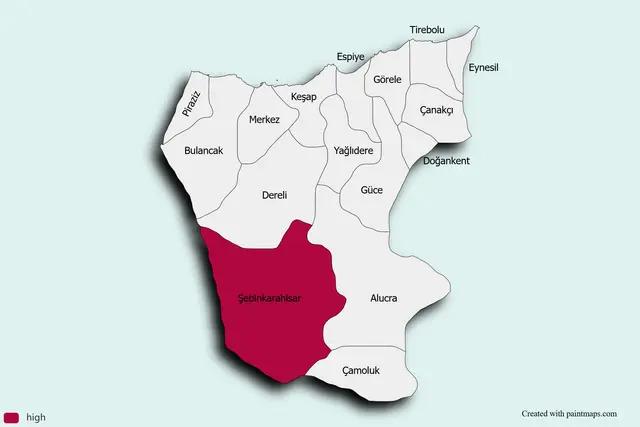
Şebinkarahisar, with a surface area of 1,349 km², is located at coordinates around 39°47′ N – 38°29′ E. It is 118 km from Giresun city center, 198 km from Sivas, and 124 km from Erzincan. Bordered by Dereli to the north, Yağlıdere to the northeast, Alucra to the east, Çamoluk to the southeast, Akıncılar and Gölova to the south, Suşehri and Koyulhisar to the west, and Mesudiye to the northwest, it serves as a junction point for economic and transportation corridors to both the Black Sea and Central Anatolia regions.
Geologically, the region is covered with extensive layers of gypsum-bearing terrain and the resulting erosion of these layers of sand, gravel, and rock. Its location on the Erzincan-İzmit fault line indicates that it is located in a seismically risky area.
Rising from the north as a branch of the Giresun Mountains, the massifs open to the Black Sea through the Eğribel (2,200 m) and Şehitler (2,000 m) passes. The Karagöl Mountains, a continuation of the Canik Mountains, with peaks reaching 3,095 m, constitute the highest points in the region. Major elevations in the district's surroundings include Kale Tepe (1,550 m), Kayabaşı and Öksürük Kayası (1,970 m), Dikmen Tepesi (1,758 m), Tutak Dağı (2,544 m), Baltaşı (1,300 m), and Sarıkaya Hills (1,912 m). These mountain ranges play a decisive role in shaping both transportation and the climate regime.
The majority of the land cover is covered by forests. Approximately 25,000 hectares of forested land are home primarily to Scots pine, fir, poplar, and oak. This vegetation, which transitions to maquis formations in places, is sparser, particularly on the western and southern slopes, and becomes denser on the northern slopes. Meadow formations predominate on the higher plateaus, and transhumance activities contribute to the continuity of the natural landscape.
In terms of climate, Şebinkarahisar forms a transitional zone between the humid Black Sea climate and the semi-arid Central Anatolian climate. Summers are hot and dry, while winters are cold and snowy. High mountains trap moist air masses coming from the sea, preventing them from reaching the interior; therefore, total annual precipitation exceeds 1,300 mm along the coast, while in the district it remains around 500–750 mm. Precipitation shifts to spring and autumn, highlighting these seasons.
During the winter months, precipitation generally falls as snow, and frost is common; February and March are the coldest months of the year. Temperatures sometimes drop to -15°C. In summer, July is the hottest month, with daytime temperatures ranging from 25°C to 32°C. These sharp climate transitions place significant pressure on agricultural activities and settled life, increasing the importance of land use and urban planning, particularly drainage, road construction, and thermal insulation measures.
As of 2024, the Şebinkarahisar district's population was recorded at 19,506. Of this population, 9,876 were male and 9,630 were female; the gender composition is notable at 50.63% male and 49.37% female. This balanced distribution of the total population demonstrates a similar level of male and female participation in both the district's production and service sectors.
Annual population data reveals that Şebinkarahisar had a population of 23,731 in 2007, with a general downward trend in subsequent years. Between 2008 and 2010, the population fluctuated around 22,000, recovering slightly from 2011 to 2013, rising above 23,000 again. However, the decline that began after 2014 slowed to 19,150 in 2020 and has stabilized in the 19-20,000 range according to current data. This long-term population change can be explained by factors such as internal migration in rural areas, mechanization in agricultural production, and the young population's tendency to seek education and employment opportunities in urban centers.
From 2007 to 2024, the male population averaged between 50-51% each year, while the female population remained around 49-50%. This is consistent with the predominance of male-oriented agricultural activities, commonly observed in rural areas. The greater male role in the production of regional agricultural products, such as tobacco and hazelnuts, particularly impacts the demographic balance in this direction.
The fluctuations in the population growth rate also reveal the fragility of the district's economic structure and its external dependence. The decline, which began after the highest recorded value in 2013, was reinforced after 2020 by the impact of the pandemic and the acceleration of migration flows from rural areas. In contrast, the slight recovery seen in the 2023 data may indicate a refocusing of the remaining population on local resource-based economic activities or the beginning of a partial return.
The economic structure of Şebinkarahisar district, in line with its geographical location and natural resource potential, has been shaped around agriculture, animal husbandry, forestry, mining, and small-scale industrial workshops. Its location between the Black Sea and Central Anatolian climate zones, encompassing both semi-arid and humid climates, creates both opportunities and constraints for agricultural activities. The E-80 state highway, connecting the district to Giresun and Alucra, forms the backbone of the transportation infrastructure, while the vast majority of other roads are stabilized or unpaved, highlighting the importance of investments to strengthen production and trade links.
In terms of agricultural production, Şebinkarahisar's arable land is defined as 41,185 hectares, but approximately 21,000 hectares of this land are effectively cultivated. In this context, grain production (wheat and barley) maintains its priority, while tobacco, whose cultivation areas have recently expanded rapidly, significantly contributes to both producer incomes and the local economic cycle. Fruit and vegetable growing activities are limited, and most of the products produced do not exceed local consumption. Mulberries, walnuts, pears, cranberries, plums, quinces, cherries, sour cherries, apples, black mulberries, almonds, and peaches are among the primary fruits cultivated within the district. The fishing potential offered by Kılıçkaya Dam Lake suggests that the aquaculture sector could be a promising investment opportunity.
Livestock farming holds the second-most importance in the district's economic profile, right after agriculture. Extensive pasturelands such as the Asarcık, İndimerek, Saydere, Yedigöz, Sarıçiçek, and Çetek plateaus offer favorable conditions for the husbandry of both cattle and sheep. The increase in the number of cattle and sheep in recent years has increased milk production to an average of 200 tons per day. However, due to inadequate logistics and processing infrastructure, much of this potential is utilized through domestic operations. The district's extensive steppe vegetation also provides suitable ground for beekeeping; according to 1988 records, honey production, carried out with approximately 10,000 beehives, offers advantages in quality and yield, particularly due to the diversity of the flora.
In Şebinkarahisar, where modern-scale industrial facilities are almost non-existent, the majority of industrial establishments are small workshops. A zinc-lead flotation facility and a nail production factory near Çağlayan Village stand out as the district's largest industrial production units. In addition, approximately 500 artisan workshops of various sizes diversify into carpentry workshops, agricultural tool production and repair shops, and businesses manufacturing honey frames and kitchenware. Traditional processing activities, such as drying fruit and turning it into fruit pulp and molasses, are carried out by small-scale facilities. The fact that approximately 200 employers have applied for the establishment of an organized industrial zone in 2023 indicates that industrialization trends are increasing.
From a forestry perspective, the district has a total of 24,888 hectares of forested land; although 72% of this land is covered by forests, actual forest cover, relative to the total area within the district, is only 18.4%. Scots pine and fir forests dominate the higher elevations, while species such as oak, poplar, and hazelnut occupy the lower elevations. The production of logs, industrial wood, paper raw material, and fuelwood provides raw materials for the local lumber industry.
Mining is another economic activity reflecting the regional geological richness. Alunite (alum), pyrite, granite, lignite, uranium, lead, and zinc deposits have historically determined the district's economic importance; the zinc-lead mine currently in operation on the İnler Plateau holds reserves of approximately 3–5 million tons. The exploitation of alunite reserves, in particular (approximately 30 million tons of proven reserves), represents the potential to contribute significantly to regional development.
Sustainable growth in all these sectors depends on addressing infrastructure deficiencies, improving the transportation network, and increasing the added value of local production. Strengthening highway connections, establishing cold chain and processing facilities, developing tourism infrastructure, and managing natural resources in a planned manner are among the priority strategies for diversifying Şebinkarahisar's economy and achieving long-term development goals.
The district of Şebinkarahisar, a settlement situated on the northern slopes of the Kelkit Valley at the southern foot of the high mountain range of the Eastern Black Sea region, at an average altitude of 1,300 m above sea level, stands out for its natural and cultural riches. Since ancient times, it has existed under Hittite, Urartian, Persian, and Pontic rule. It came under Turkish sovereignty in the 11th century with the Mengücek and Danishmend raids. Following the Otlukbeli Victory in 1473, it was incorporated into Ottoman rule. Following a visit by Gazi Mustafa Kemal Atatürk in the early years of the Republic, the district's name was changed to Şebinkarahisar. It gained provincial status in 1923 and district of Giresun in 1933. In addition to its geographical location, its transition between the semi-arid Central Anatolian climate and the humid Black Sea climate allows for the diversification of agricultural production and transhumance activities.
In terms of intangible cultural heritage, Şebinkarahisar reveals a unique identity through a rich tradition of oral literature and the diverse games, folk songs, and folk songs produced by its communities. Folk narratives, featuring unique idioms and expressions reflecting daily life—bridal tales like "Seet Gaç" and the subtle, humorous stories seen in "Half Ticket"—are fundamental examples of oral literature. In addition to these narratives, the folk dances unique to the Tamzara, Oturak Havası, and Efeler traditions, preserved in the city, demonstrate the fusion of Erzurum and Giresun repertoires, providing concrete evidence of regional interaction. Children's games are also integral parts of this whole: the rituals depicting the camel driver and bride characters in the Rumi New Year's Play performed on January 13th, the imitation of agricultural cycles in the Farmer's Play, and traditional dance practices like "Halvacı Gelin" (The Bride of Halva) stand out for their performative dimension, facilitating intergenerational transmission. Poems and proverbs ensure that oral culture remains alive by simultaneously reflecting the irony of daily life and social value judgments.
In terms of tangible cultural heritage, the district's most prominent symbol is Şebinkarahisar Castle, atop Hacı Kayası. Originally established before the Roman period, this structure, repaired and expanded during the Mengücek, Seljuk, and Ottoman periods, represents continuity in military architecture with its inner-outer castle structure, pointed-arched entrance gate, semicircular towers, and functional elements such as the "Kırk Badal" water tunnel. In addition to the castle, the Virgin Mary Monastery, dating from the 5th-6th centuries, sheds light on the early Christian period with its four-story, thirty-two-room plan nestled in a natural rocky cave structure. The 17th-century Taşhan, the 19th-century Atatürk Museum House, 19th-century Greek churches (Licese, Asarcık, and Turpçu), the late Byzantine Göynük Chapel, subsequent Ottoman church-masjid conversions, and numerous mosques such as Fatih, Behramşah, Kurşunlu, Tamzara, Yeniyol, and Balcana reveal the layered history of religious and civil architecture. Fountains in and around the town center (Alay, Müftü Efendi, İstiklal, Kurşunlu, Eyvan, Osman Paşa, Pertevniyal, Taşlıpınar, and Yedipınar), the ruins of caravanserais and bridges, historic primary schools, and traditional stone and masonry mansions (Abdi Bey and Akşenler) constitute spaces of urban memory. Among the natural elements, Çağlayan Waterfall, Kılıçkaya Dam Reservoir, Dikmetaş and Çatalgöl touristic living areas and high plateaus offer a rich ecosystem that supports ecotourism and cultural tourism together.
Gastronomy-wise, Şebinkarahisar is characterized by its unique regional products and the ways they are processed. Locally grown fruits like Şebin walnuts, mulberries, cranberries, and pestil-köme form the staples of the table, while durable products like molasses and oven-dried dried fruit contribute to nutritional diversity during the long winter months. Flower honey stands out with its aromatic profile, rooted in the natural flora. Toyga soup and teddomak soup represent a soup tradition that utilizes healthy, local herbs. Pastries like katmer and fetir; dairy or vegetable preparations like cottage cheese, cut dough soup, and siron; and nettle-oil soup and kaçamak dessert are all dishes that meet the region's high energy needs and foster a culture of sharing and feasting.
Anadolu Agency. “Şebinkarahisar’s cultural heritage bears the traces of past civilizations.” Anadolu Agency, July 16, 2024. Access date April 23, 2025. https://www.aa.com.tr/tr/kultur/sebinkarahisarin-kulturel-varliklari-gecmis-medeniyetlerin-izlerini-tasiyor/3276540
Giresun Provincial Directorate of Culture and Tourism. “Şebinkarahisar.” Republic of Turkey Ministry of Culture and Tourism. 2025. Access date 23 April 2025. https://giresun.ktb.gov.tr/TR-58029/sebinkarahisar.html
Giresun Governorship. “Şebinkarahisar.” TC Giresun Governorship. nd Access date 23 April 2025. http://www.giresun.gov.tr/sebinkarahisar
Paintmaps. “Turkey Provinces Map – Highlighting Şebinkarahisar, Giresun.” Access date: April 15, 2025. https://paintmaps.com .
Republic of Turkey, Şebinkarahisar District Governorship. “Monastery of the Virgin Mary.” Republic of Turkey, Şebinkarahisar District Governorship. nd Access date: 23 April 2025. http://www.sebinkarahisar.gov.tr/meryemana-manastiri
Republic of Turkey Ministry of Culture and Tourism. “Şebinkarahisar Old Government Office.” Culture Portal. nd Access date 23 April 2025. https://kulturportali.gov.tr/turkiye/giresun/gezilecekyer/sebinkarahisar-eski-hukumet-konagi
Republic of Turkey Ministry of Culture and Tourism. “Şebinkarahisar Castle.” Culture Portal, 27 March 2013. Access date 23 April 2025. https://www.kulturportali.gov.tr/turkiye/giresun/gezilecekyer/sebinkarahisar-kalesi
Şebinkarahisar Municipality. “Geography.” Şebinkarahisar Municipality, 05 June 2024. Access date 23 April 2025. https://www.sebinkarahisar.bel.tr/icerik/cografya.html
Şebinkarahisar Municipality. “Economy.” Şebinkarahisar Municipality, 05 June 2024. Access date 23 April 2025. https://www.sebinkarahisar.bel.tr/icerik/ekonomi.html
Şebinkarahisar Municipality. “Culture.” Şebinkarahisar Municipality, 2021. Access date: April 23, 2025. https://www.sebinkarahisar.bel.tr/icerik/kultur.html
Şebinkarahisar Municipality. “Our Games.” Şebinkarahisar Municipality, 2021. Access date April 23, 2025. https://www.sebinkarahisar.bel.tr/icerik/oyunlarimiz.html
Şebinkarahisar Municipality. “History.” Şebinkarahisar Municipality, 2021. Access date: April 23, 2025. https://www.sebinkarahisar.bel.tr/icerik/tarihce.html
Şebinkarahisar Municipality. “Tourism Guide.” Şebinkarahisar Municipality, 06 June 2024. Access date 23 April 2025. https://www.sebinkarahisar.bel.tr/icerik/turizm-rehberi.html
TC Şebinkarahisar District Governorship. “Atatürk House and Museum.” TC Şebinkarahisar District Governorship. nd Access date 23 April 2025. http://www.sebinkarahisar.gov.tr/ataturk-evi-ve-muzesi
TC Şebinkarahisar District Governorship. “Çağlayan Waterfall.” TC Şebinkarahisar District Governorship. nd Access date 23 April 2025. http://www.sebinkarahisar.gov.tr/caglayan-selalesi
TC Şebinkarahisar District Governorship. “Şebinkarahisar Castle.” TC Şebinkarahisar District Governorship. nd Access date 23 April 2025. http://www.sebinkarahisar.gov.tr/sebinkarahisar-kalesi
TC Şebinkarahisar District Governorship. “History.” TC Şebinkarahisar District Governorship. nd Access date 23 April 2025. http://www.sebinkarahisar.gov.tr/tarihce
TC Şebinkarahisar District Governorship. “Historical Taşhanlar.” TC Şebinkarahisar District Governorship. nd Access date 23 April 2025. http://www.sebinkarahisar.gov.tr/tarihi-tashanlar
Turkish Statistical Institute (TurkStat). Address Based Population Registration System Results, 2024. Access date: April 20, 2025. https://data.tuik.gov.tr/Bulten/Index?p=Adrese-Dayali-Nufus-Kayit-Sistemi-Sonuclari-2024-53783 .

Şebinkarahisar (District)
Province(s) | Giresun | ||||||||
|---|---|---|---|---|---|---|---|---|---|
Area(s) | Eastern Black Sea Region | ||||||||
Population (2024) | 19506 | ||||||||
Postal Code | 28400 | ||||||||
Climate(s) | Semi-arid | ||||||||
Mayor(s) | Omer Senturk | ||||||||
District Governor | Yasin Ardıç | ||||||||
No Discussion Added Yet
Start discussion for "Şebinkarahisar (District)" article
History
Geography and Climate
Population and Demography
Economy
Tourism - Culture - Cuisine
This article was created with the support of artificial intelligence.