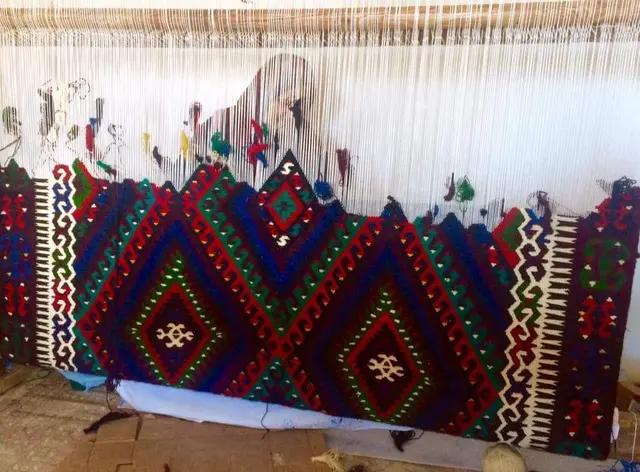
+2 More

Geographical Indication Type(s) | Protected Geographical Indication | ||||||||
|---|---|---|---|---|---|---|---|---|---|
Registration Number | 483 | ||||||||
Registration Date | 03.02.2020 | ||||||||
Product / Product Group(s) | Carpets and Rugs (Halılar ve kilimler) | ||||||||
Province(s) | Muğla | ||||||||
Seydiler Kilim is a geographically indicated type of flat-woven rug produced in the Seydiler, Seki, Atlıdere, and Ören neighborhoods of the Seydikemer district in Muğla Province, Türkiye. Reflecting a deep-rooted weaving tradition, it was registered as a Protected Geographical Indication on February 3, 2020, under the Industrial Property Law No. 6769, and is protected by the Fethiye Chamber of Commerce and Industry.
Seydiler Kilim is a traditional handwoven textile in which the nomadic Yörük communities of the region express their lifestyle through unique colors and motifs. These kilims are used as runners, prayer rugs, or saddlebags, and are characterized by several distinctive elements:
The production of Seydiler Kilim is a multi-stage process shaped by traditional knowledge and regional expertise. Each step carries both technical and cultural significance.
In the past, yarn was made by cleaning sheep’s wool and spinning it with a spindle (tengerek / kirman) to the desired fineness. The yarns were dyed using locally grown plants. Today, weavers often use commercially produced warp and weft yarns, though pattern yarns are frequently dyed by hand using traditional methods. Colors are created using time-tested local dyeing techniques.
Before dyeing, yarns undergo a mordanting process, locally known as faşıllama or acımıklama, to fix and enhance the durability of the colors. Natural substances such as alum, bitter orange, lemon peel, spurge, and thyme are used as mordants.
The dyeing process varies depending on the color:
Each dyeing method reflects techniques refined and transmitted through generations of local weavers.
Weaving is done on wooden looms locally known as “kilim ağacı.” The main parts of the loom include:
Seydiler Kilim is woven using the plain weave (tabby / bezayağı) technique. The process includes the following stages:
Each step represents a form of technical and cultural continuity sustained through generations.
The motifs, compositions, and color schemes of Seydiler Kilim reflect the inherited craftsmanship of local artisans. For this reason, every stage of production must take place strictly within the defined geographical boundaries.
Inspections are coordinated by the Fethiye Chamber of Commerce and Industry and carried out by a local expert committee. They evaluate the pattern structure, motif arrangement, dyeing methods, and use of the geographical indication at least once a year, or more frequently when required.
Türk Patent ve Marka Kurumu. “Seydiler Kilimi Coğrafi İşaret Sicil Belgesi.” Accessed October 25, 2025. https://ci.turkpatent.gov.tr/Files/GeographicalSigns/2588c413-b4a0-428c-9a6c-fa7e5c62f408.pdf
Türk Patent ve Marka Kurumu. “Seydiler Kilimi.” Coğrafi İşaretler Portalı. Accessed October 25, 2025. https://ci.turkpatent.gov.tr/cografi-isaretler/detay/38680

Geographical Indication Type(s) | Protected Geographical Indication | ||||||||
|---|---|---|---|---|---|---|---|---|---|
Registration Number | 483 | ||||||||
Registration Date | 03.02.2020 | ||||||||
Product / Product Group(s) | Carpets and Rugs (Halılar ve kilimler) | ||||||||
Province(s) | Muğla | ||||||||
Definition and Distinctive Features
Production Process
Yarn Preparation
Dyeing and Mordanting
Tools and Equipment
Weaving Technique
Geographical Boundary and Cultural Connection
Inspection
This article was created with the support of artificial intelligence.