
+2 More

Type(s) | Renewable Energy Technology | ||||||||
|---|---|---|---|---|---|---|---|---|---|
Primary Use | Global Energy Production | ||||||||
Key Technologies | Wireless Power Transmission Photovoltaics | ||||||||
Applications | Terrestrial Grids, Space Exploration | ||||||||
Benefits | Continuous Energy, High Efficiency | ||||||||
Challenge(s) | High Costs Transmission Safety | ||||||||
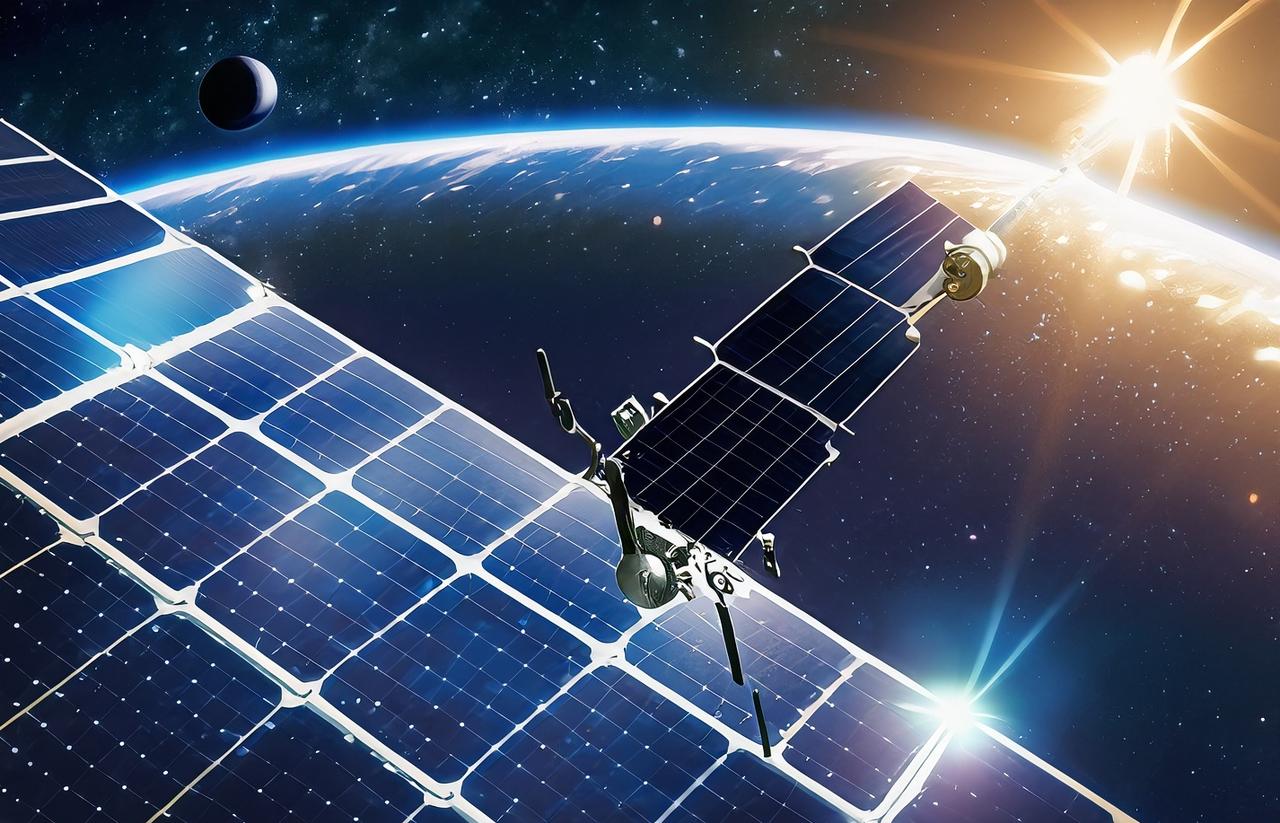
Space-Based Solar Power (SBSP) is the concept of capturing solar energy in outer space and transmitting it wirelessly to Earth for conversion into electricity. The system involves placing large solar power satellites in a high Earth orbit, where they can receive intense, unfiltered sunlight nearly 24 hours a day. This constant solar exposure avoids the limitations of terrestrial solar power, such as nighttime cycles, cloud cover, and atmospheric absorption. The collected energy is converted into microwaves or lasers and beamed to a dedicated receiving station on the ground, which then converts it back into usable electricity for distribution through the power grid.
A typical Space-Based Solar Power system consists of three primary segments: the space-based solar collector, the wireless power transmission system, and the ground-based receiving station. The space segment is a large satellite, often kilometers in scale, equipped with vast arrays of photovoltaic panels or solar thermal collectors. These satellites are typically proposed for geostationary orbit (GEO), allowing them to remain over a fixed point on Earth. In space, the satellite converts the captured sunlight into DC electricity. This electricity then powers the transmission system, which converts the energy into a precisely aimed beam of electromagnetic waves, usually microwaves. The ground segment consists of a large receiving antenna, which is an array of dipole antennas with rectifying diodes that convert the incoming microwave energy back into DC electricity for grid use.
The core technology enabling SBSP is wireless power transmission (WPT) over long distances. The most studied method involves converting the satellite's generated DC electricity into a high-frequency microwave beam, typically around 2.45 GHz or 5.8 GHz. This frequency is chosen to minimize atmospheric absorption and allow the beam to pass through clouds and precipitation with minimal energy loss. The satellite's transmitting antenna must be very large to focus the beam accurately onto the ground rectenna, which itself must cover a large area to capture the low-intensity energy beam. The power density of the beam is designed to be within established safety limits at its center and significantly lower at its edges, presenting a low risk to aircraft, wildlife, or persons that might inadvertently pass through it. An alternative concept uses lasers, but this method is more susceptible to atmospheric interference and requires a direct line of sight.
The implementation of Space-Based Solar Power faces significant technical and economic challenges. A primary obstacle is the high cost associated with launching the massive weight and volume of the solar power satellites into geostationary orbit. The in-space assembly and maintenance of these large and complex structures would require advanced robotics and autonomous systems that are still in development. Another major challenge is achieving a high end-to-end conversion efficiency, from the initial collection of sunlight in space to the final delivery of electricity to the terrestrial grid, to ensure the system is economically viable. The long-term durability of the satellite's components, particularly the solar panels and electronics, in the harsh radiation environment of space is also a critical consideration for the system's operational lifetime and financial return.
Abhilash, P. C., et al. “Recent Advancements in Agriculture Robots: Benefits and Challenges.” Machines 11, no. 1 (2023). Accessed: September 14, 2025. https://www.mdpi.com/2075-1702/11/1/48.
Green.org. "Space-Based Solar Power." Accessed: September 14, 2025. https://green.org/wp-content/uploads/2024/01/Space-Based-Solar-Power-3.jpg.
Marinoudi, V., et al. "Evaluating an autonomous electric robot for real farming." ScienceDirect. Accessed: September 14, 2025. https://www.sciencedirect.com/science/article/pii/S2772375524002004.
Mousa, M.A.A., et al. "Application of AI techniques and robotics in agriculture." ScienceDirect. Accessed: September 14, 2025. https://www.sciencedirect.com/science/article/pii/S2667318523000016.
Raja, M., and T. S. N. S. Hemanth, eds. Robots and Autonomous Machines for Agriculture Production. MDPI Books, 2024. Accessed: September 14, 2025. https://www.mdpi.com/books/reprint/7738-robots-and-autonomous-machines-for-agriculture-production.
Yang, Tian, et al. "Editorial: Intelligent robots for agriculture." Frontiers in Robotics and AI. Accessed: September 14, 2025. https://www.frontiersin.org/journals/robotics-and-ai/articles/10.3389/frobt.2025.1597912/full.

Type(s) | Renewable Energy Technology | ||||||||
|---|---|---|---|---|---|---|---|---|---|
Primary Use | Global Energy Production | ||||||||
Key Technologies | Wireless Power Transmission Photovoltaics | ||||||||
Applications | Terrestrial Grids, Space Exploration | ||||||||
Benefits | Continuous Energy, High Efficiency | ||||||||
Challenge(s) | High Costs Transmission Safety | ||||||||
No Discussion Added Yet
Start discussion for "Space-Based Solar Power" article
System Architecture and Operating Principle
Wireless Power Transmission
Technical and Economic Challenges
This article was created with the support of artificial intelligence.