


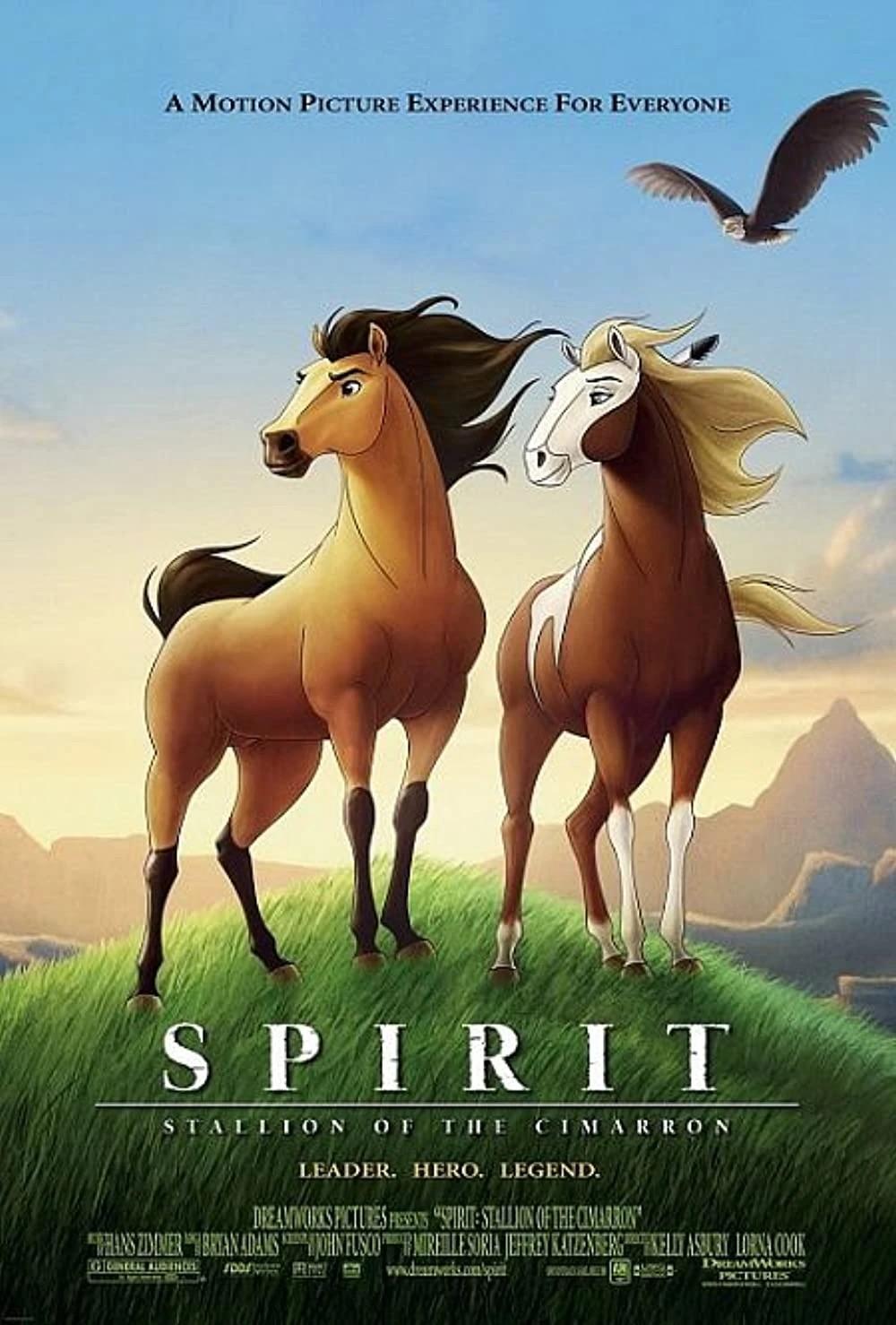
Movie poster (Photo: Wildtech, Spirit Fandom)
Director(s) | Lorna Cook Kelly Asbury | ||||||||
|---|---|---|---|---|---|---|---|---|---|
Screenplay(s) | John Fusco | ||||||||
Production Company | Jeffrey Katzenberg Mireille Soria | ||||||||
Release Date(s) | May 24 2002 | ||||||||
Runtime | 83 minutes | ||||||||
Spirit: Stallion of the Cimarron is a 2002 American Western animated film produced by DreamWorks Animation. Directed by Kelly Asbury and Lorna Cook, the film was created using a combination of traditional animation and computer-generated imagery (CGI).
Set in the late 19th century, during the period of the American Indian Wars, the story follows the journey of Spirit, a Kiger Mustang stallion. Spirit is captured by the U.S. Cavalry but is eventually freed by a Lakota man named Little Creek and a mare named Rain. Unlike many other animated films featuring animal characters, Spirit and the other horses do not speak in human language but express their emotions and communication through non-verbal sounds and body language. While the horses display human-like facial expressions, the film avoids full anthropomorphism in their portrayal.
Spirit: Stallion of the Cimarron was released on May 24, 2002. Although its box office performance fell short of expectations, earning $122 million against an $80 million budget, the film received positive reviews from critics and was nominated for the Academy Award for Best Animated Feature.
Movie poster (Photo: Wildtech, Spirit Fandom)
Set in the American West during the late 19th century, Spirit: Stallion of the Cimarron begins with the birth of Spirit, a young Kiger Mustang foal. Growing up as part of a wild horse herd, he eventually becomes the leader. One night, while patrolling his territory, Spirit notices an unusual light in the distance. Curious, he follows the light and discovers a group of men camping with their horses tied up nearby. When the men wake up, they capture Spirit and take him to a U.S. Cavalry fort.
The Colonel, the fort’s commander, attempts to break Spirit’s will and tame him using harsh training methods. However, Spirit resists all efforts, even fighting off the blacksmith. Frustrated, the Colonel ties Spirit to a post without food or water for three days in an attempt to weaken him. Meanwhile, a Lakota Native American man named Little Creek is also captured and brought to the fort. His companions smuggle a knife over the wall, allowing him to free himself.
On the third day, Spirit is so weakened that the Colonel momentarily gains control over him, declaring, "Every wild horse can be tamed." Witnessing the despair of the other captive horses, Spirit gathers his strength, throws off the Colonel, and escapes. During his escape, he frees the other horses as well. Spirit and Little Creek flee together, heading toward the Lakota village. Although Little Creek attempts to tame Spirit, Spirit refuses to be broken. Over time, however, he bonds with Rain, a domesticated mare. As his connection with Rain deepens, a mutual respect forms between Spirit and Little Creek, who eventually realizes that Spirit was never meant to be tamed and decides to let him go.
As Spirit prepares to return to his herd, he witnesses the U.S. Cavalry preparing to attack the Lakota village. He returns to help defend the village. During the battle, the Colonel shoots Rain, causing her to fall into the river. Spirit rushes to save Rain, knocking the Colonel off his horse and preventing further attacks. Searching for Rain, Spirit falls into the river’s strong currents, but he ultimately finds Rain alive. However, before they can escape, the Colonel and his men recapture them and leave them for dead.

Rain and Spirit (Photo: The Guardian)
Little Creek, realizing that Spirit had saved his village, follows the soldiers to rescue him. Spirit, along with other captive horses, is loaded onto a train for transportation. Feeling hopeless, Spirit remembers his herd, regains his strength, and manages to escape, freeing the other horses as well. He causes a train accident, setting off a massive fire in the forest before finally gaining his freedom with Little Creek’s help.
The next day, the Colonel and his cavalry pursue Spirit and Little Creek into the Grand Canyon, resulting in a high-speed chase. Spirit makes a daring leap across a deep canyon, successfully escaping. Impressed by his courage, the Colonel chooses to end the chase and respectfully acknowledges Spirit's indomitable will.
After celebrating their freedom, Spirit and Little Creek reunite with Rain, who has fully recovered. Little Creek names him "Spirit Who Cannot Be Broken" and entrusts Rain to his care. Spirit returns to his herd, reunites with his mother, and continues his life as a free stallion, running across the open plains.
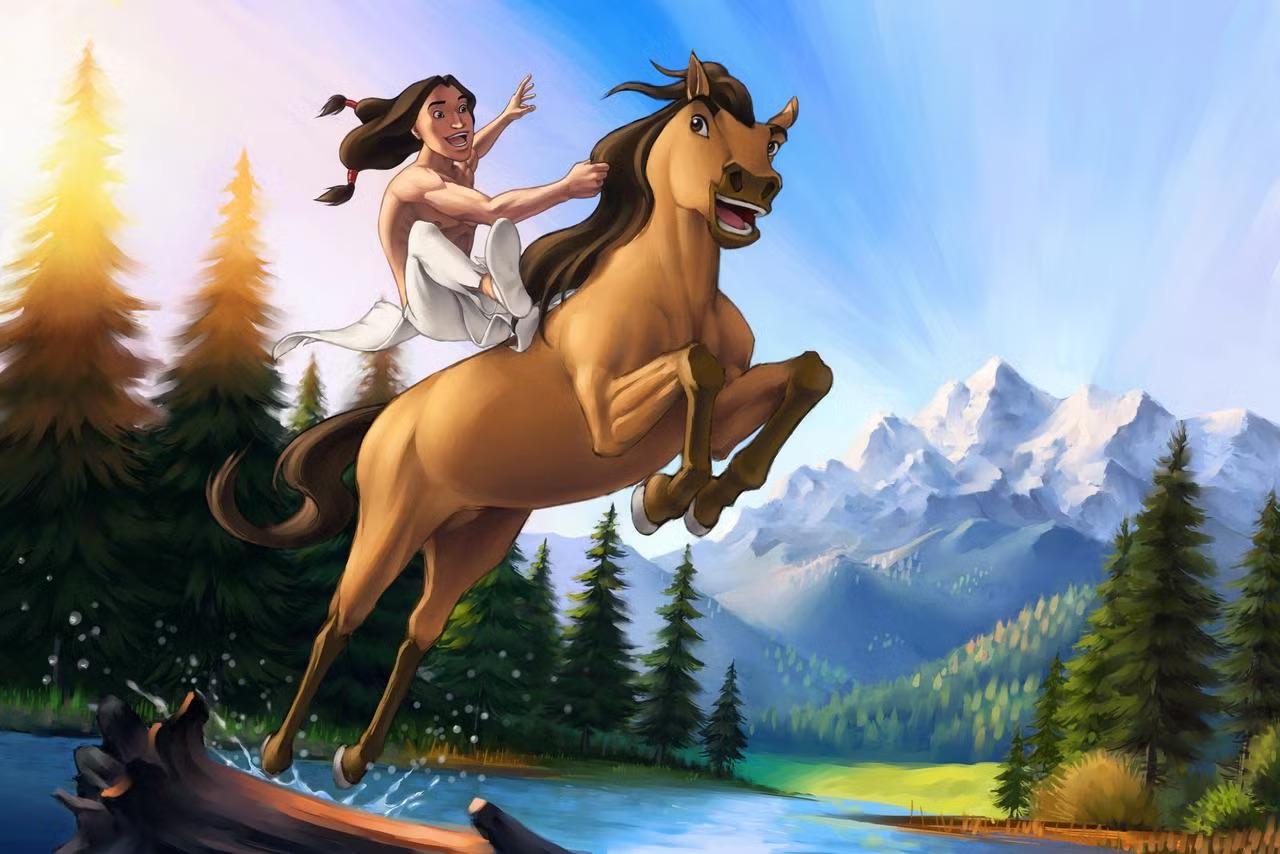
Little Creek and Spirit fan art (Photo: HawkeyeWong)
The film ultimately portrays the impact of colonization not only as a cultural struggle but also as a symbol of humanity’s intrusion into nature. Spirit and the other characters raise a universal question: Is mankind's desire to dominate nature simply a physical trait, or is it an inherent, fundamental instinct? This film tells the story of resistance against that instinct.
The main character, Spirit, does not speak but narrates the story. His character represents freedom and resistance, forming an emotional connection with the audience.
A Native American man who befriends Spirit. He respects Spirit’s independence and ultimately realizes that Spirit was never meant to be tamed.
A domesticated mare and Spirit’s love interest. She is loyal and brave, symbolizing the emotional bonds Spirit develops.
The ruthless leader of the Cavalry fort. He views Spirit’s freedom as a challenge to his authority, but in the end, he acknowledges Spirit’s untamed nature.
The production of Spirit: Stallion of the Cimarron combined both traditional hand-drawn animation and computer-assisted techniques. Animators closely studied real horses to ensure accurate movement and behavior, blending realistic animation with expressive character designs. The film features minimal dialogue, relying on visual storytelling and emotional expressions.
During production, the animation team traveled across the American West to gather inspiration from natural landscapes. Locations such as Glacier National Park, Yellowstone National Park, Yosemite National Park, and the Teton Range influenced the film’s scenery. The Cavalry fort was inspired by Monument Valley, further enhancing the authenticity of the film’s setting.
Lead animator James Baxter described animating the horses as one of the most challenging aspects of production. Initially, he underestimated the complexity of horse anatomy and movement, which led to intensive study and observation. To capture realistic horse behavior, the animation team brought a live horse named "Donner" to their studio in Glendale, California, using it as a real-life reference model.
The sound design also received meticulous attention. Tim Chau and his sound team recorded real horse sounds at ranches outside Los Angeles to create authentic audio effects. Unlike many animated films, none of the animal characters speak English, except for Matt Damon's narration as Spirit. Instead, the horses’ natural vocalizations and hoof sounds were carefully recorded to enhance realism.
Sargın, B. (2022). Amerika ve Türkiye Yapımı Animasyon Filmlerinde Biçimbilimsel Analiz: Özgür Ruh ve Doru Örneği. İletişim Ve Toplum Araştırmaları Dergisi, 2(2), 154-170. https://doi.org/10.29228/itamder.4
"Film Hafızası - Size İnsan Anlatacağım: Spirit". Fil'm Hafızası. Erişim: 30 Ocak 2025. https://filmhafizasi.com/sizeinsanianlatacagim83211-2/
Doğukan, Büyüközkan. "Spirit Film İncelemesi: Macera Dolu Bir Öykü”. Söylenti. Son erişim : 30 Ocak 2025. https://www.soylentidergi.com/spirit-film-incelemesi-macera-dolu-bir-oyku/
Peter, Bradshaw. Spirit: Stallion of the Cimarron review – disappointingly tame tale of a wild horse [JPG]. The Guardian. Erişim adresi: https://www.theguardian.com/film/2002/jul/05/culture.reviews1
Wildtech. Spirit: Stallion of the Cimarron [JPG]. Spirit fandom. Erişim adresi: https://spirit.fandom.com/wiki/Spirit:_Stallion_of_the_Cimarron?file=Spirit_Stallion_of_the_Cimarron_poster_2.jpg
ScreenAnt. Little Creek and Spirit [JPG]. Erişim adresi: https://screenrant.com/spirit-stallion-cimarron-pieces-spirit-fan-art-fans-have-see/

Movie poster (Photo: Wildtech, Spirit Fandom)
Director(s) | Lorna Cook Kelly Asbury | ||||||||
|---|---|---|---|---|---|---|---|---|---|
Screenplay(s) | John Fusco | ||||||||
Production Company | Jeffrey Katzenberg Mireille Soria | ||||||||
Release Date(s) | May 24 2002 | ||||||||
Runtime | 83 minutes | ||||||||
No Discussion Added Yet
Start discussion for "Spirit: Stallion of the Cimarron" article
Plot Summary
Cast and Characters
Production Process
Animation and Design