+2 More

Location | Tarsus Mersin / Türkiye | ||||||||
|---|---|---|---|---|---|---|---|---|---|
Year Built | 1850 | ||||||||
Restoration Period | 1997–2001 | ||||||||
Area(s) | 460 m² | ||||||||
Opened as Museum | 2001 | ||||||||
Architectural Plan | Three-nave rectangular church with apses | ||||||||
Floor Material | Black-and-white marble tiles | ||||||||
Architectural Feature(s) | Rectangular plan Corinthian capitals frescoes of Christ and the Four Evangelists four-column vaulted portico three naves | ||||||||
UNESCO Status | Added to Temporary List in 2000 as “St. Paul Church, Well and Historical Surroundings | ||||||||
The St. Paul Monument Museum is located in Tarsus, Mersin, Türkiye. It was created by restoring St. Paul Church, a significant site in early Christian history, transforming it into a museum. Notable for both its architectural features and religious function, the building today serves as a center for touristic and faith-based visits. In 2000, the church, its well, and surrounding historic area were added to the UNESCO World Heritage Temporary List, ensuring protection under international guidelines.

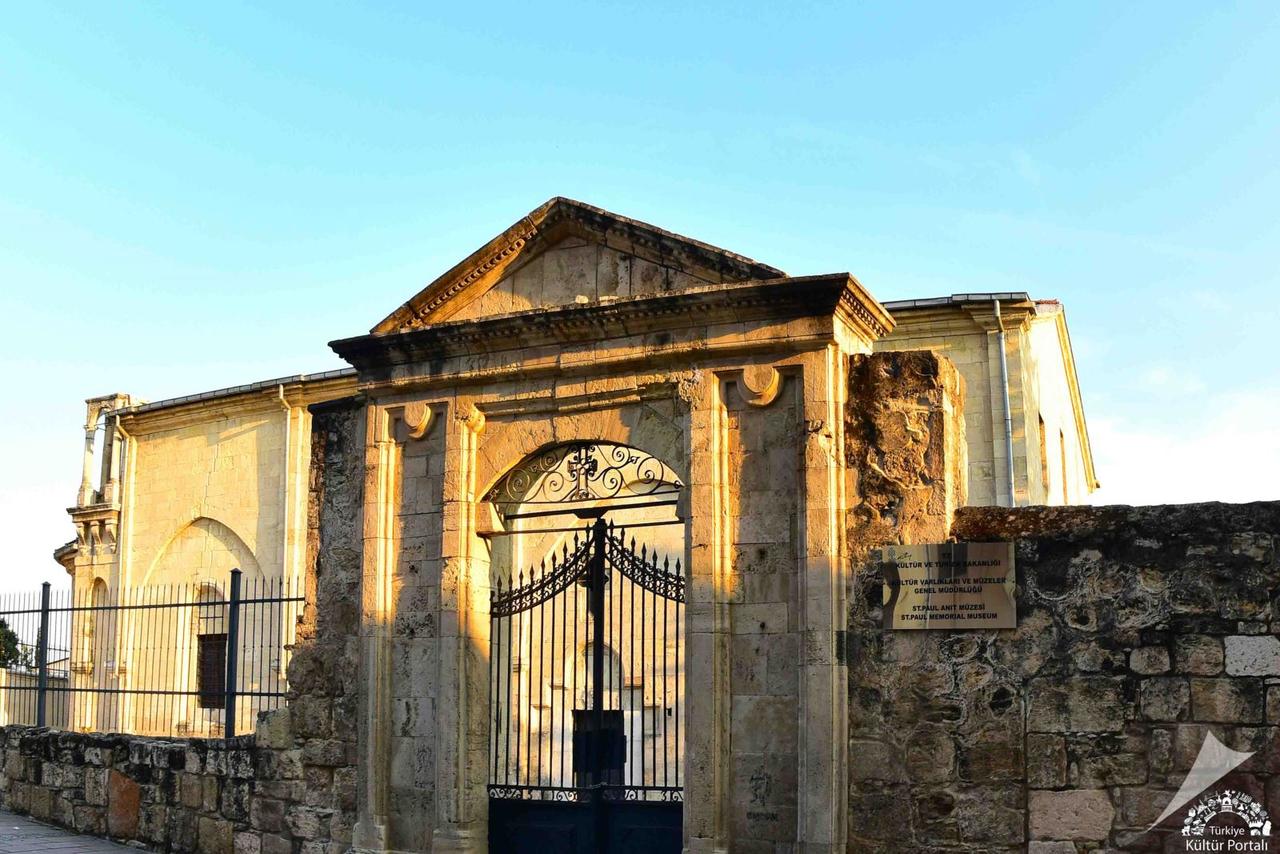
St. Paul Memorial Museum (T.C. Tarsus Kaymakamlığı)
While there are varying opinions regarding the exact construction date, the church was built in 1850 by the Orthodox Arab-Greek Community in Tarsus. Since Christianity was officially recognized from the 4th century AD, many churches dedicated to Saint Paul were constructed. This church remains the only surviving example in Tarsus, the birthplace of Saint Paul, making it one of the city’s most important monumental structures. A major renovation was conducted in 1862.
Until 1993, the church was used for different purposes. In 1994, it was officially registered and transferred to the Ministry of Culture. Restoration began in 1997 and was completed in 2001, after which it opened as the St. Paul Monument Museum. The restoration not only preserved the building but also incorporated surrounding properties to create a holistic environment.
The church occupies an area of 460 m², featuring a rectangular plan with three naves. Its monumental entrance on the north façade stands out for its symmetrical design. To the right of the entrance lies the St. Paul Well, approximately 30 meters deep, considered sacred by Christians and used in baptism ceremonies.
The vaulted portico on the west façade, supported by four columns, is painted sky blue inside and adorned with stylized plant motifs at the corners. Corinthian column capitals reflect classical architectural influence. The floor consists of black-and-white marble tiles, with a triangular pattern emphasizing the prayer area.

The Interior (Türkiye Kültür Portalı)
The interior highlights religious frescoes and iconographic elements. The sacred area, where the central nave meets the apse, is separated by a decorated marble screen. Wall niches are designed for depictions of saints and icons, repeated in the side apses. Above the central apse, a circular window is flanked by two angel figures, with a landscape motif below.

The Interior (Türkiye Kültür Portalı)
The vault features a “Eye motif” inside a triangle, followed by depictions of Jesus Christ and the Four Evangelists. Each evangelist is represented with their traditional symbols: John with an eagle, Mark with a lion, Matthew (upper part damaged), and Luke with an ox. Figures wear red and blue robes, depicted frontally. Christ is shown extending his right hand forward.
A small column supports a bell tower at the northeast, while the south façade has a wooden balcony mezzanine accessed by a dual-exit stone staircase. The balcony’s railing features landscape paintings. Symmetrically placed windows in apses and side walls provide lighting, some shaped like crosses.

The Authors of the Four Gospels and the Prophet. Jesus. (T.C. Tarsus Kaymakamlığı)
The museum operates under the Ministry of Culture and Tourism, and entry is available via Museum Card (MüzeKart).
The museum is a significant pilgrimage site in the Christian world. Services and baptisms are occasionally held here. Architecturally, the church combines Catholic and Orthodox features. During 2008–2009, the “St. Paul Year” declared by Pope Benedict XVI increased the church’s international recognition, attracting many Christian visitors.
Anadolu Ajansı. “Tarsus’un UNESCO Gözdesi: St. Paul.” Anadolu Ajansı. Access date: 29 April 2025. https://www.aa.com.tr/tr/turkiye/tarsusun-unesco-gozdesi-st-paul/1239869
T.C. Kültür ve Turizm Bakanlığı. “St. Paul Anıt Müzesi.” Türkiye Kültür Portalı. Access date: 29 April 2025. https://www.kulturportali.gov.tr/turkiye/mersin/gezilecekyer/st-paul-anit-muzesi
T.C. Kültür ve Turizm Bakanlığı. “St. Paul Anıt Müzesi.” Muze.gov.tr. Access date: 29 April 2025. https://muze.gov.tr/muze-detay?SectionId=MPM01&DistId=MRK
T.C. Tarsus Kaymakamlığı. “St. Paul Anıt Müzesi.” T.C. Tarsus Kaymakamlığı Offical Website. Access date: 29 April 2025. http://www.tarsus.gov.tr/st-paul-anit-muzesi

Location | Tarsus Mersin / Türkiye | ||||||||
|---|---|---|---|---|---|---|---|---|---|
Year Built | 1850 | ||||||||
Restoration Period | 1997–2001 | ||||||||
Area(s) | 460 m² | ||||||||
Opened as Museum | 2001 | ||||||||
Architectural Plan | Three-nave rectangular church with apses | ||||||||
Floor Material | Black-and-white marble tiles | ||||||||
Architectural Feature(s) | Rectangular plan Corinthian capitals frescoes of Christ and the Four Evangelists four-column vaulted portico three naves | ||||||||
UNESCO Status | Added to Temporary List in 2000 as “St. Paul Church, Well and Historical Surroundings | ||||||||
No Discussion Added Yet
Start discussion for "St. Paul Monument Museum" article
History and Preservation Process
Architectural Features
Interior and Artistic Elements
Usage and Visiting Information
Religious and Cultural Tourism
This article was created with the support of artificial intelligence.