


Succulent plants are species that have evolved unique adaptations to survive in arid and semi-arid ecosystems. These plants can store water in their stems, leaves, or roots, making them exceptionally resilient to drought conditions.
Succulent plants possess specialized structures called hydrenchyma, which allow them to store water within their cellular tissues. These structures enable the plant to survive extended periods of drought. The cell walls of succulents are typically thin and elastic, allowing them to contract during water loss while maintaining structural integrity. This characteristic enhances their resilience to dehydration cycles and provides a biomechanical advantage.
Additionally, succulent plants utilize a unique photosynthetic pathway known as Crassulacean Acid Metabolism (CAM). This metabolic adaptation allows the plant to absorb carbon dioxide during the night, minimizing water loss during the daytime. CAM metabolism is one of the most crucial adaptations that enable succulents to thrive in arid environments.

Succulent.
Succulent plants exhibit remarkable diversity across different ecosystems, particularly in arid regions. This group comprises approximately 10,000 to 12,500 species, which have independently evolved in over 30 different plant lineages.
The most well-known succulent families include:
Succulents play a crucial role in ecosystems. In regions experiencing desertification, these plants contribute to soil stabilization and serve as essential components of the food chain. Additionally, succulents support pollinators such as bees and other insects by providing vital habitats.
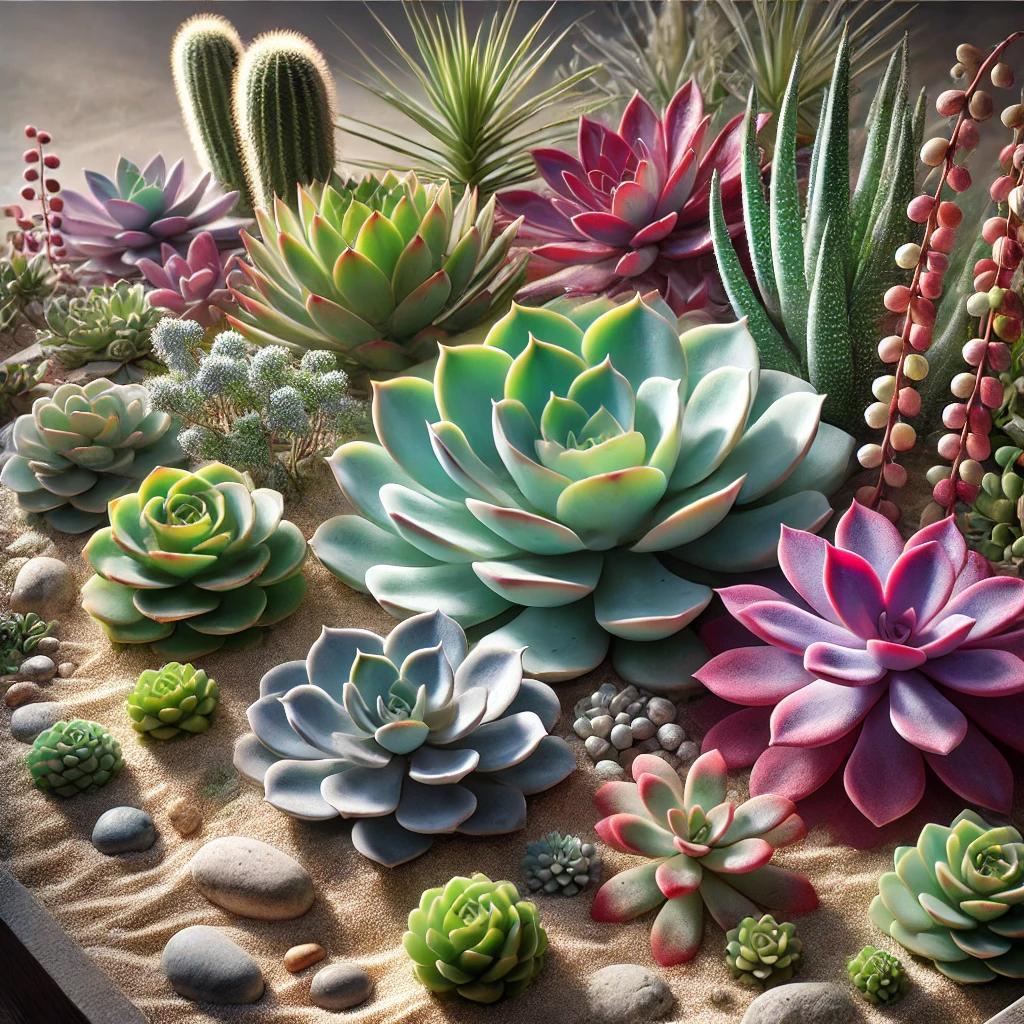
Types of Succulents.
The evolutionary origins of succulent plants date back millions of years. For instance, cacti are estimated to have originated around 35 million years ago during the Miocene Epoch, a period characterized by the expansion of arid regions. During this time, Crassulacean Acid Metabolism (CAM) and other drought adaptations rapidly diversified.
From an evolutionary perspective, succulents have developed various adaptations to fill ecological niches in arid environments:
Climate change poses a significant threat to ecosystems through increasing drought and rising temperatures. In this context, succulents are gaining importance due to their contributions to carbon sequestration, landscape restoration, and climate resilience. However, the destruction of natural habitats and overharvesting threaten many succulent species with extinction. Sustainable cultivation techniques and conservation programs are critical to securing the future of these plants.
Succulent plants, with their remarkable adaptations to harsh environments and crucial ecological roles, represent one of nature’s marvels. They offer great potential for biodiversity conservation and sustainable use. Future research focusing on genetic diversity, drought resistance, and ecosystem services will enhance our understanding of this unique plant group.
Mucina, Ladislav, Norbert Jürgens, Annelise le Roux, Michael C. Rutherford, Ute Schmiedel, Karen J. Esler, Leslie W. Powrie, Philip G. Desmet, ve Susanne J. Milton. Succulent Karoo Biome. Strelitzia 19, 2006.
Vendramini, Fernanda, Sandra Díaz, Diego E. Gurvich, Peter J. Wilson, Ken Thompson, ve John G. Hodgson. “Leaf Traits as Indicators of Resource-Use Strategy in Floras with Succulent Species.” New Phytologist 154, no. 1 (2002): 147–157. Accessed: 31.01.2025 https://doi.org/10.1046/j.1469-8137.2002.00357.x.
Grace, Olwen M. “Succulent Plant Diversity as Natural Capital.” Plants, People, Planet 1, no. 4 (2019): 336–345. Accessed: 31.01.2025 https://doi.org/10.1002/ppp3.25.
Fradera-Soler, Marc, Olwen M. Grace, Bodil Jørgensen, ve Jozef Mravec. “Elastic and Collapsible: Current Understanding of Cell Walls in Succulent Plants.” Journal of Experimental Botany 73, no. 8 (2022): 2290–2307. Accessed: 31.01.2025 https://doi.org/10.1093/jxb/erac054.
Arakaki, Mónica, Pascal-Antoine Christin, Reto Nyffeler, Anita Lendel, Urs Eggli, R. Matthew Ogburn, Elizabeth Spriggs, Michael J. Moore, ve Erika J. Edwards. “Contemporaneous and Recent Radiations of the World’s Major Succulent Plant Lineages.” Proceedings of the National Academy of Sciences of the United States of America 108, no. 20 (2011): 8379–8384. Accessed: 31.01.2025 https://doi.org/10.1073/pnas.1100628108.
Griffiths, Howard, ve Jamie Males. “Succulent Plants.” Current Biology 27, no. 17 (2017): R853–R909. Accessed: 31.01.2025 https://doi.org/10.1016/j.cub.2017.07.056.

Key Characteristics and Physiology of Succulents
Ecological Role and Diversity of Succulents
Evolutionary History and Adaptation Process
Climate Change and the Importance of Succulents
This article was created with the support of artificial intelligence.