


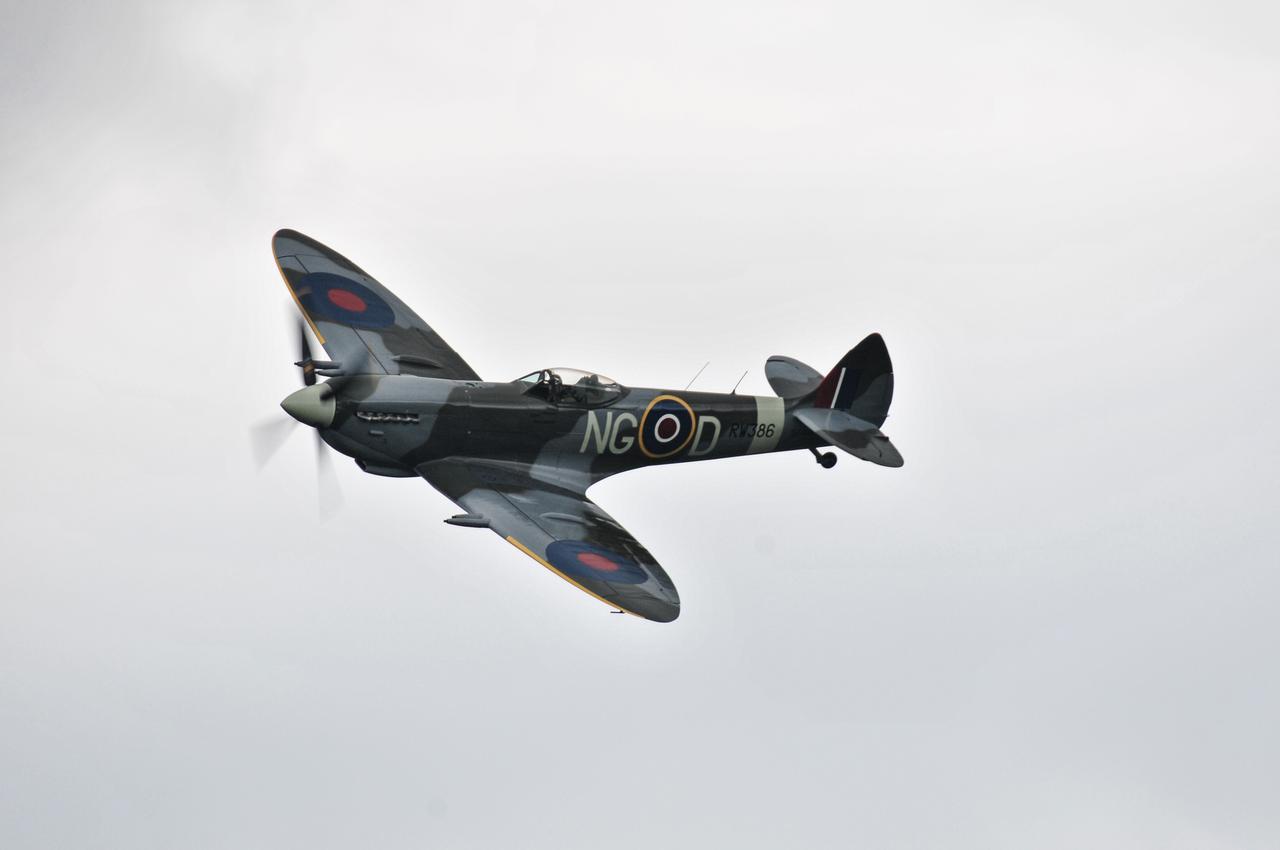
The Supermarine Spitfire is one of the fighter aircraft produced for the Royal Air Force (RAF) during World War II and significantly altered the course of the war. Designed by Reginald J. Mitchell, this aircraft made its maiden flight on March 5, 1936, and entered service in 1938.
The Spitfire is particularly renowned for its aerodynamic design, maneuverability, and speed. Its elliptical wing structure reduced drag, enhancing flight performance. Equipped with the Rolls-Royce Merlin engine, the Spitfire operated effectively at high altitudes and achieved superiority over enemy aircraft.
This aircraft is especially remembered for its critical role in the Battle of Britain in 1940. Establishing an effective defense against the German Luftwaffe, the Spitfire contributed to the RAF’s victory. Various models were produced and developed for different missions. Even after the war, it served in the air forces of many nations.
The Supermarine Spitfire is recognized as one of the most iconic fighter aircraft of World War II. Its design originated in the early 1930s with the British Air Ministry's F7/30 specification, which called for a modern fighter capable of 250 mph to replace the Gloster Gauntlet biplane. Supermarine’s chief designer, R.J. Mitchell, responded with the Type 224 model. However, this open-cockpit, fixed-landing-gear design failed to meet expectations and was not approved for production.
Following this disappointment, Mitchell and his team drew upon their experience from Schneider Trophy seaplane races to develop a more aerodynamic and advanced design: the Type 300. This new design featured retractable landing gear, an enclosed cockpit, and the more powerful Rolls-Royce PV XII V-12 engine (later named "Merlin"). Detailed design work began in 1934, and on December 1, 1934, the Air Ministry awarded a £10,000 contract for the prototype of Mitchell’s improved Type 300 design.

Supermarine Type 250 (Photo: Dizzyfugu, flickr.com)
On March 5, 1936, the prototype, serial number K5054, made its first flight from Eastleigh Aerodrome. Piloted by Vickers’ chief test pilot, Captain Joseph "Mutt" Summers, the flight lasted approximately eight minutes. Following this successful flight, the prototype underwent various improvements and tests, focusing on speed and maneuverability. Initial tests measured a speed of 330 mph, which increased to 348 mph with a new, better-shaped two-blade wooden propeller.
After successful prototype tests, on June 3, 1936, the Air Ministry placed an order worth £1,395,000 for the production of 310 Spitfires, initiating its mass production. Throughout World War II, the Spitfire became one of the most critical fighter aircraft for Allied forces. Its pivotal role in the Battle of Britain highlighted its durability and flexibility, helping it gain superiority over powerful rivals like the Luftwaffe’s Messerschmitt Bf 109. The Spitfire also became a symbol of Britain’s national resistance.

Supermarine Spitfire in Factory (Photo: MemoryCatcher, pixabay.com)
Mitchell and his team adopted an elliptical wing design to enhance the aircraft’s performance. This design allowed the wings to remain thin, reducing drag, while also being thick enough to house retractable landing gear and weapon systems. The elliptical planform minimized induced drag, improving aerodynamic efficiency. Additionally, the alignment of the pressure center with the main spar prevented wing twisting.
The Spitfire’s wing structure featured an innovative spar design composed of five square tubes, which tapered in thinner regions to create a lightweight yet strong main spar. The landing gear was mounted on the rear section of the main spar, enabling a retractable design. The thick covering at the wing’s leading edge formed a rigid D-shaped box structure to bear wing loads. Initially intended for an evaporative cooling system, this structure was later adapted to house integral fuel tanks.
Mitchell’s goal was to create a light but strong fighter aircraft. During its production, advanced technologies such as Merlin engines were employed. The Rolls-Royce Merlin engine enabled the Spitfire to reach speeds exceeding 600 km/h. The Spitfire had multiple variants, such as the Mk I, Mk V, and Mk IX, each optimized for different mission requirements. For instance, the Mk IX model was more effective at high altitudes due to its more powerful engine and increased armament capacity.
With over 20,300 units produced, the Spitfire not only became an example of advanced aviation engineering but also reflected the spirit of collective effort, as women and young workers played significant roles in its production, especially after factory bombings.

Technical Drawing of Supermarine Spitfire (Photo: Blueprints)
The Spitfire faced numerous Luftwaffe aircraft, particularly the Messerschmitt Bf 109. It is estimated to have contributed to the downing of over 1,200 German aircraft during the Battle of Britain. Additionally, it participated in missions such as the Normandy landings and the North African campaigns. The Spitfire demonstrated its versatility by performing not only as a fighter but also in reconnaissance and bombing roles.

Supermarine Spitfire (Photo: Lillandie, pixabay.com)
One major issue with the Spitfire was the delivery delays during its early production phase. Although initial orders were placed in 1936, production challenges meant that deliveries did not occur until 1938. The elliptical wing design, requiring high precision, slowed production speeds.
Furthermore, the Spitfire’s narrow landing gear made takeoffs and landings on muddy or uneven airstrips challenging. The initial fuel tanks were prone to puncture and ignition under enemy fire, posing risks to pilot safety. This issue was later addressed with the introduction of armored plates and self-sealing fuel tanks.
The Spitfire’s complex design also posed maintenance challenges, particularly during the war, when quick repairs were essential. The compact arrangement of components often extended maintenance times, creating operational difficulties.

Maintenance of a Supermarine Spitfire (Photo: Phil Defer, flickr.com)
Spitfire pilots praised the aircraft’s maneuverability and speed. Notable pilots like Geoffrey Wellum described the Spitfire as an extension of the pilot’s own body. In his memoir First Light, Wellum expressed the exhilaration he felt when flying the Spitfire: "It was unlike anything I had ever experienced. It was like a dream, a Peter Pan kind of dream."【1】 However, some pilots criticized the cramped cockpit design and limited visibility. Despite these drawbacks, the Spitfire was widely regarded as one of the best fighter aircraft of its time.
Spitfire Pilot John Romain (Photo: Peter Berrill, flickr.com)
Spitfire pilots often employed "turn fighting" tactics that emphasized the aircraft’s superior maneuverability. The Spitfire performed well even at low altitudes, using high-speed dives and sudden turns to outmaneuver opponents. Against aircraft like the Messerschmitt Bf 109, pilots focused on maintaining energy and altitude advantage. During the Battle of Britain, strategies incorporating radar system data allowed rapid responses, further enhancing the Spitfire’s effectiveness.
Bungay, S. (2000). The Most Dangerous Enemy: A History of the Battle of Britain. Aurum Press.
Bishop, E. (2004). Spitfire: The Biography. HarperCollins.
Royal Air Force Müzesi. "Supermarine Spitfire.” Son erişim: 25 Ocak 2025. www.rafmuseum.org.uk
Brown, Eric. Wings of the Luftwaffe. London: Airlife Publishing, 2017.
Price, Alfred. Spitfire: The Biography. London: Macmillan, 2002.
Geoffrey, Wellum. First Light. Vikingd Press, 2002.
MemoryCatcher (17 Ocak 2020). Tükürük ateşi, İkinci dünya savaşı, Uçak görseli [JPG].
Pixabay. Erişim adresi: https://pixabay.com/tr/photos/t%C3%BCk%C3%BCr%C3%BCk-ate%C5%9Fi-ikinci-d%C3%BCnya-sava%C5%9F%C4%B1-4772857/
lillandie (8 Nisan 2017). Spitfire, Hava gösterisi [JPG]. Pixabay. Erişim adresi: https://pixabay.com/tr/photos/spitfire-hava-g%C3%B6sterisi-plan-2206592/
Dizzyfugu (25 Ocak 2020). 1:72 Supermarine (Type 250) “Skylark Mk. I”, aircraft “50” of the Irish Army Air Corps (IAAC) No. 1 Squadron; Baldonnel (Dublin), late 1938 (What-if/modified Hasegawa kit) [JPG]. Flickr. Erişim adresi: https://flic.kr/p/2ifuQBS
Phil DeFer (28 Temmuz 2015). Supermarine Spitfire [JPG]. Flickr. Erişim adresi: https://flic.kr/p/wiKhRB
Drawingdatebase. Supermarine Spitfire Blueprint [JPG]. Drawing database. Erişim adresi: https://drawingdatabase.com/supermarine-spitfire/
Peter Berrill (1 Kasım 2018). Spitfire Pilot [JPG]. Flickr. Erişim adresi:https://flic.kr/p/29P3Jto
[1]
Geoffrey, Wellum. First Light. Vikingd Press, 2002.

No Discussion Added Yet
Start discussion for "Supermarine Spitfire (EN)" article
Historical Development and Early Prototypes
Design
Combat, Achievements, and Missions
Chronic Issues
Pilot Feedback
Combat Strategies of Spitfire Pilots