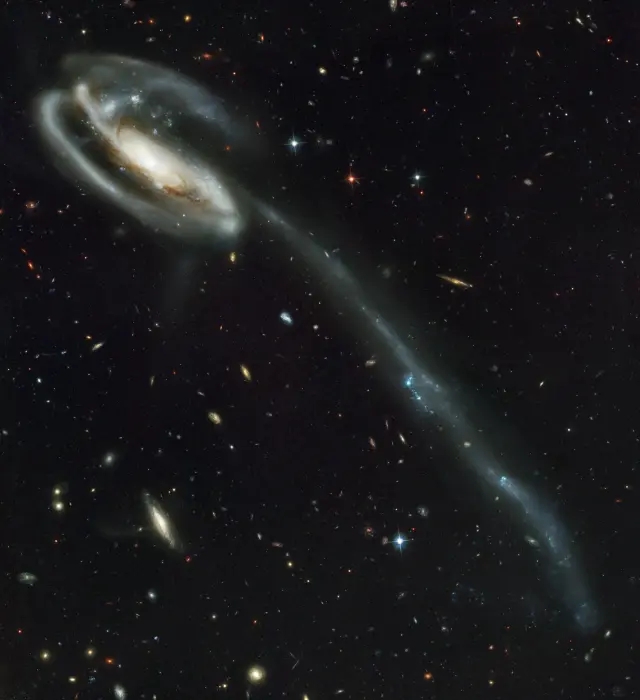


Tadpole Galaxy, or catalogued as UGC 10214, is a collision-distorted spiral galaxy located in the constellation Draco. Situated approximately 420 million light-years away, this celestial object is named “tadpole” due to its prominent tail-like structure. This tail, which extends to about 280,000 light-years in length, is composed of interstellar material, young stars, and star clusters.

Tadpole Galaxy Compass and Scale (NASA)
UGC 10214 was first identified as part of the UGC (Uppsala General Catalogue of Galaxies). However, it gained widespread attention following detailed observations by the Hubble Space Telescope (HST) in 2002. High-resolution images taken with Hubble’s Advanced Camera for Surveys (ACS) revealed the galaxy’s morphological structure in great detail.
The Tadpole Galaxy is classified as a distorted disk galaxy resulting from a galactic collision. Its main body displays a disrupted spiral structure, while the tail-like part consists of stars and gas ejected from the galaxy due to tidal interactions.
This tail structure is the result of a past close encounter with another smaller celestial object, likely a dwarf galaxy. Observations show that this interaction disrupted the galaxy’s structural integrity and increased the star formation rate.
Intense star formation is observed in both the tail region and areas near the galaxy’s core. The stars formed in these regions are typically short-lived, hot, and massive. Spectral analyses indicate that many of these stars belong to the blue giant class. In addition, numerous open star clusters scattered throughout the tail point to a starburst process triggered by the galactic collision.
UGC 10214 is significant for understanding the impact of galactic interactions on morphology. The observed phenomena such as structural deformations following a collision, disruption of spiral arms, increased star formation rates, and formation of tidal tails are directly related to theories of galactic evolution. In this context, the Tadpole Galaxy serves as a case study for examining post-collision galactic morphology in its later stages.
UGC 10214 has been studied not only with Hubble but also with various other telescopes such as the Spitzer Space Telescope, Chandra X-ray Observatory, and GALEX. These observations have revealed the galaxy’s characteristics across different wavelengths, providing data on star formation and possible core activity in the infrared and X-ray bands.
Currently available data suggest that the galaxy does not have a prominent active galactic nucleus (AGN), although there may have been core activity in the past.
The Tadpole Galaxy offers a clear and observable example of how close galactic collisions can dramatically alter the structure of galaxies. Its tail structure, star-forming regions, and distorted spiral form make this galaxy an important observational target for studies on galaxy evolution.

Discovery and Observations
Morphology and Structural Features
Star Formation and Spectral Characteristics
Evolutionary Significance
Current Research and Studies
This article was created with the support of artificial intelligence.