

Name(s) | Tanegashima Leatherleaf Fern | ||||||||
|---|---|---|---|---|---|---|---|---|---|
Class | Others | ||||||||
Production Area | Kagoshima, Kumage District | ||||||||
Applicant Organization | JA Taneyaku | ||||||||
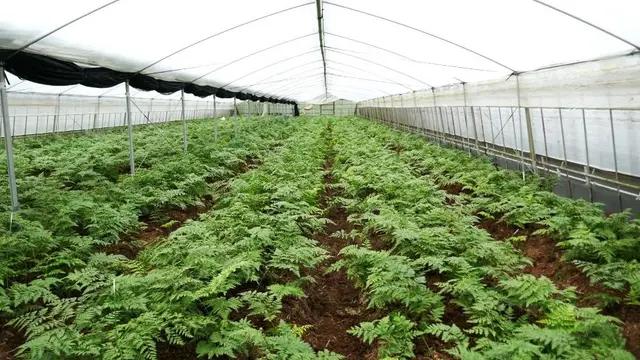
The Tanegashima Leatherleaf Fern is a registered Geographical Indication (GI) product cultivated on Tanegashima Island, Kagoshima Prefecture, Japan, and used as an ornamental cut leaf. This fern is known for its glossy, dark green color and symmetrical shape.
The Tanegashima Leatherleaf Fern was first introduced to Tanegashima Island in 1985. Initially proven to be more profitable than the island's main crops, sweet potatoes and sugar cane, the entire region supported its production and sales promotions. As a result of these incentives, specialized cultivation technologies tailored to regional characteristics were developed.
The producer association, JA Taneyaku, has taken on roles in areas such as light control, irrigation and refrigerated transport, and has traditionally used bagasse (filtered residue) from local sugar cane to protect plants from the cold, especially during the winter months.
The production area is Tanegashima Island, encompassing Nishinoomote City, Nakatane Town, and Minamitane Town in Kumage District, Kagoshima Prefecture, Japan. Tanegashima Island has a temperate climate. The soil on the island is acidic due to volcanic ash. These natural conditions provide a suitable environment for the cultivation of the leathery fern, which prefers acidic soil. The ferns are grown using varieties selected by JA Taneyaku, in facilities with year-round light control, following specific instructions.
During the winter months, bagasse is laid locally to keep the soil warm and ensure consistent yields. The region is Japan's largest fern producer, both in terms of area and production volume.
The Tanegashima Leatherleaf Fern commands a higher than average market price due to its high quality. Harvested fronds should be watered for one to two days before shipping and sorted according to JA Taneyaku's "Transportation Standards and Evaluation Criteria Table." When shipping in boxes, the fronds should be covered with a plastic sheet over newspaper.
Information Website on Japan Geographical Indication Products. “Tanegashima Leatherleaf Fern.” Information Website on Japan Geographical Indication Products. Accessed October 25, 2025. https://pd.jgic.jp/en/register/entry/148.html
Ministry of Agriculture, Forestry and Fisheries (MAFF). “Tanegashima Leatherleaf Fern (Registration No. 148).” Ministry of Agriculture, Forestry and Fisheries (MAFF). Accessed October 25, 2025. https://www.maff.go.jp/e/policies/intel/gi_act/register/250701_4.html

Name(s) | Tanegashima Leatherleaf Fern | ||||||||
|---|---|---|---|---|---|---|---|---|---|
Class | Others | ||||||||
Production Area | Kagoshima, Kumage District | ||||||||
Applicant Organization | JA Taneyaku | ||||||||
No Discussion Added Yet
Start discussion for "Tanegashima Leatherleaf Fern" article
History and Development
Production Area and Conditions
Quality and Shipping
This article was created with the support of artificial intelligence.