

Border | It is innervated by the motor branch of the mandibular nerve (V3). | ||||||||
|---|---|---|---|---|---|---|---|---|---|
Artery | It is supplied by the maxillary artery and the deep temporal arteries. | ||||||||
Function(s) | It lifts the lower jaw and makes a retraction movement. contributes to chewing. | ||||||||
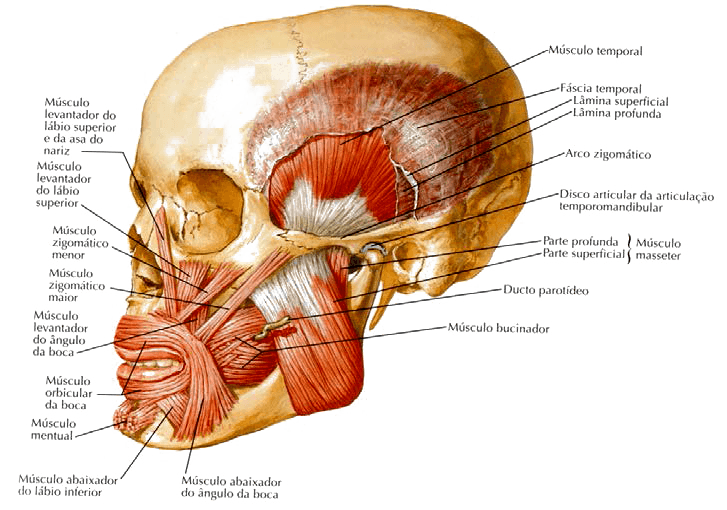
The Temporalis Muscle , one of the largest chewing muscles, is a fan-shaped muscle located in the temporal fossa . It controls the elevation of the lower jaw ( mandible ) and chewing movements.
The Temporalis Muscle is a fan-shaped, superficial chewing muscle that occupies a large area on the lateral surface of the skull. It originates from the temporal fossa of the temporal bone and the overlying temporal fascia. Its fibers extend from above to the temporal line and converge below to form a strong tendon. This tendon inserts into the coronoid process and ramus of the mandible. This wide location allows the muscle to contract forcefully during chewing. The muscle fibers are divided into anterior and posterior portions based on their direction. The anterior fibers run vertically and elevate the mandible; the posterior fibers are more horizontal and play a role in retraction of the mandible. This allows the muscle to perform both powerful closing and retraction movements.
The Temporalis Muscle is one of the muscles of the first pharyngeal arch and originates from the paraxial mesoderm. It is functionally classified as a masticatory muscle and is innervated by the mandibular nerve (CN V₃).
The muscle is innervated by the deep temporal branches of the mandibular nerve. Its blood supply is provided by the deep temporal arteries of the maxillary artery. These vessels branch into both the superficial and deep portions of the muscle, forming an extensive vascular network.
The temporalis muscle elevates the jaw (elevation) and retracts the mandible (retraction). These functions contribute to the grinding motion. Working in conjunction with the masseter, the muscle supports a forceful closure during chewing. Clinically, overactivity of the temporalis muscle can cause pain and headaches in the temporal region in cases of bruxism. Treatment options include the use of a night guard or botulinum toxin injections. Furthermore, in vascular inflammations such as temporal arteritis, the temporal artery, which runs over the muscle, is affected, and severe headaches and vision loss can occur. Diagnosis is usually made through a temporal artery biopsy. The muscle can be used as a flap in reconstructive surgery. Excessive muscle traction in jaw fractures can cause TMJ dysfunction.
“The Velocity of Temporalis Muscle Wasting in Cerebral Metastasis Is Prognostic for Poor Survival.” 2023. ResearchGate . Accessed July 3, 2025. https://www.researchgate.net/publication/389453635_The_velocity_of_temporalis_muscle_wasting_in_cerebral_metastasis_is_prognostic_for_poor_survival .
“The En Bloc Fat Graft for the Care of the Temporal Hollow after Temporalis Muscle Transposition: A Preliminary Report.” 2023. ResearchGate . Accessed July 3, 2025. https://www.researchgate.net/publication/392328484_The_en_bloc_fat_graft_for_the_care_of_the_temporal_hollow_after_temporalis_muscle_transposition_a_preliminary_report .
“Technical Approaches for Preservation of the Temporalis Muscle in Neurosurgery: A Systematic Review.” 2023. ResearchGate . Access date: 3 July 2025.
“Temporalis Muscle Cavernous Hemangioma in a Pediatric Patient.” 2023. ResearchGate . Accessed July 3, 2025. https://www.researchgate.net/publication/391884027_Temporalis_Muscle_Cavernous_Hemangioma_in_a_Pediatric_Patient .

Border | It is innervated by the motor branch of the mandibular nerve (V3). | ||||||||
|---|---|---|---|---|---|---|---|---|---|
Artery | It is supplied by the maxillary artery and the deep temporal arteries. | ||||||||
Function(s) | It lifts the lower jaw and makes a retraction movement. contributes to chewing. | ||||||||
Anatomy
Morphology and Connection Points
Embryological Origin and Classification
Nerve Innervation and Vascular Supply
Function and Clinical Relationships