Artist | Raffaello Sanzio da Urbino (Raphael) | ||||||||
|---|---|---|---|---|---|---|---|---|---|
Technique | Fresco (Wall Painting) | ||||||||
Size(s) | Approximately 7.7 x 5 meters | ||||||||
Topic | An Allegorical Representation of Philosophical Thought Through Ancient Greek Philosophers | ||||||||
Location | Apostolic Palace Stanza della Segnatura Vatican | ||||||||
Prominent Figures | Plato, Aristotle, Socrates, Pythagoras, Euclid, Zoroaster, Heraclitus | ||||||||
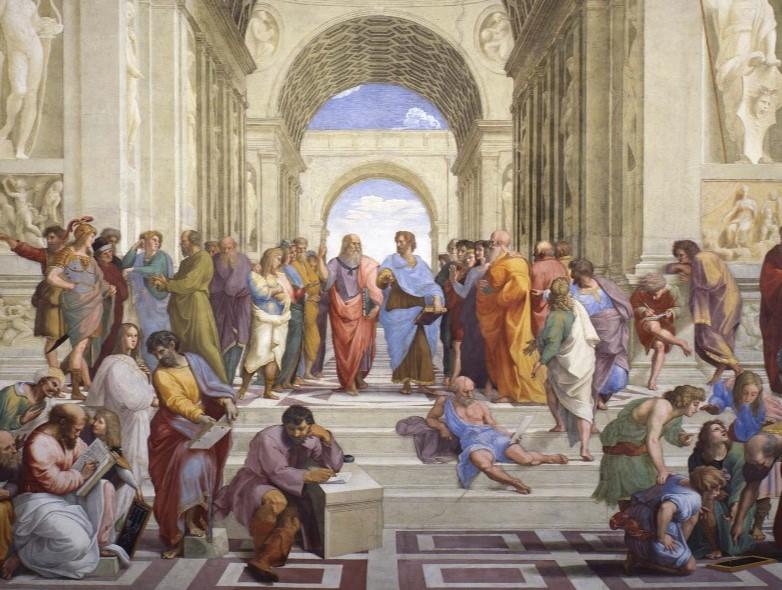
The School of Athens (Scuola di Atene) is a wall fresco painted by one of the leading artists of the Italian Renaissance, Raffaello Sanzio da Urbino (Raphael), between 1509 and 1511 using the fresco technique. Located on one wall of the Stanza della Segnatura in the Vatican Palace, this work brings together the figures of classical philosophy within an idealized architectural setting, symbolically reflecting Renaissance humanism. The fresco celebrates the elevation of reason, wisdom, and philosophy.
In 1508, Pope Julius II commissioned Raphael as one of several artists selected to decorate the Vatican’s Stanze. The School of Athens is one of the four main frescoes in the room known as the Stanza della Segnatura, and it represents the theme of “Philosophy,” one of the four concepts visualized in the room. The other three themes are “Theology,” “Poetry,” and “Justice.”
The fresco portrays prominent figures of classical philosophy gathered within an ideal architectural space, illustrating the historical continuity of philosophical thought. While depicting these figures, Raphael modeled their facial features on famous personalities of his own time. For example, Plato is depicted with the face of Leonardo da Vinci, Heraclitus with the features of Michelangelo, and Euclid bears a resemblance to the architect Bramante.

The School of Athens (Scuola di Atene) (Flickr)
Raphael (1483–1520) was one of the most significant painters and architects of the High Italian Renaissance. Born in Urbino, he was a student of Perugino and later gained great fame in Florence and Rome. Under the patronage of Pope Julius II and Pope Leo X, he produced important religious and intellectual works. Raphael’s art is rooted in symmetry, proportion, grace, and the ideal of beauty. The School of Athens is considered one of the peaks of his artistic maturity and intellectual vision.

Portrait of Raphael. (AI-generated)
The fresco of The School of Athens features a symmetrical composition structured through central perspective. All the perspective lines converge on the two central figures—Plato and Aristotle—who represent the foundations of philosophical history. The vanishing point coincides precisely with the center of the arch behind them, directing the viewer’s gaze toward the focal point.
The architectural setting of the fresco is inspired by classical Roman buildings. The semicircular arches, Corinthian columns, and expansive vaulted ceilings lend both depth and grandeur to the space. The design resembles the architectural plans developed by Bramante for St. Peter’s Basilica, the leading architect of the time.

Central Perspective in The School of Athens (Christopher W. Tyler, ResearchGate)
The approximately 50 figures depicted in the fresco are not only historical individuals but also representatives of various philosophical schools and intellectual currents. Raphael placed these figures with both visual balance and conceptual coherence, merging oppositions and continuities of thought on a unified plane. The prominent figures and their symbolic meanings are as follows:
Plato stands at the center, on the left. He holds his work, Timaeus, and points upward. This gesture represents his theory of the “world of ideas.” According to Plato, true knowledge exists not in the sensory world but in the realm of unchanging, perfect forms. In Timaeus, he states that the universe was organized by a demiurge (divine craftsman) according to these ideas.
Aristotle, standing next to Plato at the center right, holds his Nicomachean Ethics and extends his palm downward. This gesture reflects his empirical approach. For Aristotle, reality is understood through observation in the natural world, and knowledge must be based on experience. Nicomachean Ethics argues that a virtuous life is built on balance and moderation.

Detail of Plato and Aristotle (flickr)
Pythagoras, in the lower left corner, is seen explaining the harmony of numbers and music on a tablet to his students. This depiction symbolizes the Pythagorean belief that numerical ratios form the foundation of universal order. It highlights the connection between philosophy and science through the relationship between numbers, nature, and art.
Euclid (or, according to some interpretations, Archimedes) appears in the lower right corner. He is bent over, drawing geometric shapes on the floor with a compass, instructing the young men around him. This scene symbolizes the systematic transmission of knowledge and the foundational role of geometry in structuring thought.
Socrates, standing in the middle left stairway, is recognizable by his distinct facial features and characteristic posture. His hand gestures toward surrounding figures—possibly Alcibiades and Xenophon—evoke his dialectical method. This figure reminds us that philosophical inquiry progresses through questioning and dialogue.
Heraclitus, seated alone on the step in front of the central figures, carries the facial features of Michelangelo. His withdrawn and contemplative posture expresses themes of melancholy and introspection. His isolated placement is both a reference to philosophical solitude and a gesture of respect from Raphael to Michelangelo.
Zoroaster appears in the far right background, holding a celestial globe. This figure is associated with cosmic order, astrological knowledge, and the concept of universal time. The Zoroastrian cosmological view of ordered creation finds symbolic expression here.
Ptolemy, positioned next to Zoroaster, holds a terrestrial globe. This represents scientific knowledge of the Earth and the development of geographical and astronomical systems. Ptolemy’s geocentric model placed the Earth at the center of the universe.
Raphael himself is placed at the far right edge of the fresco, turning his face directly toward the viewer. This self-portrait shows that the artist considered himself not merely an observer but also an intellectual participant in the scene.

Raphael’s Self-Portrait (flickr)
These figures contribute to the philosophical depth of the fresco not only through their individual identities but also through the disciplines they represent. Raphael’s arrangement unites various fields of knowledge—philosophy, geometry, music, astronomy, and ethics—forming both a historical and conceptual unity among intellectual traditions.
The fresco is meticulously constructed not only in terms of perspective but also in mathematical proportions. The hand gestures of Plato and Aristotle correspond to horizontal and vertical lines divided according to the golden ratio. The triangular arrangements of figure groups further reinforce harmony within the composition. This presents a visual example of the Renaissance reinterpretation of Pythagorean thought.
The School of Athens is more than just a panorama of the history of philosophy; it is also a stage for Raphael’s intellectual dialogue with his contemporaries through visual references. By depicting figures such as Leonardo da Vinci, Michelangelo, and Bramante as classical philosophers, the fresco emphasizes the intellectual continuity between Ancient Greece and the Renaissance. Each figure is not only a representative of a specific field but also a component of the living and ongoing transmission of knowledge.
Antigone Journal. “Raphael’s School of Athens.” Antigone Journal. Accessed August 5, 2025. https://antigonejournal.com/2023/02/raphael-school-of-athens/
Flickr. “Plato and Aristotle JPG.” Flickr. Accessed August 5, 2025. https://flic.kr/p/5dJFEM
Flickr. “Raphael_School_of_Athens JPG.” Flickr. Accessed August 5, 2025. https://flic.kr/p/TcfuQN
Flickr. “School of Athens JPG.” Flickr. Accessed August 5, 2025. https://flic.kr/p/5VmNqy
Flickr. “raphael_school_athens_detail_6_1509 JPG.” Flickr. Accessed August 5, 2025. https://flic.kr/p/z84FmY
Garrigues, Gertrude. “Raphael’s ‘School of Athens’.” The Journal of Speculative Philosophy 13, no. 4 (1879): 406–20. Accessed August 5, 2025. https://www.jstor.org/stable/25667781?seq=1
Haas, Robert. “Raphael’s School of Athens: A Theorem in a Painting?” Journal of Humanistic Mathematics 2, no. 2 (July 2012): 1–22. Accessed August 5, 2025. https://scholarship.claremont.edu/jhm/vol2/iss2/3/
Musei Vaticani. “School of Athens.” Musei Vaticani – Collezioni, Stanza della Segnatura. Accessed August 5, 2025. https://www.museivaticani.va/content/museivaticani/en/collezioni/musei/stanze-di-raffaello/stanza-della-segnatura/scuola-di-atene.html
Städel Museum. “Study of Diogenes in the School of Athens.” Städel Museum. Accessed August 5, 2025. https://sammlung.staedelmuseum.de/en/work/study-of-diogenes-in-the-school-of-athens?gad_source=1&gad_campaignid=22332317935&gbraid=0AAAAADGswQiZy3nQcTczBgLoRyvX9lLFi&gclid=EAIaIQobChMImYyQgIXzjgMVukFBAh36VB0VEAAYASAAEgJz4_D_BwE
Tyler, Christopher W. “The School of Athens by Raphael (1505): A Fine Example of Architectural Perspective.” ResearchGate. Accessed August 5, 2025. https://www.researchgate.net/figure/The-School-of-Athens-by-Raphael-1505-a-fine-example-of-architectural-perspective_fig4_252564519
Veneranda Biblioteca Ambrosiana. “The School of Athens.” Ambrosiana. Accessed August 5, 2025. https://ambrosiana.it/en/opere/the-school-of-athens/
Zucker, Steven, and Dr. Beth Harris. “Raphael, School of Athens.” Smarthistory. Accessed August 5, 2025. https://smarthistory.org/raphael-school-of-athens/


Artist | Raffaello Sanzio da Urbino (Raphael) | ||||||||
|---|---|---|---|---|---|---|---|---|---|
Technique | Fresco (Wall Painting) | ||||||||
Size(s) | Approximately 7.7 x 5 meters | ||||||||
Topic | An Allegorical Representation of Philosophical Thought Through Ancient Greek Philosophers | ||||||||
Location | Apostolic Palace Stanza della Segnatura Vatican | ||||||||
Prominent Figures | Plato, Aristotle, Socrates, Pythagoras, Euclid, Zoroaster, Heraclitus | ||||||||
No Discussion Added Yet
Start discussion for "The School of Athens (Painting)" article
Historical Background
Artist: Raphael (Raffaello Sanzio da Urbino)
Composition and Technical Analysis
Figures and Philosophical Representations
Symmetry, Geometry, and Mathematical Structure
Artistic Context and Layers of Meaning
This article was created with the support of artificial intelligence.