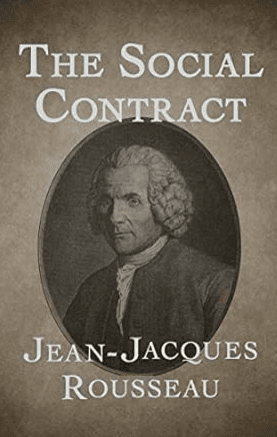
The Social Contract is a political philosophy text written by Enlightenment thinker Jean-Jacques Rousseau and was first published in 1762. It explores the theoretical foundations of political authority, legitimacy, and collective governance. The book is considered one of the principal works shaping modern theories of democracy, citizenship, and popular sovereignty.
The book addresses the question of how individuals, transitioning from the state of nature, can live together in an organized society without surrendering their natural freedom. Rousseau introduces the concept of a “social contract” as a framework through which individuals voluntarily unite under a common authority while preserving their autonomy.
According to Rousseau, the state of nature is a hypothetical condition where individuals are free and equal, but lack security and social structure. As society evolves—due to the emergence of private property, population growth, and increasing inequality—people must establish a social framework to coexist peacefully. The social contract is this framework: a mutual agreement through which each individual merges into a collective body governed by the “general will.”
This contract forms the basis for legitimate political authority. Rousseau argues that sovereignty resides with the people and is inalienable and indivisible. The “general will” (volonté générale) reflects the collective interest of all citizens and should guide the formation of laws and public policy. In this model, individuals are both the authors and subjects of the laws, thus maintaining their freedom by obeying rules they have collectively established.
Throughout the book, Rousseau systematically discusses key political concepts such as direct democracy, popular sovereignty, lawmaking, the non-transferability of authority, and the role of government as an executor of the general will. He rejects representative government as a substitute for direct civic participation, emphasizing that political legitimacy arises not from institutions alone but from the active moral engagement of the citizenry.
The social contract, therefore, is not only a legal construct but a moral and philosophical foundation that balances individual liberty with collective order. Rousseau frames this principle as essential for building a just and cohesive society.
General Will (Volonté Générale)
The “general will” is the collective will that reflects the common good. It is distinct from the sum of individual interests and serves as the foundation for all legitimate laws and governance structures. Political authority must be aligned with this general will to be considered just.
Sovereignty and Its Inalienability
Rousseau insists that sovereignty belongs to the people and cannot be delegated or transferred. Sovereignty is exercised through direct participation and must remain with the citizen body to ensure legitimacy.
Freedom and the Social Contract
True freedom, for Rousseau, is not the absence of restraint but obedience to laws one has prescribed for oneself through participation in the general will. The social contract allows individuals to transition from natural liberty to civil liberty without sacrificing autonomy.
Laws must be expressions of the general will and created with the consent of all citizens. Legitimacy arises not from rulers or institutions but from the collective agreement and engagement of the people.
Forms of Government and the Role of the State
Rousseau distinguishes between the sovereign (the people) and the government (the administrative body). He examines various forms of government—monarchy, aristocracy, democracy—and argues that government is merely an agent of the sovereign will, not its possessor.