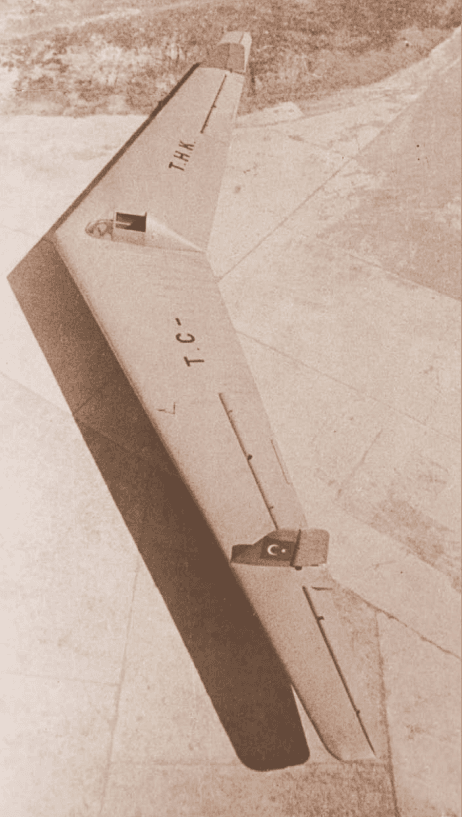
THK-13 (Flying Wing Glider)
Name(s) | THK-13 | ||||||||
|---|---|---|---|---|---|---|---|---|---|
Type(s) | Experimental Glider (Flying Wing Design) | ||||||||
Developer(s) | Turkish Aeronautical Association (Etimesgut Aircraft Factory) | ||||||||
Designer | Senior Engineer Yavuz Kansu and Team | ||||||||
First Flight(s) | August 26 1948 | ||||||||
Year of Production | 1948 | ||||||||
Units Produced | 2 (Only One Underwent Flight Testing) | ||||||||
Wingspan | Approximately 13.6 m | ||||||||
Length(s) | 3.5 m | ||||||||
Empty Weight | Approximately 200 kg | ||||||||
Maximum Speed | 85 km/h | ||||||||
Pilots | Kadri Kavukçu Cemal Uygun | ||||||||
Structural Features | Tailless Fuselage-less Cockpit Embedded in Wing Fixed Landing Gear | ||||||||
Test Area | Ankara – Çankaya and vicinity of Turkish Military Academy | ||||||||
Status | Project Terminated (1949) | ||||||||
Historical Significance | First and only flying wing design ever produced in Turkey | ||||||||
THK-13 is an experimental flying wing glider designed and built in 1948 by Senior Engineer Yavuz Kansu under the auspices of the Turkish Aeronautical Association (THK). Diverging from the conventional aerodynamic structure of traditional aircraft, the THK-13 holds the distinction of being the first and only aircraft of its kind in Turkey to undergo flight testing. Designed and manufactured at the Turkish Aeronautical Association's Etimesgut Aircraft Factory, the THK-13 conducted its test flights in August 1948.

T.H.K. Etimesgut Aircraft Factory 1948 – Final Form of the THK-13 Flying Wing Glider – August 24, 1948 (MMO)
In 1941, the Turkish Aeronautical Association (THK) expanded its ambitions by establishing the Etimesgut Aircraft Factory. By 1948, the THK Aircraft Factory had completed its 13th original project, designated as the THK-13. The project was led by Senior Engineer Yavuz Kansu, with contributions to its design and production from engineers Saffet Müftüoğlu, Necati Alper, Orhan Ölmez, Ömer Çiftçi, and Emel Dilmen. Test flights were conducted by pilots Kadri Kavukçu and Cemal Uygun. At the time, the president of THK was General Seyfi Düzgören.

THK-13 Flying Wing Glider, T.H.K. Etimesgut Aircraft Factory, 1948 (UTED)
In the design of the THK-13, a tailless structure was chosen to minimize aerodynamic drag. The aircraft lacks a traditional fuselage and tail section, with all control surfaces and lift-generating components integrated directly onto the wing. This configuration is based on the “flying wing” principle. Drawing inspiration from the designs of the German Horten brothers, the THK-13 also reflects the influence of Northrop Flying Wing projects, which Yavuz Kansu encountered during his internship in the United States.
The main technical specifications of the glider are as follows:
As noted in a source published by UTED, the absence of a nose, tail, and vertical stabilizer in the THK-13 required alternative aerodynamic solutions beyond conventional approaches. The glider features a fixed, single-wheel landing gear system supplemented by stabilizing supports. The embedded cockpit design aimed to further reduce drag. Additionally, fixed fins and aerodynamic brakes located at the wing tips were employed to enhance directional stability.
The project was officially approved on January 31, 1948, by Selahattin Beler, Director of the THK Aircraft Factory, and the design process was swiftly initiated. A plan to conduct wind tunnel tests in France had to be abandoned due to budgetary constraints. Instead, at the suggestion of Orhan Ölmez, a platform was mounted on the THK-5 aircraft, and a 1/10 scale model of the THK-13 was tested in flight. This method represented a testing technique being applied for the first time globally at that time.
The first flight took place on August 26, 1948, over Çankaya, with the glider towed by a tug aircraft. The aim was to present this innovative project to the Presidency and garner public support amid concerns about potential factory closures. However, during the flight, the THK-13 unexpectedly detached and performed a controlled landing on the hills of Çankaya. In a subsequent second launch, the glider detached again over the Turkish Military Academy and sustained damage due to a hard landing.
On September 29, 1948, pilot Cemal Uygun was assigned for a second test flight. Uygun initially performed a ground test by towing the glider with a jeep and reported no issues. However, during a towed flight conducted later that evening, the glider veered to the right, crashed, and sustained severe damage, injuring the pilot. Post-crash investigations revealed that a clamp (mandrel) had been inadvertently left in the right wing, which led to control surface jamming. The glider was damaged beyond repair.
Based on Yavuz Kansu’s reports and Cemal Uygun’s statements, the causes of the crash included:
THK engineers began working on a second THK-13 and completed a new prototype in August 1949 after 15,000 hours of labor. However, the project was shelved before further test flights could be conducted.
The Flying Wing project was seen as a last resort to prevent the closure of the THK factories. THK President Seyfi Düzgören submitted numerous reports to the ministry in support of the project. Nevertheless, contemporary media focused on the project’s failures and published damaging reports targeting the THK Etimesgut Aircraft Factory. Some assessments suggest that this public criticism may have contributed psychologically to Düzgören’s death shortly afterward.
The beginning of the Marshall Plan in 1947 and the subsequent Thronborg Report marked a period when political decisions significantly influenced the closure of THK’s Aircraft and Engine Factories. Around the same time, the United States' own flying wing projects—the B–35 and B–49—also ended unsuccessfully. On June 5, 1948, a B-49 crashed during a test flight, resulting in the deaths of pilots Daniel Forbes and Glen Edwards. In this broader context, the technical challenges experienced with the THK-13 should be seen as part of the natural progression of global aviation history.

THK-13 Glider (top left), Horten Ho 229 (top right) [14], Northrop YB-49 (bottom left), Northrop Grumman B-2 (bottom right)(MMO)
Güleren, Kürşad Melih, and Mert Sülümbaz. “Türk Hava Kurumu Uçak Tasarımları.” Mühendis ve Makina 54, no. 638 (2013): 54–61. Accessed July 16, 2025. Access Address.
J2mcL Planeurs. “THK-13.” J2mcL Planeurs. Accessed July 16, 2025. Access Address.
Koç, İsa. “THK-13 Uçan Kanat Türk Hayalet Bombardıman Uçağı Kopyası Amerikan B2 Bombardıman Uçağı?” İsaKoç.com (archived version). Accessed July 16, 2025. Access Address.
UTED (Uçak Teknisyenleri Derneği). “THK-13 Uçan Kanat Planörü.” uted.org. Accessed July 16, 2025. Access Address.
Yavuz, İsmail. Mustafa Kemal’in Uçakları: Türkiye’nin Uçak İmalat Tarihi (1923–2012). İstanbul: Türkiye İş Bankası Kültür Yayınları, 2012. Accessed July 16, 2025. Access Address.

THK-13 (Flying Wing Glider)
Name(s) | THK-13 | ||||||||
|---|---|---|---|---|---|---|---|---|---|
Type(s) | Experimental Glider (Flying Wing Design) | ||||||||
Developer(s) | Turkish Aeronautical Association (Etimesgut Aircraft Factory) | ||||||||
Designer | Senior Engineer Yavuz Kansu and Team | ||||||||
First Flight(s) | August 26 1948 | ||||||||
Year of Production | 1948 | ||||||||
Units Produced | 2 (Only One Underwent Flight Testing) | ||||||||
Wingspan | Approximately 13.6 m | ||||||||
Length(s) | 3.5 m | ||||||||
Empty Weight | Approximately 200 kg | ||||||||
Maximum Speed | 85 km/h | ||||||||
Pilots | Kadri Kavukçu Cemal Uygun | ||||||||
Structural Features | Tailless Fuselage-less Cockpit Embedded in Wing Fixed Landing Gear | ||||||||
Test Area | Ankara – Çankaya and vicinity of Turkish Military Academy | ||||||||
Status | Project Terminated (1949) | ||||||||
Historical Significance | First and only flying wing design ever produced in Turkey | ||||||||
No Discussion Added Yet
Start discussion for "THK-13 (Flying Wing Glider)" article
Historical Background and Institutional Structure
Design and Technical Specifications
Development Process and Wind Tunnel Testing
Flight Tests and Issues Encountered
Historical Significance and Controversy
This article was created with the support of artificial intelligence.