+1 More

Kingdom(s) | Animalia | ||||||||
|---|---|---|---|---|---|---|---|---|---|
Phylum | Chordata | ||||||||
Subphylum | Vertebrata | ||||||||
Class | Reptilia | ||||||||
Order | Squamata | ||||||||
Family | Viperidae | ||||||||
Genus | Crotalus | ||||||||
Specie(s) | Crotalus horridus | ||||||||
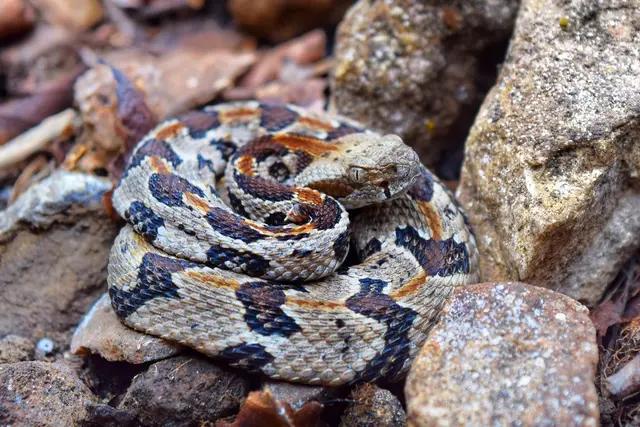
Timber Rattlesnake (Crotalus horridus), commonly known as the Common Rattlesnake, is a venomous snake with a wide geographical distribution. It is listed as Least Concern (LC) on the IUCN Red List.
The scientific name of Timber Rattlesnake was given by Linnaeus in 1758. Taxonomically, it belongs to the Animalia kingdom, Chordata phylum, Reptilia class, Squamata order and Viperidae family.
This species is widely distributed in the United States, with a marginal range into Southern Canada, but is extinct in Canada. Its distribution extends from Central New England to Northern Florida and West to Eastern Texas, Central Oklahoma, Eastern Kansas, Southeastern Nebraska, Southern and Eastern Iowa, and Southeastern Minnesota. Scattered populations have been noted on the western and northern edges of the range.
About the Common Rattlesnake (Nature Picture Library)
Timber Rattlesnake is represented by numerous localities, but many of these are thought to be unlikely to be viable long-term populations. The adult population size is unknown but is estimated to be greater than 100,000. The species is still quite common in some parts of its range. However, it is declining or locally extinct throughout the northeastern states. For example, the population in Southern Ontario, Canada was last recorded as extinct in 1941. The general consensus among scientists and observers is that the common rattlesnake is declining throughout most of its range. The population trend is currently decreasing.
In the Northeast, this species typically inhabits mountainous or hilly deciduous or mixed deciduous-coniferous forests with rocky outcrops, steep slopes, and rock slides. In the south, it prefers habitats such as hardwood forests, swamps, floodplains, and hydric hammock forests along the Loess Ridge and many river bottoms. Its activity is primarily terrestrial, although it is occasionally observed climbing vegetation. Hibernacula typically occur in rocky areas with underground crevices to provide overwintering. Males and non-gravid females are primarily forest dwellers, while gravid females utilize open, sparsely forested areas.
The species' primary threats are habitat loss, habitat fragmentation and isolation, which can render populations small and unviable, direct mortality caused by humans (including illegal snake catchers) and vehicles through habitat encroachment by urban/residential development. Other significant threats include detrimental exploitation of bounty systems and commercial hunting and gathering for the pet trade, which have locally reduced or eliminated populations. Additionally, in some areas, the threat of "shading" from tree growth near dens (wintering grounds) can be a problem, particularly for basking and birthing areas used by gravid females.
Known den (wintering) areas and adequate surrounding foraging habitat (generally within a 1.5- to 2.5-mile radius from the den site) need to be protected.【1】Conservation needs include promoting conservation through public education and not disclosing den locations to the general public or unknown individuals. The species is present in at least one protected area (PA). Other needed conservation actions include habitat and wildlife restoration, species management (including prey management and trade management), and awareness and communication efforts.
Falk, Ann. "“Crotalus horridus – Timber Rattlesnake.” Animal Diversity Web. Accessed October 25, 2025. https://animaldiversity.org/accounts/Crotalus_horridus/
IUCN Red List of Threatened Species. “Crotalus horridus.” IUCN Red List of Threatened Species. Accessed October 25, 2025. https://www.iucnredlist.org/species/64318/12765920
Nature Picture Library. "Timber rattlesnake (Crotalus horridus) drinking during rainstorm, Maryland, USA." YouTube. Accessed October 25, 2025. https://www.youtube.com/watch?v=cbGevkE7kXk
[1]
IUCN Red List of Threatened Species. “Crotalus horridus” IUCN Red List of Threatened Species, page 6. Access October 25, 2025. https://www.iucnredlist.org/species/64318/12765920

Kingdom(s) | Animalia | ||||||||
|---|---|---|---|---|---|---|---|---|---|
Phylum | Chordata | ||||||||
Subphylum | Vertebrata | ||||||||
Class | Reptilia | ||||||||
Order | Squamata | ||||||||
Family | Viperidae | ||||||||
Genus | Crotalus | ||||||||
Specie(s) | Crotalus horridus | ||||||||
Taxonomy
Geographic Distribution
Population
Habitat and Ecology
Threats
Protection Actions
This article was created with the support of artificial intelligence.