


This article was automatically translated from the original Turkish version.
+2 More
Location | Samandağ Türkiye Hatay | ||||||||
|---|---|---|---|---|---|---|---|---|---|
Period(s) | Roman Empire | ||||||||
Length(s) | 1 380 m | ||||||||
Width | 6 m | ||||||||
Height(s) | 7 m | ||||||||
Protection Status | Protected as cultural heritage candidate for UNESCO provisional list | ||||||||
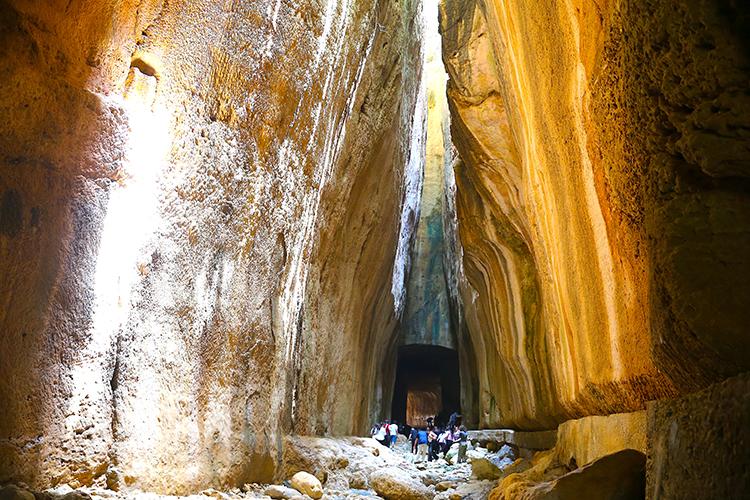
The Titus Tunnel is a massive, manually excavated water drainage structure from the Roman Empire period, located in the Çevlik locality of the Samandağ district, within Hatay Province in southern Türkiye. Stretching approximately 1,380 meters in length, it was constructed to protect the ancient port city of Seleukeia Pieria from floodwaters and stands as an example of the engineering expertise of its time. Although named after the Roman emperors Vespasianus and Titus, its completion occurred during the reign of Emperor Hadrianus.

Titus Tunnel (Türkiye Culture Portal)
The city of Seleukeia Pieria was founded in the 3rd century BCE by the Seleucids and served as a vital maritime gateway during the Hellenistic and Roman periods. As the port of Antioch, it was situated at the foot of the Amanos Mountains, where heavy rainfall over time caused flash floods that gradually rendered the harbor unusable.
To eliminate this environmental threat and ensure the sustainability of port operations, Roman engineers and laborers designed a massive drainage system. Work initiated under Emperor Vespasianus in the late 1st century CE was continued by his son Titus and ultimately completed during the reign of Emperor Hadrianus. This prolonged construction period highlights Rome’s commitment to long-term urban planning and infrastructure investment.
The Titus Tunnel was entirely carved out of a natural rock mass. Built without explosives or advanced construction machinery, its scale achieved solely through hand tools places it among the most remarkable feats of ancient engineering.
The structure consists of the following components:
The tunnel has an approximate height of 6 meters and a width of 4 meters. These dimensions not only facilitated water conveyance but also allowed for maintenance and drainage operations within the tunnel itself.
The tunnel is situated on the southwest-facing steep slopes of the Amanos Mountains. This region is prone to frequent flooding due to its steep topography, loose soil structure, and intense rainfall. The vulnerability of Seleukeia Pieria to these natural conditions made the tunnel’s construction essential.
The dominant bedrock in the area is limestone. The tunnel’s excavation within a homogeneous and solid limestone block ensured both the structure’s durability and made the excavation process relatively manageable.
Located southwest of the Titus Tunnel, the Cradle Cave is another significant archaeological structure that must be considered in conjunction with the tunnel system. This cave contains rock-cut burial chambers from the Roman period, featuring cradle-shaped sarcophagi, multi-chambered tomb complexes, and a colonnaded facade. The Cradle Cave provides valuable insights into Roman social structures through its architectural design and funerary traditions.

Cradle Cave (Anadolu Agency)
The construction of the tunnel relied heavily on convicts, slaves, and engineering units attached to Roman legions. Greek inscriptions at the tunnel entrance bear the names of Emperors Vespasianus and Titus, confirming the project’s official, public nature.
Excavation techniques were limited to simple hand tools such as wedges, hammers, and chisels. This method resulted in a construction period spanning several decades. Nevertheless, the development of a sustainable solution to mitigate natural disaster risks demonstrates the success of Roman engineering.
Titus Tunnel (YouTube)
The Titus Tunnel was added to UNESCO’s Temporary List of World Heritage Sites in 2014. Today, it is protected by the Ministry of Culture and Tourism under the Hatay Çevlik Archaeological Site. It is a major cultural heritage destination visited by both domestic and international tourists and serves as a subject of academic research in the fields of engineering history, archaeology, and environmental conservation.
The structure’s integrity has been largely preserved, with the interior of the tunnel still accessible for walking. Together with the Cradle Cave, it offers visitors a comprehensive view of ancient Rome’s technical, cultural, and artistic legacy.
Anadolu Ajansı. “Hatay’daki Titus Tüneli ve Beşikli Mağara FPV Dronla Görüntülendi.” Anadolu Ajansı Foto Galeri. July 12, 2023. Accessed June 3, 2025. https://www.aa.com.tr/tr/pg/foto-galeri/hataydaki-titus-tuneli-ve-besikli-magara-fpv-dronla-goruntulendi.
EXPO 2021 Hatay. "Titus Tüneli." YouTube video, 1:45. March 25, 2022. Accessed June 3, 2025.
Hatay İl Directorate of Culture and Tourism. *Titus Tüneli Brochure*. Hatay: Ministry of Culture and Tourism of the Republic of Turkey, 2018. Accessed June 3, 2025. https://hatay.ktb.gov.tr/Eklenti/103875,titus-tuneli-brosur-turkcepdf.pdf
Ministry of Culture and Tourism of the Republic of Turkey. "Hatay Çevlik Örenyeri." *Turkish Museums*. Date Published unknown. Accessed June 3, 2025. https://www.turkishmuseums.com/museum/detail/2059-hatay-cevlik-orenyeri/2059/1.
Ministry of Culture and Tourism of the Republic of Türkiye. "Titus Tüneli andBeşikli Mağara." *Culture Portal*. Date Published February 1, 2013. Last updated February 25, 2021. Accessed June 3, 2025. https://www.kulturportali.gov.tr/turkiye/hatay/gezilecekyer/titus-tuneli-ve-besikli-magara.
T.C.Samandağ Belediyesi. "Titus Tüneli." Accessed June 3, 2025. https://samandag.bel.tr/tarihi-merkez/titus-tuneli/1.
T.C.Samandağ Kaymakamlığı Governorship. "Titus Tüneli." February 25, 2025. Accessed June 3, 2025. http://www.samandag.gov.tr/titus-tuneli.
Turkish Museums. "Hatay Çevlik Örenyeri." Accessed June 3, 2025.
Yıldız, Mustafa. "Roma Mühendisliğinin Bir Örneği Olarak Vespasianus-Titus Tüneli." Journal of World Geography and Development 3, no. 1 (2022): 25–42. Accessed June 3, 2025.
Yılmaz, Fatih. "Dünya Miras Listesi ve Vespasianus-Titus Tüneli: Süreç Üzerine Bir Değerlendirme." *Uluslararası Sosyal Araştırmalar Dergisi* (The Journal of International Social Research) 11, no. 55 (February 2018): 123–145. https://doi.org/10.17719/jisr.20185537205.


Location | Samandağ Türkiye Hatay | ||||||||
|---|---|---|---|---|---|---|---|---|---|
Period(s) | Roman Empire | ||||||||
Length(s) | 1 380 m | ||||||||
Width | 6 m | ||||||||
Height(s) | 7 m | ||||||||
Protection Status | Protected as cultural heritage candidate for UNESCO provisional list | ||||||||
Historical Background
Architectural and Engineering Features
Geological and Geographic Context
Relationship with the Cradle Cave
Construction Process and Labor Force
Conservation Status and Contemporary Significance