

Artery | Supplied by superior and inferior epigastric arteries. | ||||||||
|---|---|---|---|---|---|---|---|---|---|
Function(s) | Increases intra-abdominal pressure for stabilization and abdominal wall tightening. | ||||||||
Nerve Supply | Innervated by thoracodorsal and intercostal nerves. | ||||||||
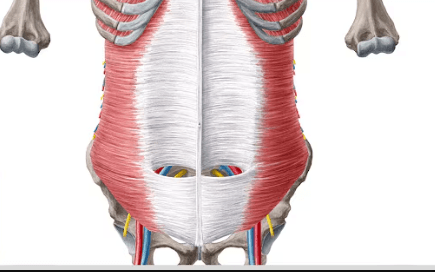
The Transverse Abdominal Muscle is a significant layer of smooth muscle fibers located in the inner layer of the anterior and lateral abdominal wall, just deep to the internal oblique muscle. Its functions include compressing and retaining abdominal contents and assisting with exhalation. Its anatomical location and function play a critical role in abdominal stability.
The Transverse Abdominal Muscle is the innermost of the abdominal wall muscles. It is called "transverse" because its fibers run horizontally. The muscle attaches anteriorly to the linea alba by forming a broad aponeurosis. The upper two-thirds of the aponeurosis lie posterior to the rectus abdominis muscle, while the lower one-quarter lies anterior to it. This anatomical location contributes to the structural integrity of the abdominal wall. The transverse abdominis muscle originates from the lateral third of the inguinal ligament, the anterior four-thirds of the iliac crest, the inner surfaces of the cartilages of the lower six ribs (7–12), the thoracolumbar fascia, and intersects with the diaphragm. The muscle fibers form an aponeurotic structure that widens anteriorly. Its lower fibers curve medially and inferiorly to insert at the apex of the pubic and pectineal line, where they form the inguinal conjoint tendon. Through these attachments, the muscle establishes mechanical connections with both the lower and upper trunk regions.
The Transverse Abdominal Muscle develops embryologically from the parietal mesoderm, a derivative of the lateral mesoderm. Developmentally, it is located among the muscles of the trunk wall and is classified as the "abdominal wall muscles." It is part of the muscle groups that provide structural and functional stability to the trunk.
The Transverse Abdominal Muscle is innervated by the thoracoabdominal nerves (T7-T11), the iliohypogastric nerve, and the ilioinguinal nerve (L1). These nerves provide both motor and sensory control of the muscle. The muscle's vascular supply is primarily provided by the intercostal arteries and the deep epigastric arteries. This structural support, provided by the nerves and vessels, enables the muscle to function regularly and perform its vital functions.
The primary function of the Transverse Abdominal Muscle is to contribute to trunk stability by increasing intra-abdominal pressure. It contracts during exhalation, helping to expel air from the thoracic cavity. It also supports the pelvic region during labor, facilitating the birth process. The muscle works in conjunction with the segmental stabilizers of the spine (e.g., the multifidus) to provide postural control and balanced movement. It prevents abdominal bloating by pulling the abdominal wall inward, contributing to a flat abdominal appearance. The Transverse Abdominal Muscle is also called the "corset muscle" because its active contraction pulls the abdominal wall inward, creating a flatter abdomen. Poor functioning can lead to low back pain, postural problems, and trunk instability. Conventional abdominal exercises, unless they directly target this muscle, do not provide effective straightening. Therefore, specific exercises targeting the Transverse Abdominal Muscle are recommended in physiotherapy and rehabilitation programs. Strengthening the TVA is an important treatment goal, especially for individuals experiencing low back pain.
YouTube.Transversus Abdominis Muscle Kenhub. September 27, 2017. Video, 3:41. Accessed July 28, 2025. https://www.youtube.com/watch?v=RFiyGkXaKZ4&pp=ygUjdHJhbnN2ZXJzdXMgYWJkb21pbmlzIG11c2NsZSBrZW5odWI%3D.
Chen, L., and S. Park. “Surgical Anatomy of Transversus Abdominis Muscle for Transversus Abdominis Release: A CT-Based Study in Three Patient Groups.” 2023. ResearchGate. Accessed July 28, 2025. https://www.researchgate.net/publication/373953281_Surgical_Anatomy_of_Transversus_Abdominis_Muscle_for_Transversus_Abdominis_Release_A_CT-Based_Study_in_Three_Patient_Groups.
Patel, R. S., and Y. J. Kim. "Transversus Abdominis Activation Is Similar in Healthy and Unhealthy Individuals." 2023. ResearchGate. Accessed July 28, 2025. https://www.researchgate.net/publication/389859002_Transversus_abdominis_activation_is_similar_in_healthy_and_unhealthy_individuals.
Smith, J. D., and H. K. Lee. "Effect of Transversus Abdominis Plane Blocks in Abdominplasties on Postoperative Outcomes." 2023. ResearchGate. Accessed July 28, 2025. https://www.researchgate.net/publication/392874174_Effect_of_transversus_abdominis_plane_blocks_in_abdominplasties_on_postoperative_outcomes.

Artery | Supplied by superior and inferior epigastric arteries. | ||||||||
|---|---|---|---|---|---|---|---|---|---|
Function(s) | Increases intra-abdominal pressure for stabilization and abdominal wall tightening. | ||||||||
Nerve Supply | Innervated by thoracodorsal and intercostal nerves. | ||||||||
No Discussion Added Yet
Start discussion for "Transverse Abdominal Muscle" article
Anatomy
Morphology and Connection Points
Embryological Origin and Classification
Nerve Innervation and Vascular Supply
Function and Clinical Relationships