

History | June 30, 1908 | ||||||||
|---|---|---|---|---|---|---|---|---|---|
Location | Podkamennaya Tunguska River Basin (Siberia) | ||||||||
Estimated Time | 07.17 am | ||||||||
Estimated Energy Release | 10-15 Megatons of TNT | ||||||||
Affected Area | ~2150 square kilometers | ||||||||
Explosion Height | 5-10 meters | ||||||||
Seismic Magnitude | ~5.0 Richter scale | ||||||||
Eyewitness Effects | Windows were broken up to 500 km away people jumped out of their seats | ||||||||
Optical Effects | Bright nights (noctilucent clouds) were seen for days in Eurasia | ||||||||
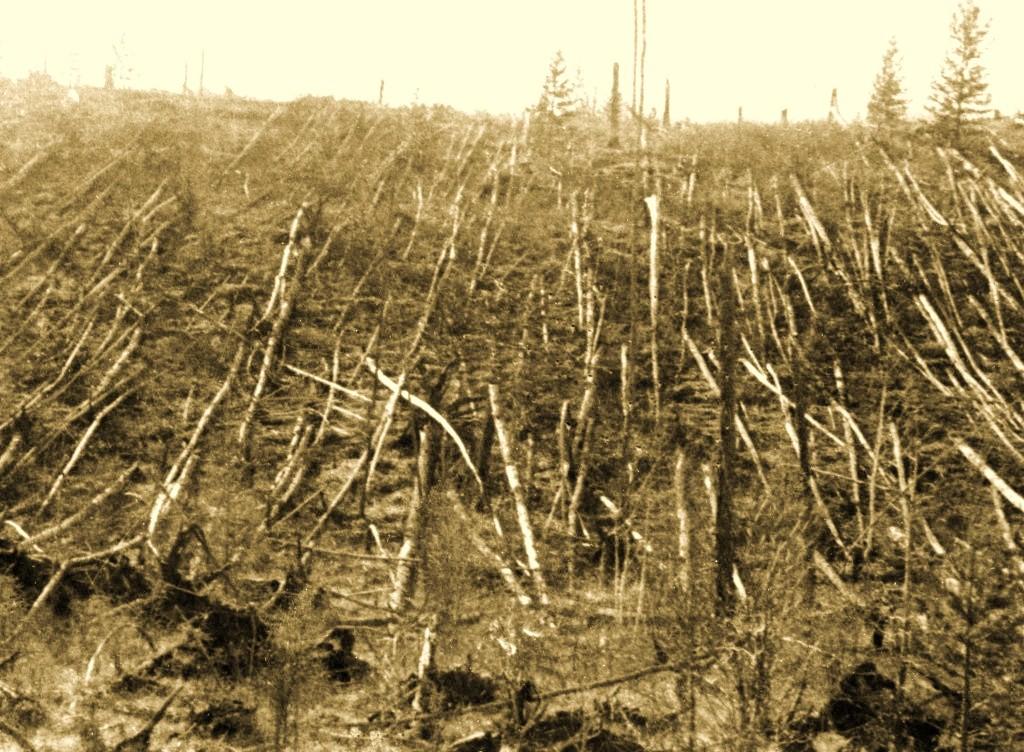
On the morning of June 30, 1908, the largest cosmic air explosion in history occurred in the Podkamennaya Tunguska River basin of Siberia. The event felled and burned an estimated 80 million trees over an area of approximately 2,150 square kilometers. The energy released from the explosion is estimated at 10–15 megatons of TNT equivalent, approximately a thousand times the power of the atomic bomb dropped on Hiroshima in 1945.
One of the most striking features of the event is that it did not leave a large impact crater on the surface. Scientists believe the object exploded in the atmosphere at an altitude of 5 to 10 kilometers (3 to 6 miles) rather than impacting the Earth's surface (an airburst). The fact that trees near the epicenter were stripped of their branches but remained standing (a "telegraph pole" effect) suggests that the energy was largely converted into a blast wave and that thermal radiation was limited.
The explosion generated shock waves powerful enough to shatter windows hundreds of kilometers away and were recorded by seismic devices and barometers worldwide. Extraordinarily bright nights were observed across much of Europe and Asia for several days following the event. These bright nights are thought to be related to high-altitude ice particles (noctilucent clouds) formed by water vapor released into the atmosphere by the explosion.
Asteroid Airburst Hypothesis: The most common scientific explanation is that a stony asteroid, approximately 50–60 meters wide, exploded in the atmosphere. This hypothesis is supported by smaller airbursts such as the 2013 Chelyabinsk meteor.
Cometary Airburst Hypothesis: This theory proposes that the event was caused by the disintegration of an icy comet. The bright nights observed after the explosion are explained by high levels of water vapor released into the atmosphere from the comet's icy nucleus.
There is evidence to support and contradict both hypotheses. Alternative theories, such as antimatter, UFOs, or natural gas explosions, have also been put forward, but most have not withstood scientific scrutiny.

The explosion created a "butterfly" pattern of destruction that caused trees to fall radially. Microparticles of extraterrestrial origin were found at the scene, but it was not possible to definitively determine whether the object was an asteroid or a comet. Whether Lake Cheko is an impact crater remains a matter of debate.
Despite over a century of research, the precise nature and composition of the Tunguska object remain unresolved. This event is considered the "cosmic airburst paradigm" and the "standard of destructive impact" for impact events. Tunguska demonstrated that even a relatively small object can cause widespread regional destruction without leaving a crater. This highlights the importance of preparing for similar future events and improving capabilities to detect and track Near-Earth Objects (NEOs). The Tunguska event reinforces the need for international cooperation and investment in planetary defense.
American Physical Society. "June 30, 1908: The Tunguska Event." American Physical Society . Accessed June 28, 2025. https://www.aps.org/archives/publications/apsnews/201806/history.cfm .
Kletetschka, Gunther. et al. “New Evidence of High-Temperature, High-Pressure Processes at the Site of the 1908 Tunguska Event: Implications for Impact and Airburst Phenomena.” Airbursts and Cratering Impacts 3(1). 2025. https://www.scienceopen.com/hosted-document?doi=10.14293/ACI.2025.0001 .
Longo, G. "The Tunguska Event." ResearchGate , 2015. https://www.researchgate.net/publication/282256596_The_Tunguska_Event .
The Economic Times. "Did an asteroid 'bounce' off earth? Wild new theory reveals shocking details behind Tunguska celestial strike." The Economic Times , 19 February 2024. https://m.economictimes.com/magazines/panache/did-an-asteroid-bounce-off-earth-wild-new-theory-reveals-shocking-details-behind-tunguska-celestial-strike/articleshow/118066905.cms .
Uri, John. "115 Years Ago: The Tunguska Asteroid Impact Event." NASA . 2023. https://www.nasa.gov/history/115-years-ago-the-tunguska-asteroid-impact-event/ .

History | June 30, 1908 | ||||||||
|---|---|---|---|---|---|---|---|---|---|
Location | Podkamennaya Tunguska River Basin (Siberia) | ||||||||
Estimated Time | 07.17 am | ||||||||
Estimated Energy Release | 10-15 Megatons of TNT | ||||||||
Affected Area | ~2150 square kilometers | ||||||||
Explosion Height | 5-10 meters | ||||||||
Seismic Magnitude | ~5.0 Richter scale | ||||||||
Eyewitness Effects | Windows were broken up to 500 km away people jumped out of their seats | ||||||||
Optical Effects | Bright nights (noctilucent clouds) were seen for days in Eurasia | ||||||||
Leading Scientific Theories
Major Hypotheses for the Tunguska Event
Environmental Traces and Discussions
The Enduring Mystery and Implications for Planetary Defense
This article was created with the support of artificial intelligence.