
+2 More

Category | Strategic Bomber Aircraft | ||||||||
|---|---|---|---|---|---|---|---|---|---|
Origin(s) | Soviet Union (Tupolev) | ||||||||
Engine(s) | 4 x Kuznetsov NK-12 turboprop engines | ||||||||
Service Entry | 1956 | ||||||||
Crew | 6–7 persons | ||||||||
Maximum Speed | 925 km/h | ||||||||
Range(s) | 15 000 km | ||||||||
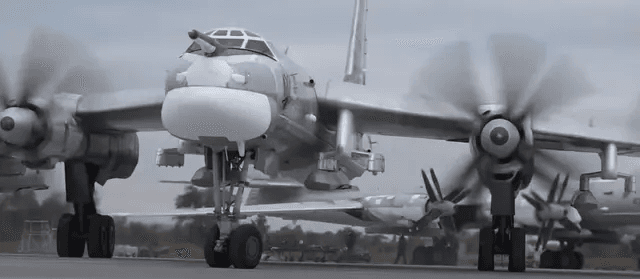
The Tupolev Tu-95 is a large, four-engine strategic bomber and missile platform developed by the Soviet Union. Designated "Bear" by NATO, the aircraft has been in service since the 1950s and remains one of the few propeller-driven bombers still operational today. The Tu-95 has become one of the iconic symbols of the Cold War.

Tupolev Tu-95 (MOTORIZADO)
The development of the Tu-95 originated from the Soviet Union's need for an aircraft capable of performing long-range nuclear deterrence missions across its vast geography. Despite the rise of jet bombers at the time, the design opted for turboprop engines for better range and fuel efficiency.
The aircraft's most distinguishing feature is its four massive Kuznetsov NK-12 turboprop engines with contra-rotating propellers. These engines, with 15,000 horsepower, are the most powerful turboprop engines of that era ever produced. The noise generated by the propellers is so loud that it can even be detected by submarine sonars. Although it is a propeller-driven aircraft, the Tu-95 can achieve speeds close to those of jet bombers thanks to its swept-back wings.
Tupolev Tu-95 (MOTORIZADO)
The massive size and powerful engines of the Tu-95 provide it with unique performance.
Although initially designed to carry free-fall bombs, its main role became a cruise missile platform. Modern Tu-95MS versions can carry long-range cruise missiles such as the Kh-55 (AS-15 Kent), housed under the wings or in the internal bomb bay. This allows the aircraft to strike targets without having to enter enemy airspace. Furthermore, specialized versions have been developed for missions such as maritime patrol and anti-submarine warfare.
The long lifespan of the Tu-95 has been made possible by countless modernizations and variant developments.
Thanks to these continuous modernizations, the Tu-95 continues to keep up with contemporary aviation standards and remains a vital strategic bomber for the Russian Air Force.
Aerocorner. "Tupolev Tu-95." Accessed October 19, 2025. https://aerocorner.com/aircraft/tupolev-tu-95.
Air Vectors. "Tupolev Tu-95/-142." Accessed October 19, 2025. https://www.airvectors.net/avbear.html.
Charpentreau, Clement. "Tupolev Tu-95." Accessed October 19, 2025. https://www.aerotime.aero/tag/tupolev-tu-95.
Finlay, Mark. "7 Amazing Facts About The Tupolev Tu-95 Bomber." Accessed October 19, 2025. https://simpleflying.com/tupolev-tu-95-bomber-amazing-facts.
Kopp, Dr. Carlo. "Tu-95 and 142 Bear." Air Power Australia. January 27, 2014. Accessed October 19, 2025. https://www.ausairpower.net/APA-Bear.html.
Sevel, Haluk M. "Tupolev Tu-95." Tayyareci. Accessed October 19, 2025. https://www.tayyareci.com/v2/rus-ucaklari/tu95.asp.html.


Category | Strategic Bomber Aircraft | ||||||||
|---|---|---|---|---|---|---|---|---|---|
Origin(s) | Soviet Union (Tupolev) | ||||||||
Engine(s) | 4 x Kuznetsov NK-12 turboprop engines | ||||||||
Service Entry | 1956 | ||||||||
Crew | 6–7 persons | ||||||||
Maximum Speed | 925 km/h | ||||||||
Range(s) | 15 000 km | ||||||||
Design and Development
Structural Features and Engines
Technical Specifications
Versatile Missions
Variants and Modernizations
This article was created with the support of artificial intelligence.